If you’re thinking about selling your company, one question usually comes first: What is my business actually worth?
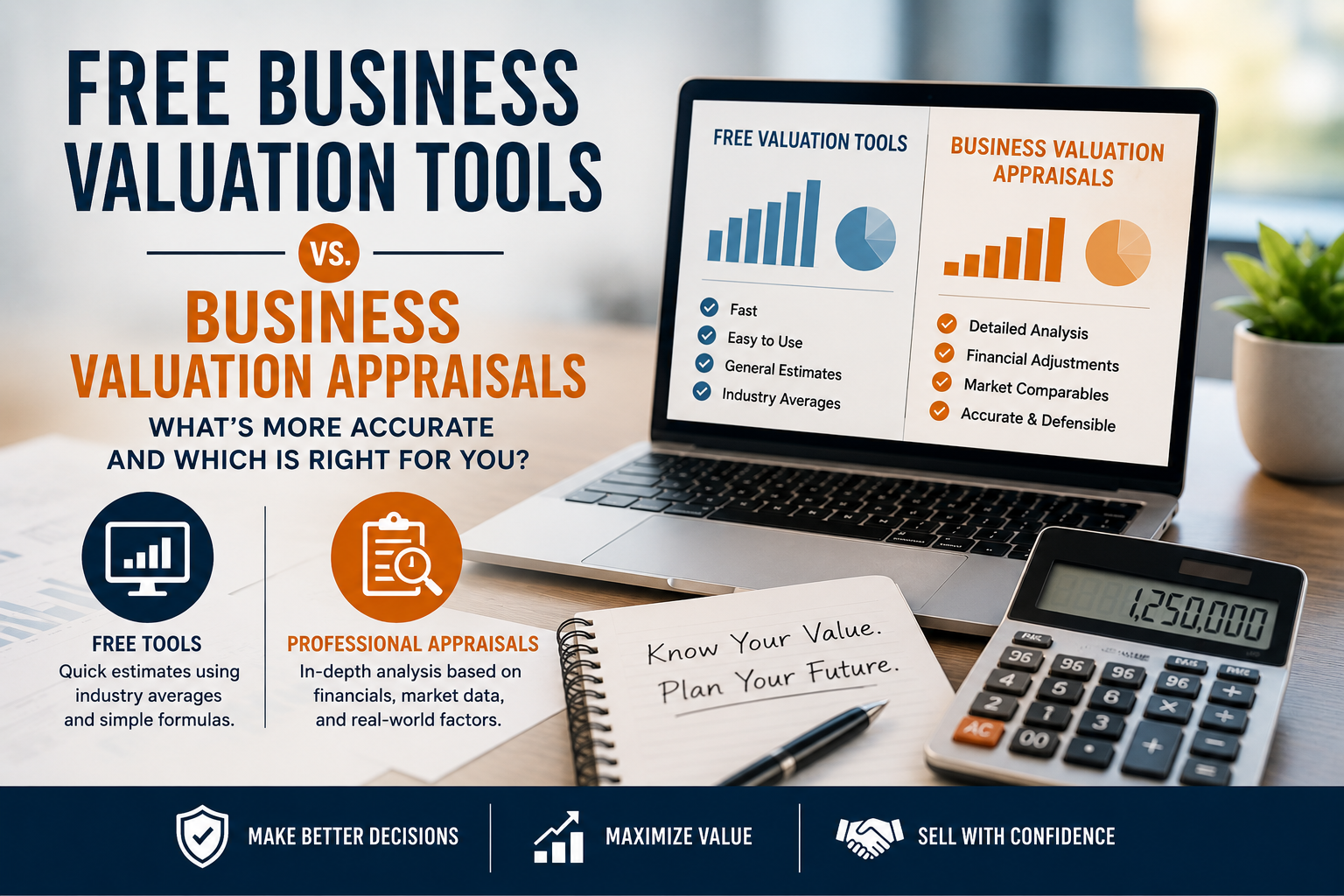
Free business valuation tools can give you a quick estimate using basic financial information. They’re useful when you’re curious about your company’s potential value or beginning to think about an eventual sale.
But an online estimate and a professional valuation aren’t the same thing.
Business valuation appraisals take a closer look at the financial, operational, and market factors that can influence what a company is worth. Understanding the difference can help you decide which option makes sense for your situation.
What Are Free Business Valuation Tools?
Free business valuation tools are online calculators designed to estimate the potential value of a company.
Most tools ask for information such as:
- Annual revenue
- Net profit
- Industry
- Location
- Number of employees
The calculator then applies a formula or industry multiple to produce an estimated value or range.
For example, a simplified valuation might use:
Normalized Earnings × Industry Multiple = Estimated Business Value
The calculation can provide a useful starting point, but it shouldn’t automatically be treated as the price a buyer will pay.
When Are Free Business Valuation Tools Useful?
You don’t necessarily need a full professional appraisal every time you want to understand how your company is performing.
Free business valuation tools can be useful when you’re:
- Beginning your exit planning
- Curious about your company’s approximate value
- Comparing your company with industry benchmarks
- Considering whether to sell in the future
- Looking for a quick starting point
- Trying to identify ways to increase business value
For owners who aren’t ready to sell, an estimate can provide a baseline.
You might discover that your company is worth less than expected and decide to spend the next few years improving profitability. You could also discover that you’ve built more value than you realized.
Either way, knowing an approximate range can help you start planning.
Where Free Business Valuation Tools Fall Short
Automated valuation tools have limitations because businesses aren’t identical.
Two companies could generate the same annual revenue and still have very different values.
One might have strong recurring revenue, diversified customers, documented systems, and an experienced management team.
The other might depend almost entirely on the owner and one major customer.
A simple calculator may not fully capture those differences.
Profitability Matters
Revenue is important, but buyers are usually interested in what the company earns.
Depending on the size and type of company, valuation analysis may consider Seller’s Discretionary Earnings (SDE), EBITDA, or other measures of normalized earnings.
Risk Matters
Buyers may also consider:
- Customer concentration
- Owner dependence
- Recurring revenue
- Employee stability
- Supplier concentration
- Competitive advantages
- Industry outlook
- Growth opportunities
These factors can influence the risk buyers associate with acquiring your company.
What Are Business Valuation Appraisals?
Business valuation appraisals provide a more detailed assessment of a company’s economic value.
Instead of relying primarily on a few numbers entered into an online calculator, a professional valuation may examine historical financial performance, assets, liabilities, earnings, market conditions, comparable transactions, and business-specific risks.
The valuation professional may review:
- Business tax returns
- Profit and loss statements
- Balance sheets
- Cash flow
- SDE or EBITDA
- Assets and liabilities
- Customer relationships
- Contracts
- Industry conditions
- Comparable business sales
Financial statements may also be normalized to account for certain owner expenses, unusual costs, or one-time events.
How Business Valuation Appraisals Determine Value
Professional valuations may use several approaches depending on the company and purpose of the valuation.
Income Approach
The income approach considers the company’s ability to generate future economic benefits.
Historical and projected earnings or cash flow may be evaluated along with the risks associated with generating those returns.
Market Approach
The market approach compares the company with similar businesses or transactions.
Valuation professionals may examine multiples based on SDE, EBITDA, revenue, or other financial measures.
Asset Approach
The asset approach considers the value of a company’s assets relative to its liabilities.
This method can be particularly relevant for businesses with substantial tangible assets such as real estate, equipment, vehicles, or inventory.
Free Business Valuation Tools vs. Professional Appraisals
The right option depends largely on why you need the valuation.
If you’re simply curious about your company’s potential value, free business valuation tools may provide enough information to get started.
If you’re preparing for an important transaction or financial decision, business valuation appraisals may provide the deeper analysis you need.
A professional valuation may make sense when you’re:
- Preparing to sell your company
- Establishing an asking price
- Evaluating an acquisition offer
- Planning an ownership transition
- Bringing in an investor or partner
- Making a significant financial decision
You don’t have to choose one approach forever. An online estimate can be the beginning of the process, followed by a more detailed valuation when you’re closer to a transaction.
Why Accurate Business Valuation Matters
Pricing can influence the entire business sale process.
If your asking price is significantly higher than what the company’s financial performance supports, qualified buyers may lose interest.
Price the business too low and you could potentially leave value on the table.
A valuation can also reveal issues that might reduce buyer interest.
For example, excessive owner dependence, declining profitability, poor financial records, or heavy reliance on one customer can make an otherwise successful business appear riskier.
Discovering these issues before going to market gives you an opportunity to address them.
How to Prepare for a Business Valuation
Whether you’re using free business valuation tools or preparing for a professional appraisal, accurate financial information is essential.
Start by gathering:
- Three years of business tax returns
- Profit and loss statements
- Balance sheets
- Current year financials
- Debt information
- Asset and equipment lists
- Customer information
- Major contracts
- Lease agreements
You should also be prepared to explain unusual expenses or major changes in revenue and profitability.
Clean financial records make it easier to understand your company’s true performance and can make future buyer due diligence easier.
Which Business Valuation Option Should You Choose?
Start with your objective.
If you’re several years away from selling and simply want an approximate value, a free tool can give you a useful starting point.
If you’re preparing to sell soon, negotiating with buyers, or making a major ownership decision, a professional appraisal can provide a more comprehensive analysis.
Most importantly, don’t wait until a buyer approaches you to start thinking about value.
Understanding your company’s strengths and weaknesses early gives you more time to improve the factors that can influence its future selling price.
Final Thoughts
Free business valuation tools offer business owners an easy way to get an initial estimate without committing to a full valuation process.
They’re particularly useful during early exit planning when you’re trying to understand where your company stands.
However, an automated estimate cannot always capture the unique financial performance, risks, assets, customer relationships, and market position of an individual company.
That’s where business valuation appraisals can provide additional insight.
Use a free valuation as a starting point. When you’re preparing for a sale or another important transaction, consider getting a more detailed analysis to understand the factors influencing your company’s value.
Find Out What Your Business Could Be Worth
Want a clearer picture of your company’s value?
Start by reviewing your numbers and understanding the factors that buyers are likely to consider. If you’re preparing for a sale, BizProfitPro can help you evaluate your business, identify potential value gaps, and prepare for the market.
Schedule a confidential consultation today to discuss your business value and exit goals.