Selling a business is one of the biggest financial decisions an owner will make. Yet many business owners enter the market unprepared, leaving money on the table or watching deals fall apart during due diligence.
The good news is that successful exits rarely happen by accident. Experienced brokers follow a proven process to make businesses more attractive to buyers, reduce risks, and maximize valuation.
If you’re wondering how to prepare a business for sale, this step-by-step blueprint walks through the same preparation process used by top brokers to help owners achieve stronger offers and smoother transactions.
Why Preparation Matters Before Selling a Business
Preparing a business for sale is not just about finding a buyer. Buyers want confidence that the company is stable, profitable, and capable of succeeding after the current owner leaves.
Well-prepared businesses often:
- Receive higher valuations.
- Attract more qualified buyers.
- Experience faster sales cycles.
- Face fewer surprises during due diligence.
- Have a greater chance of closing successfully.
Ideally, preparation should begin 12 to 24 months before the intended sale date.
Step 1: Define Your Exit Goals and Timeline
Before making changes to the business, determine what you want from the sale.
Ask yourself:
- Are you retiring?
- Are you pursuing another venture?
- Do you want to remain involved after the sale?
- What financial outcome do you need?
Your goals influence the ideal buyer type, transaction structure, and timing of the sale.
Creating a realistic timeline also prevents rushed decisions that can reduce business value.
Step 2: Organize Your Financial Records
Clean, accurate financial records are one of the strongest indicators of a healthy business.
Buyers typically request:
- Profit and loss statements for the past three years
- Balance sheets
- Tax returns
- Cash flow statements
- Accounts receivable and payable reports
- Revenue breakdowns by product or service
If personal expenses run through the business, separate them before listing the company for sale. Transparent financials increase buyer trust and simplify due diligence.
Step 3: Clean Up Operations and Document Processes
Businesses that depend heavily on the owner are often viewed as risky acquisitions.
Document key processes such as:
- Sales procedures
- Customer onboarding
- Inventory management
- Employee training
- Vendor relationships
- Marketing systems
Creating standard operating procedures allows buyers to see how the business can continue operating smoothly after ownership changes.
Step 4: Reduce Owner Dependency
Many buyers worry about what happens when the owner leaves.
If customers only deal with the owner or critical knowledge exists only in the owner’s head, the business becomes less attractive.
To reduce dependency:
- Delegate responsibilities to managers.
- Introduce team members to key clients.
- Transfer operational knowledge to staff.
- Build systems that function without constant owner involvement.
The more independent the business becomes, the more valuable it typically becomes.
Step 5: Strengthen Your Management Team
A strong leadership team provides confidence that the business can maintain performance after the transition.
Evaluate whether managers can handle:
- Daily operations
- Customer relationships
- Employee supervision
- Financial oversight
- Strategic decision-making
Businesses with experienced managers often command premium valuations because they reduce transition risk.
Step 6: Review Customer and Revenue Concentration
Heavy dependence on a single customer creates risk for buyers.
For example, if one customer generates 50% of revenue, losing that account could dramatically impact profitability.
Diversify revenue streams by:
- Expanding your customer base
- Adding complementary products or services
- Increasing recurring revenue
- Reducing reliance on individual contracts
Diversification improves stability and buyer confidence.
Step 7: Resolve Legal and Compliance Issues
Unresolved legal issues can delay or derail transactions.
Review:
- Customer contracts
- Vendor agreements
- Employment contracts
- Licenses and permits
- Intellectual property ownership
- Regulatory compliance requirements
Address disputes or expired agreements before entering the market.
Step 8: Improve Profitability Before Listing
Even small profit improvements can significantly increase valuation multiples.
Consider:
- Eliminating unnecessary expenses
- Renegotiating supplier contracts
- Improving operational efficiency
- Increasing prices where appropriate
- Expanding recurring revenue streams
Many owners spend a year improving profitability before listing because the return on investment can be substantial.
Step 9: Understand Your Business Valuation
Knowing your approximate business value helps set realistic expectations.
Common valuation methods include:
- EBITDA multiples
- Seller’s discretionary earnings (SDE)
- Revenue multiples
- Asset-based valuations
Factors that influence valuation include:
- Industry trends
- Growth potential
- Profit margins
- Customer diversification
- Operational maturity
- Competitive positioning
Obtaining a professional valuation can help identify opportunities to increase value before going to market.
Step 10: Prepare Buyer Marketing Materials
Professional presentation matters.
Most buyers expect a package that includes:
- Company overview
- Financial performance history
- Market position
- Customer information
- Growth opportunities
- Operational structure
- Transition plans
Many brokers use a Confidential Information Memorandum (CIM) to present this information in a clear and compelling format.
Step 11: Choose the Right Broker or Advisor
An experienced broker can significantly improve both deal value and closing probability.
When evaluating advisors, ask:
- How many businesses have they sold?
- What industries do they specialize in?
- What is their average sale timeline?
- How do they qualify buyers?
- What marketing process do they use?
Choosing the right advisor can make the difference between a stressful sale and a successful exit.
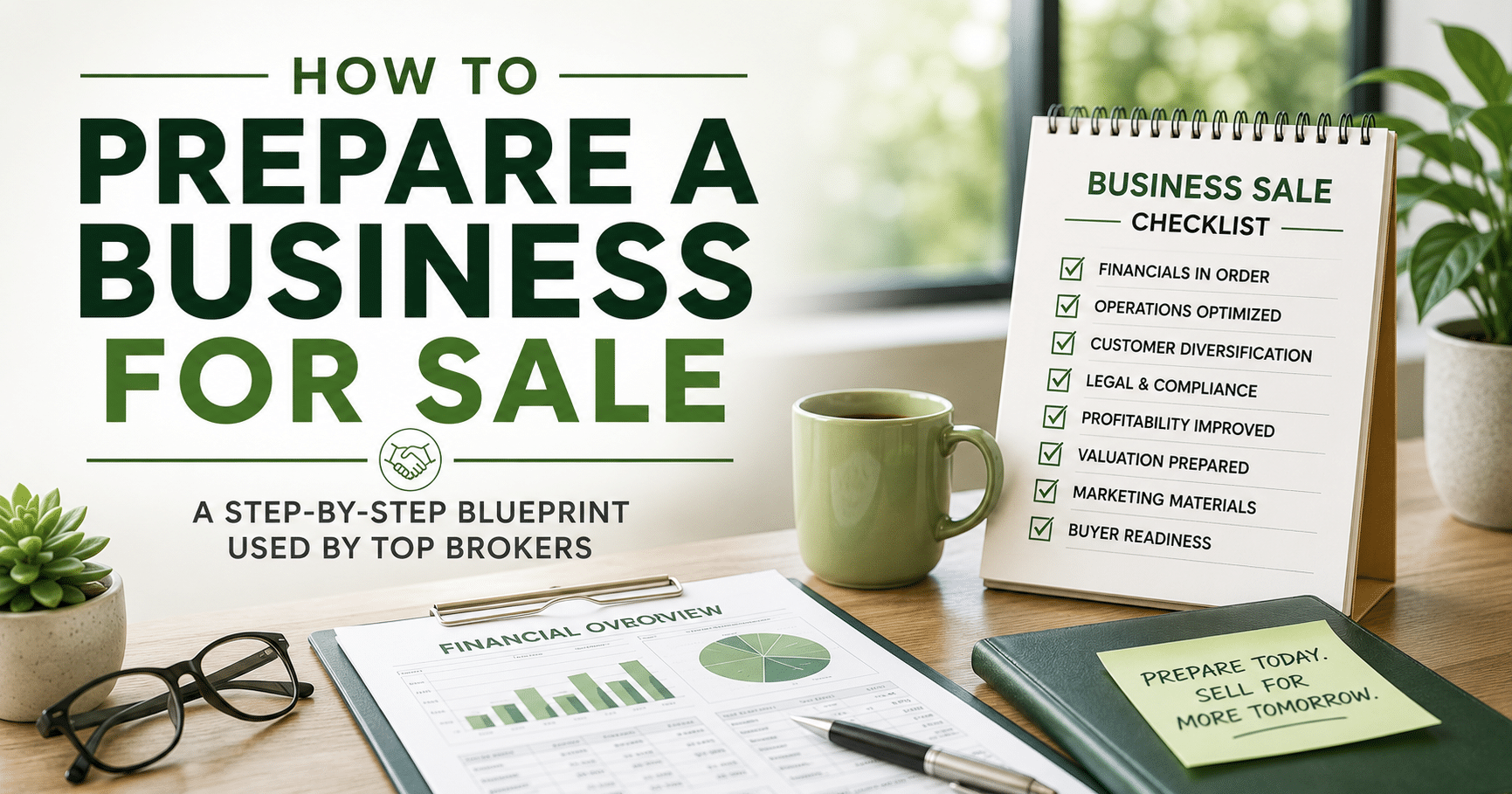
Business Sale Preparation Checklist
Before listing your business, ensure you have completed the following:
- Defined your exit goals and timeline
- Organized financial statements
- Documented operational procedures
- Reduced owner dependency
- Strengthened management systems
- Diversified customers and revenue
- Resolved legal issues
- Improved profitability
- Obtained a valuation estimate
- Prepared buyer materials
- Selected a broker or advisor
Frequently Asked Questions
How far in advance should you prepare a business for sale?
Most brokers recommend starting preparations 12 to 24 months before listing your business. This gives you time to improve profitability, organize financial records, and reduce risks that could lower your valuation.
What documents are needed to sell a business?
Buyers typically request profit and loss statements, tax returns, balance sheets, cash flow reports, customer contracts, employee agreements, licenses, permits, and operational documentation during due diligence.
How can I increase my business value before selling?
You can increase business value by improving profitability, reducing owner dependency, diversifying revenue sources, documenting processes, and building a strong management team.
Should I hire a business broker before selling my business?
A broker can help with valuation, marketing, buyer screening, negotiations, and managing the sales process. Many owners work with a broker to maximize value and improve the chances of a successful sale.
What is the biggest mistake owners make when selling a business?
One of the biggest mistakes is waiting until the last minute to prepare. Poor financial records, heavy owner involvement, and unresolved legal issues can reduce buyer interest and lower offers.
How is a business typically valued for sale?
Businesses are commonly valued using EBITDA multiples, Seller’s Discretionary Earnings (SDE), revenue multiples, or asset-based valuation methods, depending on the industry and business size.
Can I sell my business if it depends heavily on me as the owner?
Yes, but businesses that rely heavily on the owner often receive lower valuations. Reducing owner involvement and documenting processes can make the business more attractive to buyers.
Final Thoughts
Learning how to prepare a business for sale is not simply about finding a buyer. It is about creating a business that buyers want to own.
The businesses that achieve the highest valuations are usually those that begin preparing well before they enter the market. By improving operations, organizing financials, reducing risk, and planning for transition, owners can increase value and position themselves for a smoother, more profitable exit.
Whether you plan to sell next year or five years from now, the best time to start preparing is today.
