Category Business Improvement

Small Business Consultant: What They Do and How to Choose One

Small Business Consultant

Running a small business comes with countless responsibilities. From managing daily operations and overseeing finances to developing marketing strategies and planning for growth, business owners often wear multiple hats. While this hands-on approach is common, there comes a point when outside expertise can make a meaningful difference.

That’s where a small business consultant comes in.

A small business consultant provides expert advice, identifies opportunities for improvement, and helps business owners solve challenges that may be limiting growth. Whether you’re launching a startup, expanding into new markets, improving profitability, or preparing your company for sale, the right consultant can offer practical strategies tailored to your business goals.

In this guide, we’ll explain what a small business consultant does, the services they provide, the benefits of hiring one, and how to choose the right consultant for your business.

What Is a Small Business Consultant?

A small business consultant is a professional who advises business owners on improving performance, solving operational challenges, and achieving long-term goals. Unlike an employee who manages daily tasks, a consultant focuses on identifying problems, developing solutions, and creating strategies that help businesses operate more efficiently.

Consultants often work with businesses of all sizes, but many specialize in helping small businesses overcome growth challenges with limited resources.

Depending on your needs, a consultant may work on a short-term project, provide ongoing advisory services, or assist with a specific initiative such as improving profitability or preparing for expansion.

What Does a Small Business Consultant Do?

The role of a consultant varies depending on the business, industry, and objectives. However, most consultants help business owners evaluate their current operations and identify ways to improve performance.

Common responsibilities include:

  • Developing business growth strategies
  • Improving operational efficiency
  • Identifying cost-saving opportunities
  • Reviewing financial performance
  • Creating strategic business plans
  • Improving sales processes
  • Developing marketing strategies
  • Enhancing customer experience
  • Advising on technology and automation
  • Preparing businesses for expansion or sale

Rather than offering generic advice, experienced consultants analyze your business and provide recommendations based on your specific goals and challenges.

Benefits of Hiring a Small Business Consultant

Hiring a consultant is an investment in your business’s future. An experienced advisor brings knowledge, objectivity, and proven strategies that can help you make better decisions and achieve measurable results.

Gain an Objective Perspective

Business owners are deeply involved in their companies, which can make it difficult to recognize inefficiencies or missed opportunities.

A consultant provides an outside perspective, helping you identify challenges that may not be obvious from within the organization.

Improve Operational Efficiency

Many businesses lose time and money because of outdated processes, unclear workflows, or unnecessary expenses.

A consultant evaluates your operations and recommends improvements that increase efficiency while reducing costs.

Increase Profitability

Growing revenue is important, but improving profitability often has a greater impact on long-term success.

A consultant can help you:

  • Analyze pricing strategies
  • Reduce operating costs
  • Improve profit margins
  • Increase customer retention
  • Identify new revenue opportunities

Small improvements across multiple areas can significantly improve your bottom line.

Create a Clear Growth Strategy

Many businesses reach a point where growth slows because there is no long-term strategy.

A consultant helps create a roadmap that outlines goals, priorities, budgets, and measurable milestones, making it easier to scale the business with confidence.

Strengthen Financial Performance

Healthy cash flow and financial planning are essential for sustainable growth.

Consultants often review financial statements, identify trends, improve budgeting processes, and recommend strategies that strengthen overall financial performance.

Services Offered by a Small Business Consultant

Consultants provide a wide range of services depending on the needs of the business.

Some of the most common services include:

Business Strategy

Developing long-term plans that align with your company’s goals, competitive position, and market opportunities.

Financial Analysis

Reviewing revenue, expenses, cash flow, and profitability to identify opportunities for improvement.

Marketing Strategy

Helping businesses attract new customers, strengthen their brand, and improve marketing performance across digital and traditional channels.

Sales Process Improvement

Evaluating sales systems, lead generation, and customer conversion strategies to increase revenue.

Operational Improvement

Streamlining workflows, improving productivity, and implementing systems that help the business operate more efficiently.

Technology Implementation

Recommending software, automation tools, and business systems that improve communication, reporting, and day-to-day operations.

Exit Planning

For owners preparing to sell, consultants can help improve business value, reduce operational risks, and prepare the company for a successful transition.

Signs Your Business Needs a Consultant

Not every business requires outside consulting, but certain challenges often indicate it’s time to seek expert guidance.

Consider hiring a consultant if:

  • Revenue has stopped growing.
  • Profit margins continue to decline.
  • Cash flow problems are becoming frequent.
  • Business operations feel disorganized.
  • Growth has stalled despite increased effort.
  • You’re spending too much time working in the business instead of on it.
  • Customer satisfaction is declining.
  • You’re preparing for expansion or succession.

Recognizing these signs early allows you to address problems before they become larger obstacles.

How to Choose the Right Small Business Consultant

Choosing the right consultant is one of the most important decisions you’ll make. Experience, communication, and industry knowledge all play a role in the success of the relationship.

Look for Relevant Experience

Choose someone who has worked with businesses similar to yours. Industry-specific knowledge often leads to faster insights and more practical recommendations.

Review Testimonials and Case Studies

Client reviews and success stories provide valuable insight into a consultant’s ability to deliver measurable results.

Ask for examples of previous projects and the outcomes they achieved.

Understand Their Process

A professional consultant should clearly explain how they assess your business, identify challenges, develop recommendations, and measure progress.

Avoid consultants who promise quick fixes without first understanding your business.

Discuss Pricing and Scope

Consultants may charge hourly rates, monthly retainers, or project-based fees.

Before signing an agreement, make sure you understand:

  • Services included
  • Timeline
  • Deliverables
  • Communication schedule
  • Total costs

Clear expectations help prevent misunderstandings later.

Evaluate Communication

Your consultant should communicate clearly, listen carefully, and provide practical recommendations you can implement.

A strong working relationship often leads to better outcomes.

Questions to Ask Before Hiring

Before choosing a consultant, ask questions such as:

  • What industries do you specialize in?
  • Can you share client success stories?
  • What is your consulting process?
  • How do you measure success?
  • What results can I realistically expect?
  • How often will we communicate?
  • What support do you provide after implementation?

The answers will help you determine whether the consultant is the right fit for your business.

Common Mistakes to Avoid

Hiring a consultant can deliver significant value, but business owners sometimes make mistakes that limit the benefits.

Avoid these common pitfalls:

  • Hiring based only on price
  • Choosing someone without relevant experience
  • Having unclear business goals
  • Expecting immediate results
  • Failing to implement recommendations
  • Not measuring progress
  • Overlooking communication and compatibility

Consulting works best when both parties collaborate and remain committed to achieving measurable outcomes.

Is Hiring a Small Business Consultant Worth It?

For many businesses, the answer is yes.

A consultant can provide expertise that may not exist within your organization, helping you solve problems more efficiently and avoid costly mistakes. They also bring proven frameworks, objective insights, and industry experience that support better decision-making.

While hiring a consultant involves an upfront investment, the long-term benefits often outweigh the cost. Improved efficiency, stronger financial performance, increased profitability, and sustainable growth can generate a significant return on investment.

Whether you’re launching a new business, overcoming operational challenges, or preparing for expansion, the right consultant can become a valuable strategic partner.

Frequently Asked Questions

What does a small business consultant do?

A small business consultant helps business owners improve operations, increase profitability, solve challenges, and develop strategies for long-term growth.

How much does a small business consultant cost?

Costs vary depending on experience, project scope, and engagement length. Some consultants charge hourly rates, while others offer fixed project fees or monthly retainers.

Is hiring a consultant worth it?

If your business faces growth challenges, operational inefficiencies, or strategic decisions, hiring a consultant can provide valuable expertise and measurable improvements.

How long do consulting projects last?

Some projects take only a few weeks, while others continue for several months depending on the business goals and complexity.

Can a consultant help increase sales?

Yes. Many consultants evaluate sales processes, pricing strategies, customer acquisition efforts, and marketing initiatives to improve revenue growth.

What’s the difference between a consultant and a business coach?

A consultant typically analyzes your business, identifies problems, and provides specific recommendations or implementation support. A business coach focuses more on developing leadership skills, accountability, and personal performance.

Final Thoughts

A small business consultant can provide the expertise, perspective, and strategic guidance needed to help your business overcome challenges and achieve sustainable growth. From improving operations and increasing profitability to developing long-term strategies, the right consultant becomes a valuable partner in your success.

Before hiring a consultant, take time to define your goals, evaluate experience, and choose someone whose expertise aligns with your business needs. A thoughtful selection process will help ensure you receive practical advice and measurable results that support your company’s long-term success.

Ready to Grow Your Business?

At BizProfitPro, we help business owners overcome challenges, improve operations, and build stronger, more profitable companies. Whether you need guidance on growth strategies, financial performance, or preparing your business for the future, our experienced advisors are here to help.

Schedule a consultation today and discover how expert business consulting can help your business reach its full potential.

How to Increase Business Profit: A 7-Pillar Framework

Most business owners want the same thing: more profit.

Yet many focus on growing revenue instead. The problem? Revenue growth does not guarantee profitability. In fact, for many businesses, higher sales often lead to higher stress, tighter cash flow, and more complexity.

If you want to understand how to increase business profit, the answer is not working longer hours or chasing more leads. The answer is structure.

This approach is inspired by the principles outlined in Seven Pillars to Profit, a practical framework that breaks profitability into clear, manageable building blocks.

Why Increasing Business Profit Is Harder Than Increasing Revenue

Revenue is visible. Profit is not.

Many businesses appear successful on the surface but struggle behind the scenes due to:

  • Poor cash flow management

  • Inconsistent sales

  • Rising operational costs

  • Owner dependence

Without systems, profit leaks quietly. Fixing profit requires clarity across the entire business, not just the sales line.

Pillar 1: Financial Visibility Is the Foundation of Business Profit

You cannot increase business profit if you do not clearly understand where money is being made or lost.

This pillar focuses on:

  • Knowing the difference between revenue, profit, and cash flow

  • Identifying which products, services, or clients are most profitable

  • Tracking margins, not just total sales

Financial clarity allows owners to focus on what actually drives profit instead of guessing.

Pillar 2: Predictable Sales Increase Business Profit

Unpredictable sales create unpredictable profit.

A consistent sales system improves profitability by:

  • Stabilizing cash flow

  • Reducing reactive decision-making

  • Improving pricing discipline

Instead of chasing volume, profitable businesses focus on consistency and conversion.

Pillar 3: Marketing That Attracts Profitable Customers

Not all customers are equal.

Marketing plays a major role in how to increase business profit because it determines who enters your pipeline. Strong marketing:

  • Attracts customers willing to pay for value

  • Aligns messaging with higher-margin services

  • Reduces wasted ad spend

Better marketing is about alignment, not noise.

Pillar 4: Streamlined Operations Protect Profit Margins

Operational inefficiencies quietly drain profit.

This pillar focuses on:

  • Reducing errors and rework

  • Creating repeatable processes

  • Improving delivery consistency

When operations are streamlined, margins improve without raising prices.

Pillar 5: The Right Team Improves Business Profit

People costs are one of the largest expenses in most businesses.

Profit improves when teams have:

  • Clear roles and expectations

  • Proper training and accountability

  • Lower turnover and friction

Strong teams support growth without increasing chaos.

Pillar 6: Leadership Decisions That Increase Business Profit

Leadership is not about doing more. It is about deciding better.

Profit-focused leaders:

  • Say no to unprofitable work

  • Prioritize high-impact activities

  • Use data to guide decisions

Leadership discipline prevents profit erosion over time.

Pillar 7: Adaptability Protects Long-Term Profit

Markets change. Costs rise. Customer expectations shift.

Businesses that maintain profitability are adaptable. This pillar focuses on:

  • Adjusting pricing and offerings when needed

  • Monitoring industry trends

  • Identifying risks early

Adaptability ensures today’s profit lasts into the future.

Practical Steps to Increase Business Profit Starting Now

To take action:

  1. Review each pillar honestly

  2. Identify the weakest area

  3. Make one focused improvement

  4. Measure results consistently

Small, targeted changes often create the biggest profit gains.

Why Increasing Business Profit Also Increases Business Value

Profit is more than income. It is leverage.

Businesses with stable, predictable profit:

  • Command higher valuations

  • Attract stronger buyers

  • Are easier to operate and scale

Even if selling is not on your radar, profit strengthens every option you have.

Final Thoughts: Profit Is Built, Not Chased

Learning how to increase business profit starts with structure, not hustle.

The 7 Pillars framework provides a clear way to strengthen the foundation of your business so profit becomes consistent instead of accidental.

If you want a deeper dive into the framework behind these principles, Seven Pillars to Profit is available on Amazon.

Small Business Sales Trends 2026: Buyers Act Fast as Prices and Confidence Dip

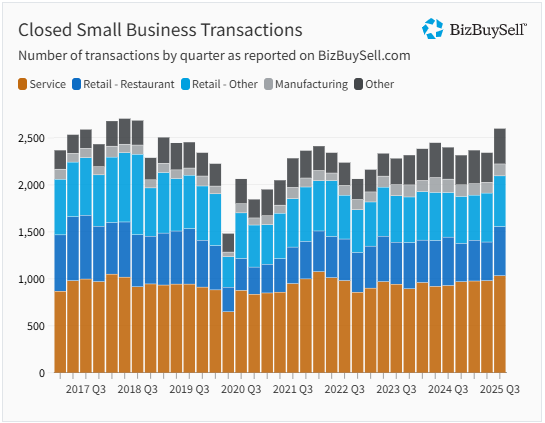
closed small business transactions

BizBuySell.com

The small business-for-sale market gained momentum in the third quarter of 2026, even as owner confidence and sale prices softened slightly. According to the latest BizBuySell Insight Report, closed transactions reached 2,599, marking an 8% year-over-year increase and an 11% gain over Q2.

These numbers confirm one thing — demand is still strong, and small business sales trends are moving upward despite broader economic headwinds.

Transaction Growth Driven by Service and Retail Sectors

Service and retail businesses are leading this wave of activity. Service-based acquisitions increased 11%, while retail jumped 14% compared to the same period last year. Buyers are clearly favoring essential industries like HVAC, plumbing, landscaping, and home improvement — sectors that remain stable even during economic shifts.

“I focus on residential and commercial services. The market is still hot for HVAC, plumbing, and electrical,” said Adam Pratt of Atlantic Business Brokers. “There are not enough listings for all the buyers.”

On the other hand, manufacturing faced headwinds, with transactions dropping 11% year-over-year. Persistent tariffs, material costs, and global supply chain uncertainty continue to suppress deal flow in that sector.

This divide highlights one of the key small business sales trends of 2026 — essential, locally-driven industries are thriving, while capital-intensive manufacturing deals are slowing down.

Lower Sale Prices, Faster Closures

Even with more activity, average sale prices slipped slightly. The median sale price fell 2% year-over-year to $320,044, and 9% quarter-over-quarter. Median revenue also declined 2% to $674,500, reflecting thinner profit margins due to rising costs.

But what’s truly notable is the speed of deal closures. Businesses now spend an average of 149 days on the market, compared to 176 days last quarter — the fastest pace since 2017.

“The market is strong. Sellers are surfacing and moving toward realistic expectations,” said Matt Valantine of Valantine Ventures.

This suggests that even though valuations have softened slightly, buyers are ready to move quickly when they find a solid opportunity — another defining characteristic of current small business sales trends.

Why More Owners Are Choosing to Sell in 2026

For many small business owners, 2026 represents the right time to sell. Rising operational costs, persistent inflation, and tariff uncertainty are pushing many to act before potential price drops.

According to the BizBuySell Insight Report, 55% of owners believe they can achieve their desired price now, while 60% worry that waiting until next year could mean receiving less.

“Sell when you, your family, and your company are ready,” advised Bill White of Murphy Business & Financial Corp. “Don’t let the economy stop you. In the end, it won’t make that much of a difference.”

This mindset reflects a growing reality: many small business owners are timing their exits around personal readiness rather than market timing — a trend that’s likely to continue into 2026.

The Rise of Corporate Refugee Buyers

The job market slowdown has created a new category of small business buyers — the “corporate refugees.”

According to the report, 40% of business buyers now fall into this group, most of them aged 40–59, who are leaving layoffs or restructuring in search of independence and stability.

“There are many more buyers than sellers,” said Joe Braier of Lake Country Advisors. “Sellers who have a good cash flow business in a desirable industry are typically choosing from multiple LOIs.”

This shift is fueling buyer demand and shortening the sales cycle, keeping competition strong even as confidence wavers. It’s one of the most visible small business sales trends shaping the 2026 marketplace.

AI Adoption Strengthens Small Business Performance

Artificial intelligence is reshaping how small businesses operate — and that’s reflected in this quarter’s data.

More than 55% of business owners report using AI tools, primarily in marketing (69%), analytics (56%), and customer service (39%). Among them, 76% say AI has improved business performance, helping cut costs, enhance decision-making, and streamline operations.

While 13% of owners reduced staff due to automation, 5% added new roles, showing that AI isn’t just replacing jobs — it’s transforming them. For buyers, this signals an opportunity to acquire businesses already optimized for efficiency and scalability.

Restaurants Hold Steady, Manufacturing Struggles

Restaurants performed better than expected in Q3, with closed deals up 2% year-over-year and 27% quarter-over-quarter. Despite a slight 1% drop in median sale price to $220,000, restaurants saw a 4% increase in cash flow and 8% rise in revenue.

This stability proves that adaptable restaurant owners — those who refine menus, optimize labor, and focus on loyal customers — can thrive even amid inflation.

By contrast, manufacturing sales fell sharply, with median prices down 37% to $550,000 and cash flow down 28%. Ongoing tariff issues, material shortages, and fluctuating input costs continue to challenge valuations in this space.

Confidence Declines, But Momentum Persists

The BizBuySell Buyer-Seller Confidence Index revealed that owner confidence dipped from 50 to 48, and buyer confidence edged down from 54 to 52. These readings show modest concern about the economy but no indication of a market slowdown.

Buyers still see opportunity: 77% remain confident they can purchase a business at a fair price today, and 78% expect to find equal or better value next year.

The Federal Reserve’s expected rate cuts later in 2026 could further stimulate acquisitions, making financing more accessible for entrepreneurs ready to enter the market.

“High interest rates remain the most impactful economic barrier for deals,” said David A. Smith of The Agency NW RE. “Once rates ease, we’ll likely see another wave of activity.”

Expert Advice for Buyers and Sellers

For Buyers:

Be realistic about your expectations.

“If you find a perfect business, get ready to compete with dozens of other buyers,” said Rebecca Carr of West Shores Realty. “If you find a decent one at a bargain, focus on making it better — that’s where the real value lies.”

For Sellers:

Preparation is key.

“If you’re taking unreported cash, stop it now — ideally three years before selling,” advised Charlie MacPherson of Inbar Group.
Clean financials, transparent tax records, and realistic pricing remain the foundation of successful exits.

The Bottom Line

Q3 2026 reaffirmed a clear pattern in small business sales trends:

  • More businesses are selling.

  • Deals are closing faster.

  • Buyers are more strategic.

  • Sellers are adjusting expectations.

While macroeconomic uncertainty continues, both buyers and sellers are adapting quickly — proof that entrepreneurship remains resilient.

If you’re considering selling your business or buying one, the next few months could be the most favorable window before 2026’s potential slowdown.

Thinking About Buying or Selling a Business?

Schedule a free consultation to discuss your goals with one of our business advisors.
📞 https://calendly.com/bizprofitpro

Entrepreneurship Quiz: Ready for Business Ownership?

Being an Entrepreneur Quiz

Becoming an entrepreneur is an exciting and challenging journey. Whether you’re just starting to explore the idea or you’re already well into it, understanding whether entrepreneurship is the right path for you is crucial. Our Entrepreneurship Quiz can help you assess your skills, mindset, and readiness for the challenges ahead. This quiz provides valuable insights into your entrepreneurial potential and helps guide your decision-making process with greater clarity and confidence.

Why Take the Being an Entrepreneur Quiz?

Starting a business requires more than just a good idea. It takes a unique combination of skills, passion, resilience, and drive. The being an entrepreneur quiz will help you evaluate your strengths and areas for improvement. It’s a helpful tool for anyone considering entrepreneurship, as it gives a snapshot of your current entrepreneurial readiness and how you can better prepare for success.

Here’s why taking this quiz is essential:

  • Understand Your Strengths: Discover your key strengths and how they can help you succeed as an entrepreneur.

  • Identify Areas for Growth: Recognize areas that may need improvement and focus on developing those skills.

  • Boost Your Confidence: Gain clarity and confidence about whether entrepreneurship is right for you.

How the Being an Entrepreneur Quiz Works

This quiz is designed to evaluate the most important traits and skills needed for entrepreneurship. It focuses on the following areas:

1. Mindset and Attitude

  • Do you have a growth mindset?

  • How do you handle failure and setbacks?

  • Are you adaptable to change and uncertainty?

2. Risk-Taking and Decision-Making

  • How comfortable are you with taking risks?

  • Can you make decisions under pressure?

  • Do you trust your instincts in business matters?

3. Business Knowledge and Skills

  • Do you have a clear understanding of business fundamentals?

  • Are you confident in managing finances, marketing, and operations?

  • Can you lead and motivate a team effectively?

4. Work Ethic and Discipline

  • How self-disciplined are you when working independently?

  • Do you have the stamina to work long hours and stay focused?

  • Are you comfortable with constant learning and personal growth?

By answering these questions, you’ll get a comprehensive understanding of your entrepreneurial readiness.

What to Expect After Taking the Quiz

Once you complete the being an entrepreneur quiz, you’ll receive a detailed analysis of your strengths and areas that need improvement. Here’s how the results can guide you:

Results Breakdown:

  • High Potential: You’re already on the right track! You have many of the essential traits and skills that can make you a successful entrepreneur. Use this information to fine-tune your business idea and take action.

  • Needs Some Development: You’ve got a solid foundation, but there are certain areas where you can improve. Consider focusing on specific skills like financial management or resilience to better prepare for the challenges of entrepreneurship.

  • Consider Your Readiness: If your results show that you have some gaps, it doesn’t mean you can’t be an entrepreneur. You may just need to work on your mindset or business knowledge before jumping in. Consider taking courses or gaining more experience in your chosen field.

Key Traits of Successful Entrepreneurs

While every entrepreneur’s journey is different, certain traits are commonly shared by successful business owners:

1. Resilience

Entrepreneurs face many obstacles, from financial struggles to rejection. Resilience is key to bouncing back after setbacks and continuing to push forward.

2. Creativity and Innovation

Successful entrepreneurs often think outside the box and bring fresh ideas to the market. Creativity helps you find solutions to problems and stay ahead of the competition.

3. Leadership

Being an entrepreneur means being a leader. Whether you’re running a small business or a large enterprise, you need to inspire and motivate your team.

4. Risk Tolerance

Entrepreneurship involves risk, but successful entrepreneurs understand how to take calculated risks and manage them effectively.

5. Adaptability

The business world is constantly changing. Entrepreneurs who can adapt to new trends and shifts in the market are more likely to succeed.

Conclusion

Taking an entrepreneur quiz is a great way to gain insight into your entrepreneurial potential. By understanding your strengths and areas for improvement, you can better prepare for the challenges of starting and running a business. Whether you’re already on the entrepreneurial path or considering it, this quiz will help you make informed decisions about your future. Having the right tools is also essential. Get your free business buyer toolkit here if you feel you are cut out for entrepreneurship. Schedule a free consultation today to discuss your entrepreneurial journey with one of our experts.

AI for Small Businesses in 2026: Transforming the Future of Operations

Artificial Intelligence (AI) has moved from a futuristic concept to a practical tool that is revolutionizing the way businesses operate. For small businesses, AI for small businesses in 2026 offers an exciting opportunity to streamline operations, improve customer experience, and boost profitability. Whether you are just starting out or looking to innovate, understanding how AI can enhance your business operations is essential.

In this article, we’ll explore how AI for small businesses is shaping the future, the key applications you should consider, and how to leverage AI to gain a competitive edge in the ever-evolving market.

Why AI is Crucial for Small Businesses in 2026

Small businesses have always faced challenges such as limited resources, competition, and the need for efficiency. AI for small businesses offers solutions that can help these companies level the playing field. In 2026, AI technology is no longer just for large corporations. It’s affordable, accessible, and scalable for small businesses of all sizes.

Here’s why small businesses should consider incorporating AI into their operations:

  • Efficiency: Automate routine tasks, saving time and resources for more strategic activities.

  • Cost Reduction: AI can help identify inefficiencies and streamline processes to reduce operational costs.

  • Better Decision-Making: AI-powered data analytics can help businesses make more informed decisions based on customer insights and trends.

  • Enhanced Customer Experience: AI allows small businesses to personalize customer interactions and provide faster, more accurate services.

Applications of AI for Small Businesses in 2026

There are several ways AI can benefit small businesses in 2026, depending on your industry and needs. Let’s dive into the key applications of AI for small businesses:

1. Customer Support and Chatbots

AI-powered chatbots are transforming the way small businesses interact with customers. These chatbots can answer common customer questions, provide product recommendations, and handle service inquiries 24/7. Not only does this improve customer satisfaction, but it also reduces the workload on human staff.

For example, businesses can use AI-powered chatbots to:

  • Answer FAQs: Provide instant responses to common questions.

  • Schedule Appointments: Help customers book appointments, freeing up time for employees.

  • Personalize Experiences: Suggest products or services based on past customer behavior.

2. Marketing and Advertising Automation

AI is revolutionizing digital marketing. AI for small businesses enables automated, data-driven marketing campaigns that can target the right audience with personalized content. Machine learning algorithms can analyze consumer data to predict behaviors, optimize ad spend, and improve lead generation efforts.

Benefits of AI marketing tools include:

  • Automated Campaigns: Set up AI-driven campaigns that run on autopilot and adjust in real time based on performance.

  • Targeted Advertising: Use AI to identify the best demographics for your products, ensuring that your ads reach the right people.

  • Personalized Messaging: Deliver personalized email marketing and social media campaigns that resonate with individual customers.

3. Inventory Management

Managing inventory is often a headache for small businesses, but AI can simplify the process. AI-driven inventory management systems can track stock levels in real time, predict demand, and suggest when to reorder. This reduces the risk of overstocking or running out of stock, saving businesses both time and money.

AI-powered systems can also:

  • Optimize Stock Levels: Use predictive analytics to forecast inventory needs based on trends and seasonality.

  • Automate Replenishment: Automatically reorder stock when it reaches a minimum threshold.

  • Track Supplier Performance: Analyze supplier reliability to make better procurement decisions.

4. Financial Analysis and Forecasting

AI-powered financial tools help small businesses stay on top of their finances by automating tasks like expense tracking, budgeting, and cash flow forecasting. Machine learning algorithms can identify trends and provide insights that help businesses manage their finances more effectively.

Here’s how AI can help in financial management:

  • Expense Management: Automatically categorize and track expenses, making it easier to spot financial issues.

  • Cash Flow Predictions: Use AI to forecast future cash flow based on past performance and seasonal trends.

  • Tax Optimization: AI can help you optimize your tax strategies by analyzing your financial data and providing insights into potential savings.

5. HR and Recruitment

AI can also streamline the recruitment process by automatically screening resumes, evaluating candidate qualifications, and even conducting initial interviews. This reduces the time spent on hiring and ensures that small businesses can find the best talent quickly and efficiently.

Key benefits for small businesses include:

  • Automated Screening: Use AI to analyze resumes and match candidates with job descriptions based on specific keywords and criteria.

  • Talent Analytics: AI tools can analyze data on employee performance to help businesses identify top performers and better manage talent.

  • Predictive Hiring: Leverage AI to predict which candidates are most likely to succeed based on historical data and patterns.

How to Get Started with AI for Your Small Business in 2026

Integrating AI into your small business doesn’t need to be overwhelming. Here’s how you can get started:

1. Identify Business Needs

Determine which areas of your business could benefit most from AI, whether it’s customer service, marketing, inventory management, or financial analysis.

2. Start Small

Begin with one AI application and scale up as you get comfortable. For example, start with an AI chatbot for customer service or an automated marketing campaign, and expand from there.

3. Choose the Right Tools

There are a variety of AI tools available for small businesses, many of which are affordable and user-friendly. Do your research and choose tools that fit your specific needs and budget.

4. Train Your Team

Educate your employees on how AI tools work and how they can leverage them to improve efficiency and productivity. It’s important to ensure your team is comfortable with the new technology.

5. Monitor and Optimize

Once you’ve implemented AI tools, continually monitor their performance and adjust as necessary. AI works best when it’s fine-tuned and optimized over time.

Embrace AI for Small Business Growth in 2026

In 2026, AI for small businesses will continue to transform how businesses operate, making it more efficient, cost-effective, and competitive. From enhancing customer experiences to automating financial processes, AI can help small businesses thrive in an increasingly digital world.

By embracing AI, you can streamline operations, improve decision-making, and increase profitability—all without breaking the bank. Whether you’re just starting or looking to expand, now is the time to explore how AI can help your small business succeed.

Next Step: Explore Smart Growth Strategies for Your Business

Technology adoption is most effective when aligned with your business goals and operational structure. If you’re considering implementing AI or evaluating where automation could have the greatest impact, expert guidance can help you prioritize the right opportunities.

Schedule your free consultation:
👉 https://calendar.app.google/yFcYaSHkgeP3cr8C8

We’ll review your current operations, identify areas where AI can provide the highest return, and outline a clear, practical roadmap for implementation.

Business Help for Small Business: Find the Right Support

Running a small business can be overwhelming. From managing finances to handling marketing and customer service, small business owners often juggle numerous responsibilities. But you don’t have to do it all alone. If you’re asking, “Where can I find business help for small business near me?”, you’re not alone.

Whether you’re looking for strategic guidance, financial assistance, or marketing expertise, there are plenty of resources available to help your business grow and thrive. In this guide, we’ll explore the various types of business help for small business near you, where to find support, and how to leverage local services to take your business to the next level.

Why Seek Business Help for Small Business?

Starting and running a small business comes with its share of challenges. From handling taxes to navigating regulations, managing staff, and growing your customer base, it can feel like a never-ending to-do list. That’s why seeking business help for small business is essential for long-term success.

Here are some key reasons why getting help is crucial:

  • Expert Advice: Business consultants, accountants, and marketing experts offer insights that can help you avoid costly mistakes and grow your business more effectively.
  • Time-Saving: Delegating tasks to experts allows you to focus on the aspects of your business that you’re passionate about.
  • Improved Efficiency: Hiring specialists can streamline your operations, reduce waste, and boost your overall productivity.
  • Financial Health: Professional help can guide you in making smart financial decisions, which is vital for the health of any small business.

Types of Business Help for Small Business Near Me

Finding the right business support is key to ensuring that your business runs smoothly and grows. Here are several types of business help for small business that you can find locally:

1. Small Business Development Centers (SBDCs)

SBDCs are great resources for small business owners. They offer free or low-cost services to help with everything from business planning and financial management to marketing strategies and regulatory compliance. The Small Business Administration (SBA) funds many of these centers, and they have locations across the country.

2. Local Chambers of Commerce

Chambers of Commerce are powerful networking hubs for small business owners. They offer a variety of services, including:

  • Networking events to connect with other local entrepreneurs
  • Workshops on topics like marketing, sales, and customer service
  • Advocacy to represent small businesses in local government and policy discussions

Joining your local chamber can provide you with invaluable connections and resources.

3. Business Consultants and Coaches

If you’re looking for strategic business help, hiring a business consultant or coach can be a game-changer. These experts provide personalized advice based on your business’s unique challenges and goals. Whether you need help with operations, marketing, or scaling, a business consultant or coach can give you the guidance you need.

You can find business consultants through local referrals, online platforms, or professional associations.

4. Accountants and Tax Professionals

Financial management is a critical aspect of running a successful business. Accountants and tax professionals can help you with:

  • Bookkeeping and financial reporting
  • Tax planning and filing
  • Business structure advice

By working with a local accountant, you ensure that your business’s financials are in order, and you can avoid costly mistakes when it comes to taxes.

5. Marketing and Branding Agencies

In today’s competitive market, effective marketing is key to growing your business. Whether you need help with social media, search engine optimization (SEO), branding, or digital advertising, a marketing agency can create a strategy that drives results.

Hiring a local agency can also help you connect with your target audience more effectively, as they’ll have a better understanding of local market trends and customer preferences.

6. Legal Assistance

Running a business involves navigating a variety of legal requirements, from business registration to intellectual property rights and employee contracts. A local business attorney can assist with:

  • Business formation
  • Contract review
  • Intellectual property protection

Having a legal expert on hand ensures that your business complies with all laws and regulations, reducing the risk of legal trouble down the line.

Where to Find Business Help for Small Business Near Me

Now that you know the types of business help available, the next step is to find the right resources near you. Here’s where to look:

1. Google Search and Online Directories

A quick search for “business help for small business near me” can lead you to local resources like SBDCs, marketing agencies, and consultants. You can also check out online business directories like Yelp or Angie’s List for highly-rated service providers in your area.

2. Local Networking Events and Meetups

Attending local networking events and meetups is one of the best ways to find the support you need. Many chambers of commerce and business organizations host events where small business owners can connect and collaborate. Websites like Meetup.com or Eventbrite also list local business-focused events.

3. Referrals from Other Small Business Owners

Word of mouth is one of the most reliable ways to find business help. Ask fellow entrepreneurs, friends, or colleagues in your community if they’ve worked with any professionals they’d recommend.

4. Local Business Incubators and Accelerators

Business incubators and accelerators are excellent resources for small business owners, especially those in the early stages of growth. These organizations provide mentorship, resources, and access to funding, often at no cost. Look for incubators in your area that focus on startups and small businesses.

5. Social Media and LinkedIn

Social media platforms, particularly LinkedIn, are great for finding business help. You can connect with local business consultants, accountants, and other professionals through LinkedIn, and even join local business groups for advice and recommendations.

Conclusion: Get the Support You Need to Succeed

Finding business help for small business near you doesn’t have to be a challenge. From local SBDCs and marketing agencies to legal professionals and business consultants, there are plenty of resources available to help your business thrive. By leveraging these local services, you can get the support you need to grow your business, increase profitability, and navigate the complexities of entrepreneurship.

Don’t hesitate to reach out and start building your network of trusted professionals. The right help is out there—it’s just a matter of finding it.

Ready to Take Your Business to the Next Level?

If you’re looking for professional business support, whether it’s marketing, financial planning, or legal guidance, schedule a free consultation with our expert team today. We can help you connect with the right resources to grow your business and achieve your goals.

Let us help you streamline operations, reduce stress, and focus on what matters most—growing your business.

How AI Data Analytics Can Unlock Small Business Success

AI Data Analytics

Running a small business means making decisions every day – about sales, marketing, customer service, and operations. But without clear data, those decisions often rely on guesswork. That’s where AI data analytics comes in.

AI-powered analytics is no longer just for large corporations. Small businesses can now use AI-driven insights to make smarter decisions, streamline operations, and improve efficiency. Instead of spending hours analyzing spreadsheets, business owners can access real-time insights that help them respond to market trends, optimize pricing, and better understand customer behavior.

This guide will explore what AI data analytics is, how it can transform small businesses, and the best ways to use AI-powered insights to drive growth.

What is AI Data Analytics?

AI data analytics uses artificial intelligence and machine learning to process and interpret business data. Unlike traditional methods, AI can quickly analyze large datasets, identify patterns, and even predict future outcomes. This allows businesses to make data-driven decisions without needing advanced technical skills.

Small businesses can use AI analytics to monitor sales trends, optimize marketing efforts, track customer behavior, and even automate routine reporting. By turning raw data into actionable insights, AI helps business owners focus on growth rather than spending hours on data analysis.

How AI Data Analytics Benefits Small Businesses

Better Decision-Making

AI analytics helps businesses move beyond gut instinct and make informed choices based on actual data. Whether adjusting pricing, identifying top-performing products, or forecasting demand, AI-driven insights enable smarter business strategies.

More Effective Marketing

Understanding customer behavior is essential for successful marketing. AI analytics can identify which campaigns generate the most sales, track customer engagement, and personalize promotions based on past interactions. This means businesses can allocate their marketing budgets more effectively, increasing return on investment.

Increased Efficiency

Instead of manually analyzing reports, AI can automate data collection and provide real-time dashboards with key performance indicators. This reduces administrative work, freeing up time for business owners to focus on strategic growth. AI can also help optimize inventory management, staffing, and workflow efficiency.

Improved Customer Experience

AI-driven insights allow businesses to personalize customer interactions, anticipate needs, and resolve issues faster. For example, AI can analyze customer feedback to identify pain points or suggest improvements to products and services. Businesses that use AI analytics to enhance the customer journey often see higher retention rates and increased customer satisfaction.

How Small Businesses Can Use AI Data Analytics

Sales Forecasting

Predicting future sales based on historical data helps businesses plan inventory, staffing, and marketing. AI analytics can identify seasonal trends, monitor buying patterns, and provide accurate forecasts to prevent overstocking or understocking products.

Customer Segmentation

Not all customers are the same, and AI can help businesses categorize them based on behavior, preferences, and purchase history. This allows for more targeted marketing efforts, ensuring customers receive relevant offers that increase engagement and sales.

Website and Social Media Insights

AI tools can analyze website traffic, social media interactions, and advertising performance. By identifying which content and ads generate the most engagement, businesses can refine their online marketing strategy and focus on what works best.

Fraud Detection and Risk Management

AI can help identify fraudulent transactions and suspicious behavior, reducing the risk of financial loss. Small businesses that handle payments online can use AI analytics to flag unusual patterns and enhance security.

Competitive Analysis

AI can track competitor pricing, customer reviews, and social media activity to give businesses a better understanding of their market position. These insights can help small businesses adjust their strategies to stay ahead of the competition.

Choosing the Right AI Data Analytics Tools

Many AI-driven analytics platforms are designed specifically for small businesses. Popular options include Google Analytics for website insights, HubSpot for customer data analysis, and Tableau for advanced data visualization. When selecting a tool, business owners should consider factors such as ease of use, integration capabilities, and pricing.

Is AI Data Analytics Right for Your Business?

AI data analytics offers small businesses the ability to make data-driven decisions without requiring a background in data science. Whether it’s improving marketing campaigns, optimizing operations, or predicting sales trends, AI-powered insights provide a competitive advantage. Businesses that adopt AI analytics early can improve efficiency, reduce costs, and gain a deeper understanding of their customers.

For small businesses looking to scale and remain competitive, leveraging AI data analytics is no longer optional – it’s a necessity.

AI Chatbots for Small Business Improvement

AI Chatbots for Small Business Improvement

Running a small business means wearing many hats – handling customer inquiries, processing orders, managing appointments, and keeping everything running smoothly. But what if you could automate a significant part of that workload without compromising service quality?

That’s where AI chatbots for small business come in. These ai tools can handle customer questions, provide instant responses, and even assist with sales – all while freeing up your time to focus on growth.

But should your small business use AI chatbots? In this guide, we’ll break down how AI chatbots for businesses can streamline operations, the pros and cons of using them, and what you need to know before integrating one into your business.

How AI Chatbots for Businesses Work

AI chatbots use machine learning and natural language processing (NLP) to understand and respond to customer messages in real-time. They can be integrated into websites, social media platforms, and messaging apps to provide instant support.

Small businesses use AI chatbots for:

  • Answering frequently asked questions
  • Booking appointments and reservations
  • Processing orders and payments
  • Providing product recommendations
  • Offering 24/7 customer support

With the right implementation, AI chatbots for small business can enhance customer service, boost sales, and reduce manual workload.

Top 5 AI Chatbots for Small Businesses

If you’re looking to integrate a chatbot into your business, here are five of the best AI chatbots for small business that can automate support, improve engagement, and increase efficiency.

  1. Zendesk’s Answer Bot
    Designed to deliver reliable customer and sales support, Zendesk’s Answer Bot provides 24/7 assistance, ensuring prospects and customers always have access to help. With support for 17 different languages, it caters to a global audience effectively.

  2. Freshchat
    Freshchat offers a range of features to automate responses, personalize interactions, and streamline workflows. It integrates seamlessly with other Freshworks products, providing a user-friendly interface for customer support, sales, and marketing.

  3. Intercom’s Fin
    Intercom’s AI customer service agent, Fin, is designed to handle complex customer queries with high accuracy. Since its launch, Fin has managed millions of queries, showcasing its capability to enhance customer support efficiently.

  4. Salesforce’s Einstein GPT
    Salesforce’s Einstein GPT extends beyond simple Q&A to assist with complex tasks such as product returns and refunds, enhancing customer relationship management. It leverages generative AI to provide personalized customer interactions.

  5. Tidio’s Lyro
    Tidio’s Lyro is an AI chatbot that learns from user interactions to deliver human-like responses within seconds. It’s particularly beneficial for automating customer support and providing instant answers to common inquiries.

Integrating these AI chatbots can help small businesses automate routine tasks, improve customer service, and drive growth.

Benefits of AI Chatbots for Small Businesses

1. 24/7 Customer Support

Unlike human employees, AI chatbots work around the clock. Customers can get immediate responses, even outside business hours, improving satisfaction and engagement.

PS: AI chatbots can only handle the common FAQs we set, but customers can always reach a live agent for more help!

2. Cost Savings

Hiring and training customer service representatives can be expensive. AI chatbots reduce labor costs while maintaining high-quality interactions.

3. Increased Efficiency

Chatbots handle multiple inquiries at once, reducing wait times and improving response speed. They also free up human employees to focus on more complex tasks.

4. Better Lead Generation and Sales

AI chatbots can engage visitors, ask qualifying questions, and guide potential customers toward a purchase. They can also recommend products based on browsing history.

5. Personalized Customer Interactions

Advanced AI chatbots analyze customer data to provide personalized recommendations and responses, improving user experience and increasing conversions.

Challenges of Using AI Chatbots for Businesses

While AI chatbots offer many advantages, they also have some limitations:

1. Lack of Human Touch

AI chatbots may struggle with complex or emotional customer issues that require empathy. A hybrid approach—using chatbots for routine tasks and humans for escalations—can help.

2. Setup and Maintenance

Implementing a chatbot requires initial setup and ongoing updates to improve responses. Without proper optimization, a chatbot may frustrate users.

3. Potential Technical Issues

Chatbots rely on accurate data and programming. If not properly managed, they can misunderstand customer queries, leading to errors and dissatisfaction.

How to Choose the Right AI Chatbot for Your Business

To get the most out of AI chatbots for small business, consider the following factors when choosing a platform:

  • Industry-Specific Features – Look for chatbots designed for your business type (e.g., e-commerce, healthcare, or service-based).
  • Integration Capabilities – Ensure the chatbot works with your website, CRM, and messaging platforms.
  • Customization Options – Choose a chatbot that allows personalized responses and branding.
  • Scalability – Pick a solution that can grow with your business as customer demand increases.

Best Practices for Implementing AI Chatbots

To maximize success, follow these best practices when integrating AI chatbots for small business:

  • Define Clear Objectives – Decide what tasks your chatbot should handle (e.g., FAQs, sales, or appointment scheduling).
  • Train the Chatbot – Use real customer conversations to improve accuracy and relevance.
  • Monitor Performance – Regularly analyze chatbot interactions to identify areas for improvement.
  • Offer Human Support as Backup – Always provide an option for customers to connect with a human agent if needed.

Final Thoughts: Are AI Chatbots Right for Your Small Business?

Integrating AI chatbots for small business can significantly improve efficiency, enhance customer service, and increase sales. However, they work best when used strategically—automating repetitive tasks while still offering human interaction when necessary.

If your business struggles with managing customer inquiries or wants to automate routine tasks, an AI chatbot for small business could be a game-changing investment. With the right approach, you can improve customer satisfaction, save time, and grow your business.

How Small Businesses Can Use AI for Social Media Marketing

AI for Social Media Marketing

Managing social media can be overwhelming for small businesses, especially with limited resources. However, by using the right tools, small businesses can make their social media marketing more efficient and effective. With the help of smart technologies, it’s possible to streamline tasks, enhance engagement, and gain valuable insights, all of which can lead to better marketing results.

What is AI for Social Media Marketing?

In simple terms, AI for social media marketing refers to tools and technologies that help businesses automate and improve their social media strategies. These tools can assist with everything from content creation and scheduling to audience targeting and performance analysis. By using these technologies, small businesses can optimize their social media efforts without having to do everything manually.

Why Small Businesses Should Consider Using AI for Social Media Marketing

For small businesses, time and resources are often limited. Social media marketing can take up a lot of time, but by using the right tools, small businesses can free up valuable time to focus on other important tasks. Tools designed to help with social media can manage everything from posting and responding to messages to analyzing data, leaving business owners with more time to work on growing their business.

Benefits of Using AI for Social Media Marketing

  • Save Time: These tools automate repetitive tasks like scheduling posts, answering messages, and tracking results.
  • Boost Engagement: With automated chat responses and personalized messages, businesses can stay engaged with their audience 24/7.
  • Create Better Content: Tools can help generate content ideas and even craft posts that resonate with your audience.
  • Make Smarter Decisions: Analyzing data can reveal which types of content are working and which aren’t, so you can adjust accordingly.
  • Reduce Costs: By automating social media processes, small businesses can save on staffing costs and improve the return on their marketing efforts.

How Small Businesses Can Leverage AI for Social Media Marketing

1. Content Creation and Curation

Tools like Copy.ai or Jarvis can assist businesses in generating ideas for content, writing social media captions, or even drafting blog posts. These tools help keep content fresh and relevant while saving time and effort in the process.

2. Chatbots for Customer Interaction

Implementing tools like ManyChat or Tidio can automate customer interactions on social media, allowing businesses to respond quickly to inquiries, provide product recommendations, and assist customers without needing to be online 24/7. This leads to quicker response times and happier customers.

3. Social Media Scheduling Tools

Platforms such as Hootsuite and Buffer make scheduling posts across multiple social media channels easy. They even help determine the best time to post by analyzing when your audience is most active, which helps ensure your posts get seen by more people.

4. Targeted Advertising and Audience Segmentation

Advertising on platforms like Facebook and Instagram can be made more effective with tools that analyze your audience’s behavior and interests. These tools help businesses run highly targeted ad campaigns, ensuring their budget is spent effectively by reaching the right people at the right time.

5. Social Listening and Trend Analysis

Tools such as Brandwatch and Sprout Social can track conversations about your brand or industry, giving you insights into what people are saying. By paying attention to trends and customer sentiment, businesses can make better decisions about what content to produce and how to interact with their audience.

6. Analytics and Performance Tracking

Tracking the performance of your social media campaigns is crucial to understanding what works and what doesn’t. Tools like Google Analytics or Socialbakers provide detailed insights, allowing businesses to refine their strategies and optimize their content for better results.

How to Implement AI for Social Media Marketing in Your Small Business

  1. Evaluate Your Needs: Identify which areas of your social media efforts could benefit from automation, such as content creation, customer support, or analytics.
  2. Select the Right Tools: Choose tools that are easy to use, affordable, and fit with your business’s objectives.
  3. Set Clear Goals: Define specific, measurable goals for your social media campaigns, such as improving engagement or driving website traffic.
  4. Integrate Tools into Your Workflow: Make sure the tools you select work well with your existing processes and platforms.
  5. Monitor and Adjust: Keep track of how your tools are performing and adjust your strategy as needed to get the best results.

Conclusion

Social media marketing doesn’t have to be overwhelming. By using the right tools to automate key tasks, small businesses can save time, improve customer engagement, and make smarter decisions that drive growth. Embrace the technology available today to optimize your social media marketing efforts and stay ahead of the competition.

10 Must-Have AI Tools for Small Business Growth

AI Tools for Small Business Growth

Running a small business often means balancing multiple tasks. From handling customer service and managing marketing to keeping track of finances, it can be overwhelming. This is where AI tools for small business growth come in. These tools help automate routine tasks, improve operational efficiency, and streamline business processes, all while allowing you to focus on what truly matters—growing your business.

What are AI Tools for Small Business?

AI tools for small business growth are applications powered by artificial intelligence that help automate tasks, optimize processes, and analyze data. These tools can streamline operations, reduce manual effort, and improve decision-making. By leveraging AI, small businesses can enhance customer service, boost productivity, and scale more efficiently.

How AI Can Transform Your Operations

AI tools have the power to revolutionize how small businesses operate by automating time-consuming tasks and improving decision-making. By streamlining processes such as customer service, marketing, and inventory management, AI can help your business run more efficiently. With data-driven insights and optimized workflows, AI enables better operational decisions and allows you to scale without adding extra resources. The transformation lies in how these tools can simplify everyday business functions, reduce human error, and provide more value for your business with minimal effort.

10 Must-Have AI Tools for Small Business Growth

1. HubSpot

HubSpot is an AI-driven platform that offers tools for inbound marketing, sales automation, and customer service. It helps small businesses automate lead generation, follow-up emails, and customer engagement. With AI tools for small business growth like HubSpot, companies can scale their marketing efforts and build stronger customer relationships.

2. Grammarly

Grammarly is an AI-powered writing assistant that ensures your content is polished and professional. It helps business owners create clear, error-free communication for emails, blog posts, and more. For businesses aiming to maintain a strong brand voice, Grammarly is a vital tool in enhancing written content and improving customer engagement.

3. ChatGPT

ChatGPT can be used as a powerful AI tool to provide customer support and generate content. Whether it’s answering customer queries, writing blog posts, or handling social media interactions, ChatGPT automates communication. This makes it a valuable addition for any small business aiming to save time and enhance their customer experience.

4. QuickBooks

QuickBooks offers AI-powered accounting tools that automate bookkeeping, tax calculations, and expense tracking. By reducing the time spent on financial tasks, QuickBooks allows small businesses to focus on growth and profitability. Using AI tools for small business growth like QuickBooks can help businesses stay organized and compliant.

5. Xero

Xero is another powerful AI-driven accounting tool that simplifies financial management. It automates tasks such as payroll, bank reconciliation, and financial reporting. Xero ensures your business stays financially organized and accurate.

6. Canva

Canva is an AI-powered design tool that allows small businesses to create professional graphics and marketing materials. From social media posts to promotional flyers, Canva’s templates and intuitive interface make design accessible to everyone. This tool is essential for small businesses looking to boost their visual content without hiring a designer.

7. Hootsuite

Hootsuite uses AI to streamline social media management. It automates post scheduling, tracks engagement, and provides insights into optimal posting times. AI tools for small business growth like Hootsuite help businesses increase their social media presence and reach new audiences with minimal effort.

8. Zoho CRM

Zoho CRM utilizes AI to help small businesses manage customer relationships effectively. It automates tasks such as lead scoring, follow-ups, and sales forecasting. By adopting AI tools for small business growth, businesses can improve customer retention and increase conversions.

9. Surfer SEO

Surfer SEO uses AI to analyze your website’s performance and suggest optimizations for better search engine rankings. By providing insights into content quality, keyword usage, and backlinks, Surfer SEO helps small businesses improve their organic search visibility. This is crucial for attracting more visitors and driving traffic to your website.

10. Freshchat

Freshchat is an AI-powered live chat tool that automates customer interactions. It can qualify leads, answer common questions, and schedule appointments, all in real-time. For small businesses, Freshchat provides a simple way to enhance customer service and increase conversion rates without needing additional staff.

Benefits of AI Tools for Small Businesses

Integrating AI into your business offers multiple benefits, including:

Time Savings: AI tools help automate tasks like customer inquiries, lead nurturing, and inventory management, allowing business owners to focus on high-level tasks.

Increased Efficiency: AI-powered tools streamline workflows and eliminate bottlenecks in business processes, leading to greater productivity.

Better Decision Making: Data analysis powered by AI offers actionable insights, helping business owners make informed, strategic decisions.

Cost Reduction: Automation reduces the need for manual labor and can lead to substantial cost savings over time.

Personalized Experiences: AI can analyze customer data and deliver tailored recommendations, leading to more engaging and personalized customer experiences.

Scalability: As your business grows, AI tools for small business growth make it easy to scale by automating repetitive tasks and increasing operational capacity.

Competitive Advantage: By adopting AI early, small businesses can stay ahead of competitors and improve their operations, marketing, and customer service strategies.

How to Implement AI Tools in Your Business

When implementing AI tools, start by identifying areas where automation could have the greatest impact, such as customer service, marketing, or accounting. Test different tools and choose those that best fit your business needs. Over time, expand the use of AI tools for small business growth across other functions, ensuring seamless integration into your workflow.

FAQs

Can AI Tools Help Small Businesses Save Money?

Yes, AI tools can save small businesses money by automating tasks that would otherwise require additional staff or resources. They help streamline processes, reduce human error, and improve efficiency. Over time, this leads to significant cost savings and allows businesses to allocate resources to more critical areas for growth.

  • Is it Okay to Use AI Tools in Business?

    Absolutely! Using AI tools in business is not only okay, but it’s increasingly necessary to stay competitive. AI helps small businesses automate time-consuming tasks, improve customer experiences, and make better decisions. The key is choosing the right tools and implementing them in ways that align with your goals and business needs. As long as AI tools are used responsibly, they can be a major asset to any business.

  • How Can AI Tools Help Small Businesses Scale?

  • AI tools help small businesses scale by automating time-consuming tasks, allowing owners and staff to focus on growth opportunities. They streamline processes such as customer service, marketing, and inventory management. As the business expands, AI tools provide the flexibility to handle increased demands without adding extra operational complexity.

    Do AI Tools Replace Human Employees in Small Businesses?

  • AI tools are designed to complement human workers, not replace them. They automate repetitive tasks, freeing up employees to focus on higher-level work that requires creativity and critical thinking. In this way, AI can enhance employee productivity and enable businesses to operate more efficiently.

  • How Do I Choose the Best AI Tools for My Business?

  • When selecting AI tools, consider your business needs and areas where automation could have the most impact. Focus on tools that align with your goals, are easy to integrate, and can scale with your business as it grows. Trial versions or demos are a great way to assess whether the tool is a good fit for your business operations.

Conclusion

The potential for AI tools for small business growth is immense. By adopting these 10 tools, small businesses can automate processes, enhance customer experiences, and drive growth. Don’t let your business fall behind – embrace AI today and unlock new opportunities for success.

Business Brokers for Small Business: How to Choose the Right One

Business Brokers for Small Business

Selling a small business is very different from selling a house or another traditional asset. Your company may represent years of work, income, customer relationships, employees, and personal investment, so choosing the right person to help sell it can have a significant impact on both the transaction and your final proceeds.

That’s why choosing business brokers for small business sales deserves careful consideration. A good broker can help determine a realistic asking price, confidentially market your company, identify qualified buyers, manage negotiations, and keep the transaction moving toward closing.

However, not every business owner needs a broker, and not every broker is the right fit for every company. Before signing an engagement agreement, you should understand exactly what a broker does, what you’ll pay, and how to evaluate whether their experience matches your business and goals.

What Do Business Brokers for Small Business Do?

A business broker acts as an intermediary between a business owner who wants to sell and potential buyers. Their job typically begins before the company is publicly marketed and continues through negotiations, due diligence, and closing.

Depending on the engagement, a broker may help organize financial information, estimate business value, prepare marketing materials, identify prospective buyers, screen inquiries, coordinate meetings, and negotiate transaction terms.

For small business owners, confidentiality is another important part of the broker’s role. Employees, customers, vendors, and competitors may not know the company is for sale, so information needs to be shared carefully with prospective buyers.

A qualified broker should have a process for determining whether someone is a serious buyer before providing sensitive business information. This can include confidentiality agreements, financial qualification, and staged disclosure of company details.

Why Hire a Business Broker to Sell a Small Business?

You can sell a business without a broker, and some owners successfully manage the process themselves. However, selling independently also means taking responsibility for valuation, marketing, buyer screening, negotiations, due diligence coordination, and many other parts of the transaction.

For an owner who is already running the company full-time, that can become a substantial workload.

Here are some of the biggest reasons owners consider business brokers for small business transactions.

1. Establish a Realistic Business Value

One of the first questions every seller asks is, “What is my business worth?” Unfortunately, the number an owner wants and the amount a qualified buyer is willing to pay aren’t always the same.

Business brokers typically review financial performance, assets, industry conditions, comparable transactions, growth trends, customer concentration, owner involvement, and other factors when developing an opinion of value.

For many small businesses, Seller’s Discretionary Earnings (SDE) or EBITDA may be considered depending on the size and structure of the company. The appropriate valuation approach can vary significantly between industries and individual businesses.

A realistic valuation matters because overpricing can discourage qualified buyers and leave a company sitting on the market. Underpricing, on the other hand, can mean leaving substantial value on the table.

2. Reach More Qualified Buyers

Finding someone interested in buying a business isn’t necessarily difficult. Finding someone who is interested, financially capable, qualified, and prepared to complete the transaction is much harder.

Experienced brokers may have relationships with individual buyers, entrepreneurs, investors, other brokers, and acquisition professionals. They can also market businesses through listing platforms and other channels while protecting the seller’s identity.

A broader buyer pool can potentially create more competition around an attractive business. More importantly, proper screening can reduce the amount of time owners spend talking with people who don’t have the resources or intent to close.

3. Protect Confidentiality

Announcing publicly that your business is for sale can create unintended problems. Employees may worry about their jobs, customers may question the company’s future, vendors may reconsider terms, and competitors may use the information to their advantage.

A broker can market the opportunity without immediately revealing the company’s identity. Prospective buyers can then be required to sign a nondisclosure agreement before receiving confidential information.

Confidentiality can’t eliminate every risk associated with a sale, but a structured process can reduce unnecessary exposure. This becomes especially important when multiple buyers are reviewing the opportunity.

4. Manage Negotiations

Purchase price is only one part of a business sale. Buyers and sellers may also negotiate financing, working capital, inventory, assets, transition assistance, seller financing, representations, contingencies, non-compete provisions, and other terms.

These conversations can become difficult when an owner has spent years building the company. Having an intermediary can help keep negotiations focused on the transaction rather than allowing emotion to derail discussions.

A broker isn’t a substitute for an attorney or accountant. Instead, the broker generally works alongside your other professional advisors as the transaction progresses.

5. Keep the Sale Moving Forward

Business transactions can lose momentum quickly. Buyers request additional documents, lenders need information, attorneys raise questions, and new issues can surface during due diligence.

An experienced broker can help coordinate communication among the parties and identify issues that need attention. Keeping everyone moving toward the same goal can be particularly valuable when the owner still needs to operate the business throughout the sale process.

How Much Do Small Business Brokers Charge?

Cost is understandably one of the biggest considerations when hiring a broker. Business brokers for small business transactions commonly structure compensation around a success fee or commission paid when the transaction closes, although fee structures vary considerably.

Some brokers may also charge upfront valuation, marketing, listing, or engagement fees. Others may use minimum commissions or tiered fee structures depending on the expected transaction value.

Before signing an agreement, ask for a clear explanation of every potential charge. You should understand when fees become payable, what services are included, whether any expenses are separate, and what happens if you decide not to sell.

The lowest commission doesn’t automatically make someone the best broker. A broker who attracts better-qualified buyers, positions the business effectively, and helps negotiate stronger terms could potentially create considerably more value than the difference between two commission rates.

How to Choose a Business Broker for Your Small Business

Choosing a broker should involve more than searching online and selecting the first person who appears in the results. You are trusting this person with confidential information and potentially one of the largest financial transactions of your life.

Consider interviewing several candidates before making your decision. Comparing their experience, process, communication style, fees, and expectations can help you identify meaningful differences.

Look for Relevant Transaction Experience

Ask prospective brokers about businesses they’ve sold that are similar to yours. Relevant industry knowledge can be useful, but transaction size matters as well.

Someone who primarily handles very small local businesses may not be appropriate for a larger lower-middle-market transaction. Likewise, an M&A advisor focused on much larger companies may not have an efficient process for selling a smaller owner-operated business.

Ask about typical transaction sizes, industries served, and recent experience. You want someone whose normal assignments resemble the type of transaction you’re planning.

Ask How They Determine Value

Be cautious if a broker gives you an attractive valuation before reviewing meaningful financial information. A credible valuation should have support behind it.

Ask what financial records they need and which valuation methodology they expect to use. You should also understand how they arrived at their recommended asking price and what assumptions are built into it.

Don’t automatically choose the broker who gives you the highest valuation. An unrealistic asking price can make a business harder to sell rather than increasing your proceeds.

Understand Their Marketing Strategy

Ask exactly how the broker plans to find buyers. A vague promise to “market the business” isn’t enough.

Find out whether they use business-for-sale marketplaces, direct outreach, existing buyer databases, professional networks, other brokers, or industry contacts. Ask how they will describe the company without compromising confidentiality.

The marketing strategy should reflect your company and likely buyer profile. Selling a neighborhood service business requires a different approach than marketing a specialized B2B company with several million dollars in revenue.

Understand How Buyers Are Qualified

A long list of inquiries doesn’t necessarily indicate a strong marketing campaign. What matters is whether those inquiries become serious, qualified buyers.

Ask how the broker verifies financial capacity and what information buyers must provide before receiving confidential documents. You should also understand when prospective buyers will learn the company’s identity and how nondisclosure agreements are handled.

Good screening can save time while reducing unnecessary exposure of sensitive information.

Review the Broker Agreement Carefully

Broker agreements can contain important provisions involving exclusivity, contract length, commissions, minimum fees, termination rights, and circumstances in which a commission remains payable after the agreement ends.

Read the entire agreement before signing it. If you’re unsure about a provision or its legal implications, have an attorney review the agreement and explain your obligations.

You should know exactly what you’re agreeing to before the broker begins marketing your company.

Questions to Ask a Business Broker Before Hiring Them

Interviewing brokers gives you an opportunity to understand how they operate before making a commitment. Don’t be afraid to ask specific questions about their experience and process.

Useful questions include:

  • How many businesses similar to mine have you sold?
  • What transaction sizes do you typically handle?
  • How would you determine the value of my company?
  • Who do you believe is the most likely buyer?
  • How will you market the business?
  • How do you protect confidentiality?
  • How do you qualify prospective buyers?
  • What information will you need from me?
  • What fees will I pay?
  • How long is the engagement agreement?
  • What happens if the business doesn’t sell?
  • Who will manage my transaction day to day?
  • How often will I receive updates?
  • Can you provide references from previous sellers?

Pay attention to the quality of the answers rather than simply how confident the broker sounds. A good advisor should be able to explain the process clearly, identify potential challenges, and set realistic expectations.

How the Small Business Sale Process Works

Although every transaction is different, most small business sales follow a similar progression. Understanding the process before you begin can make it easier to prepare and avoid unnecessary delays.

Step 1: Prepare the Business

Before marketing begins, organize your financial statements, tax returns, contracts, leases, employee information, customer information, and other documents a buyer may eventually request.

This is also the time to address obvious weaknesses. Poor financial records, excessive owner dependence, customer concentration, declining margins, or unresolved legal issues can become bigger problems once due diligence begins.

Step 2: Determine Business Value

The broker reviews financial and operational information and develops an estimated value or recommended asking price. Depending on the business, this may involve SDE, EBITDA, comparable transactions, asset values, and industry-specific multiples.

The objective is not simply to produce the highest possible number. You need a price that can be supported by the company’s performance and justified to qualified buyers.

Step 3: Prepare Marketing Materials

Once the business is ready, the broker prepares materials explaining the opportunity to potential buyers. More detailed information is generally shared only after the prospective buyer has met confidentiality and qualification requirements.

Good marketing should explain what makes the business attractive without hiding material problems. Serious buyers will eventually investigate the company thoroughly during due diligence.

Step 4: Screen Buyers

The broker reviews inquiries and determines which prospective buyers should move forward. Depending on the transaction, this may include evaluating available capital, financing plans, experience, acquisition criteria, and motivation.

Qualified buyers can then receive additional information and begin discussions with the seller. This staged process helps protect confidential information while keeping the sale focused on credible prospects.

Step 5: Negotiate an Offer

An interested buyer may submit a letter of intent or another form of offer outlining the proposed purchase price and major transaction terms. The parties can then negotiate until they reach an acceptable framework.

Don’t evaluate an offer based only on the headline price. Financing structure, contingencies, seller financing, working capital requirements, transition obligations, and other terms can materially affect the economics and risk of the deal.

Step 6: Complete Due Diligence

After an offer is accepted, the buyer typically conducts due diligence. Financial statements, tax returns, contracts, customers, employees, legal matters, assets, and other areas of the company may be reviewed.

Preparation becomes especially valuable here. Clean, organized records can make questions easier to answer and reduce the chance of unnecessary delays.

Step 7: Close the Transaction

Attorneys, accountants, lenders, brokers, and other advisors work through the remaining legal and financial details. Final agreements are signed, funds are transferred, and ownership changes according to the agreed transaction structure.

Depending on the agreement, the seller may remain involved during a transition period. Clearly defining that responsibility during negotiations can help both parties understand what happens after closing.

Common Mistakes When Hiring Business Brokers for Small Business

Choosing the wrong broker can make an already complicated transaction more difficult. Business owners should watch for several common mistakes before committing to an advisor.

Choosing the broker with the highest valuation: An inflated valuation may win the listing, but it doesn’t guarantee a buyer will pay that price. Ask for evidence supporting the recommended value.

Focusing only on commission: Cost matters, but experience, buyer access, communication, negotiation skills, and transaction management may have a much greater impact on the final result.

Ignoring relevant experience: A broker can have years of experience and still be the wrong fit for your particular business. Look at transaction size, industry knowledge, and the types of buyers they regularly work with.

Failing to understand the agreement: Know the length of the engagement, termination provisions, exclusivity requirements, and exactly when commissions or other fees become payable.

Waiting too long to prepare: Don’t wait until you want to sell next month before organizing your company. Improving financial records, reducing owner dependence, and addressing operational weaknesses may require substantial time.

Do You Always Need a Business Broker?

Not every owner needs a broker to complete a sale. Some business owners already have an interested buyer, understand the transaction process, and have experienced attorneys and accountants helping them.

Selling without a broker can also eliminate a brokerage commission. However, the owner must be prepared to handle or coordinate valuation, marketing, buyer screening, confidentiality, negotiations, due diligence, and transaction management.

The better question isn’t simply whether you can sell without a broker. Ask whether managing the sale yourself is the best use of your time and whether you have the experience and resources to protect your interests throughout the process.

For many owners, the decision comes down to complexity. The larger the transaction and the more parties involved, the more valuable experienced transaction support may become.

Preparing Your Business Before Talking to a Broker

You don’t need to wait until you’ve chosen a broker to start preparing for a sale. In fact, some of the most valuable work can happen months or even years before the business reaches the market.

Start by making sure your financial records accurately reflect the company’s performance. Buyers need to understand where revenue comes from, how profitable the company is, what expenses are necessary, and how earnings have changed over time.

Next, look at the company from a buyer’s perspective. Heavy dependence on one customer, inconsistent earnings, undocumented processes, or a business that can’t operate without the owner may affect buyer confidence and potentially valuation.

Addressing those issues before the sale can put you in a stronger position. It can also make your business easier to operate even if you ultimately decide not to sell.

Business Brokers for Small Business: FAQs

What does a small business broker do?

A small business broker helps owners prepare and market their businesses for sale, communicate with prospective buyers, protect confidentiality, negotiate transaction terms, and coordinate the sale process.

The exact services vary by broker and engagement. Ask for a written explanation of what’s included before signing an agreement.

How much do business brokers for small business charge?

Fees vary depending on transaction size, complexity, broker, and engagement structure. Compensation may include a success fee or commission, and some brokers may also charge upfront or minimum fees.

Ask for the complete fee structure in writing before hiring a broker. Understanding when each fee becomes payable is just as important as knowing the percentage or amount.

How long does it take a broker to sell a small business?

There is no guaranteed timeline because every business and buyer market is different. Financial performance, asking price, industry, financing availability, buyer demand, and deal complexity can all affect how long a sale takes.

Owners should prepare for the process rather than assuming a quick closing. Starting early gives you more flexibility to address issues before they become obstacles.

Should I get a business valuation before hiring a broker?

Having a realistic understanding of value before going to market can help you set expectations and evaluate potential offers. A broker may provide an opinion of value, while certain situations may warrant a more formal independent valuation.

The important point is to base your expectations on financial performance and market evidence. Don’t choose a selling price simply because it’s the amount you hope to receive.

Can I sell my small business without a broker?

Yes, business owners can sell without a broker, particularly when they already have a buyer or have transaction experience. However, you will need to manage the responsibilities a broker would otherwise handle.

Consider the complexity of the transaction, confidentiality requirements, your access to buyers, and the value of your time before deciding. Saving a commission doesn’t necessarily produce a better overall outcome if mistakes reduce the transaction value or prevent a deal from closing.

Choosing the Right Business Broker Can Make a Difference

Finding the right business brokers for small business sales isn’t about hiring the person who promises the highest price or charges the lowest commission. You want an experienced professional who understands your type of company, has a credible strategy for reaching qualified buyers, communicates clearly, and can help navigate a complicated transaction.

Start preparing before you’re ready to list the business. Clean up your financial records, understand what drives your company’s value, reduce unnecessary risks, and interview multiple brokers so you can compare their approaches.

Most importantly, remember that selling your business is a financial decision, not simply a marketing exercise. Understanding what your company is worth and preparing it properly can put you in a much stronger position when buyers begin asking questions.

If you’re considering selling your small business and want to understand its financial performance, value, or readiness for a transaction, BizProfitPro can help. We work with business owners to improve financial visibility, identify value drivers, and make better-informed decisions before major transitions.

Book a confidential consultation to discuss your business and your next steps.

https://calendly.com/bizprofitpro

15 Essential Questions for Entrepreneurs

Questions for EntrepreneursAre you thinking about starting your own business or trying to improve the one you already have? Whether you’re just beginning or already on your way, asking the right questions is very important. Many successful entrepreneurs emphasize the importance of self-reflection and strategic planning. By considering the right questions for entrepreneurs, you can lay a strong foundation for your business and ensure you’re on the path to success. In this guide, we’ll explore 15 essential questions for entrepreneurs that can help guide your business towards success.

15 Essential Questions for Entrepreneurs

  1. What problem does my business solve? Understanding the main problem your business addresses is crucial. Identify the issues your target customers face and how your business can solve them.
  2. Who are my target customers, and what do they need? Knowing your customers well is key. Look into their age, interests, and what they need so you can create products or services just for them.
  3. How is my product or service different from others? In a crowded market, being different is important. Figure out what makes your product or service special and why customers should choose you over others.
  4. What are my short-term and long-term goals? Set clear and reachable goals. Decide what you want to achieve soon and what you want to achieve in the future to keep your business on track.
  5. What is the best business model for my company? Choose the right way to make money from your business. Whether it’s selling products, offering services, or something else, pick what fits best with your goals.
  6. How will I fund my business? Think about how you will get the money to start and grow your business. Look into different options like personal savings, loans, or investors.
  7. What risks and challenges might my business face? Every business has challenges. Identify potential problems and plan how to handle them before they happen.
  8. Who are my competitors, and what makes me different? Study your competitors to understand their strengths and weaknesses. Use this information to make your business stand out.
  9. What is my marketing plan to reach customers? Create a plan to attract and keep customers. Use different methods like social media, advertising, and promotions to get your message out.
  10. How will I measure my business’s success? Decide on key performance indicators (KPIs) to track your progress. Regularly check these metrics to see how well your business is doing.
  11. Am I ready for the challenges of running a business? Running a business can be tough. Make sure you’re mentally and emotionally prepared to face ups and downs.
  12. Who are my mentors and support network? Surround yourself with experienced mentors and supportive people. Their advice and encouragement can be very helpful.
  13. How adaptable am I to changes in the market? Being flexible is important. Be ready to adjust your plans as the market and customer needs change.
  14. How will I manage my time effectively? Good time management is crucial. Prioritize tasks, set deadlines, and use tools to stay organized and productive.
  15. Am I passionate about my business idea? Passion is essential for success. Make sure you are genuinely excited about your business idea and ready to stick with it through tough times.

By carefully considering these 15 essential questions for entrepreneurs, you can develop a clearer vision for your business and create a solid action plan. Reflecting on these questions helps you understand your business’s strengths and weaknesses, identify opportunities, and prepare for challenges.

In conclusion, asking the right questions for entrepreneurs is not just an initial step but an ongoing process. Regularly revisiting these questions can help you stay aligned with your goals and adapt to changes in the market. Whether you are starting a new venture or aiming to grow an existing one, these essential questions provide a roadmap for making informed decisions and achieving long-term success. By thoughtfully addressing these questions, you can navigate the entrepreneurial landscape with confidence and build a thriving business.

How to Grow Your Business

Knowing how to grow your business is one of an entrepreneur’s most important business skills. A company that isn’t growing risks reduced profitability or going out of business. A company that is growing can reinvest in the business and its people. This creates an environment where businesses and people constantly improve and produce better products and services. This article will discuss three concepts that will show how to grow your business:


1. Understanding Customers 

Building a successful business starts with thoroughly understanding your customer base and your specificHow to grow your business market. The time you take to learn who your audience is and what they want will pay dividends for years to come. You should understand what their specific needs or problems are and be able to provide a solution for them. Creating value for your customer is a key tip for starting and maintaining a successful business.


Know The Marketplace

This is where understanding your market comes into play. Successful entrepreneurs have a thorough knowledge of their market and effectively apply this knowledge to increase their footprint and profitability. You need to ensure that the product or service you’re selling is something people actually want and need. Understanding your market also includes researching your competitor’s demographics, determining what your company does best, and focusing on that. Studying your customers and the marketplace puts you in the position to offer them something they cannot find anywhere else. This can be done through services that meet or exceed their needs or by providing affordable alternatives.


2. Access To The Right Team and Resources.

Businesses come in all shapes and sizes, so there’s no one-size-fits-all approach to growing a business. However, there are some basic things that all companies require to thrive: Building the right team around you is a critical factor in growing. Placing the right people in the right position is crucial but is not limited only to employees. This also includes the people who are advising you or who you have a synergistic relationship with, such as mentors, attorneys, accountants, business consultants & networking with other entrepreneurs in your industry, etc… The saying “it takes a village to raise a child” also stands true for “it takes a village to raise a business.” In addition to creating the right team, it is equally important to have access to the right “tools” to help build your company. For instance, it does not matter what industry you are in you should be making use of online tools like Google Sheets or Facebook Insights; media platforms like LinkedIn, Twitter, Instagram, Facebook, etc.


3. Have A Plan.

A key strategy in growing your company has a business plan. Your business should be designed to become more profitable while growing. An effective business plan should have details on your target market, product or service, and financial goals. Set realistic goals, but challenge yourself to improve. Keep track of ideas, projects, and key metrics and always look for ways to increase efficiency, i.e., outsourcing, automation, technology, etc.


Conclusion

To continually grow a company takes planning, discipline, and execution, among other things. Growing usually means increasing sales, raising prices, getting more customers, etc. But, it can also be done by acquiring another company in the same industry. A plumbing company might buy a smaller plumber company for its customers. Growth by acquisition is an excellent way to maintain steady growth. Every business owner has to create strategies that work best for their situation.  Be prepared to work harder and longer than you might think. Constantly exposing yourself to tips and strategies for growing your business will maximize your company’s success.

Writing a Business Plan

Writing a Business Plan For Funding

Tips on Writing a Business Plan

A business plan is a document that tells the story of your business from start to finish. It can help you determine your goals, identifyWriting a Business Plan your competition, and develop marketing and financial strategies. When starting a new business, it can be difficult to determine what steps to take for your startup to reach its full potential. This is especially true if you have no prior experience or knowledge in the business or the specific industry. Fortunately, several resources can help you develop a business plan for your new startup. The following resources can provide the information and guidance needed to create a sound business plan for your new venture.


Business Plan Resources

Business planning software: There are many different types of business planning software available, so it’s important to choose the one that best fits your specific needs and goals. You should also research the various features available, as some tools offer more than others. Also, look for free tools and templates.
Money management tools: Money management tools can play an incredibly important role in any startup, and they should be used as much as possible to improve your overall financial stability. Many different money management tools are available, so it’s important to find
Excel Spreadsheet: Google sheets or excel spreadsheets can be used to show graphs and tables. Writing a business plan requires a written plan in addition to financial projections. The business plan should include financial projections for different time frames, often referred to as Pro forma Financial Statements.

Small Business Administration (SBA): The SBA offers free resources to assist you in creating a business plan. They offer help in market research, financial calculations, funding, and more. Here is a list of Market Research Links offered by the SBA.

Business Planning

Careful business planning is critical to maximizing the potential of a business. More importantly, a business plan greatly reduces stress levels, which ultimately will cause personal and business ruin. A business plan allows for focus on the execution of the activities that bring the most value to the business. The Small Business Administration (SBA) has reliable sources for small business data trends. 


Business Plan Template


Business plans should be a work-in-progress. Even successful, growing businesses should maintain a current business plan. Many resources are available to assist in developing a business plan; however, the principals must roll up their sleeves and do much of the heavy lifting. Professionals and software providers can help produce the business plan, but the principals must fully own it. If the principals don’t own the plan, it will likely be a document that doesn’t get looked at after the bank financing comes through or the exercise is complete. Business plans can help you get funding or bring on new business partners. Investors want to feel confident they’ll see a return on their investment. Your business plan is the tool you’ll use to convince people that working with you — or investing in your company — is a smart choice. Contact us if you want a done-for-you solution where we write it for you. Schedule a call using the link below:

Done for you business plan writing

Small Business Mergers and Acquisitions

Small Business Mergers and AcquisitionsSmall Business Mergers and Acquisitions

Small business acquisitions and mergers are one of the fastest, safest, and easiest ways for companies to grow. A well-managed acquisition strategy can help avoid waiting for organic growth and associated risks. It can be less costly than hiring new salespeople, higher advertising costs, equipment costs, and other expenses necessary to grow organically. The acquisition strategy is usually limited to large corporations and big businesses, but it works just as well or better for small businesses. An acquisition strategy allows any company to scale regardless of size or capital available. Every deal is unique and involves more than just capital. Deal-making requires creativity, flexibility, and understanding of the impact on your balance sheet. Profit and Loss and cash flow should also be part of the calculation in making an acquisition.


Some basic questions should be considered before making a business acquisition:

What is the ROI?

How easy is the new company to integrate into the existing enterprise?

How long would it take to grow to the same size without the acquisition?

Are strategic benefits like gaining skilled workers, customers, vendors, equipment, brand, etc.?

Are you able to create a proper integration plan?

What will be the short-term and long-term impact on financials?


Business acquisitions should be made without disrupting the target companies’ operations and processes, thus reducing the time to maximize profits. Making acquisitions is not hard, but it does take knowledge of due diligence and experience. It is a good idea to seek an intermediary or advisor to assist in the process. There may be other benefits, but the main reasons for acquisitions are access to new customers and revenue streams. Business acquisitions are one of the fastest, safest, and easiest ways for companies to grow. A well-managed acquisition strategy can help avoid waiting for organic growth and associated risks. It can be less costly than hiring new salespeople, higher advertising costs, equipment costs, and other expenses necessary to grow organically.


Small Business Mergers and Acquisition Strategy

The acquisition strategy is usually limited to large corporations and big businesses, but it works just as well or better for small businesses. An acquisition strategy allows any company to scale regardless of size or with limited. Every deal is unique and involves more than just capital. Deal-making requires creativity, flexibility, and understanding your balance sheet. Profit and Loss and cash flow should also be part of the calculation when making an acquisition.


The Two Major Benefits of Small Business Mergers and Acquisitions

Business acquisitions should be made without disrupting the target companies’ operations and processes, thus maximizing profits. Making acquisitions is not hard, but it does take knowledge of due diligence and experience. It is good to seek an intermediary or advisor to assist in the process. There may be other benefits, but the main reasons for acquisitions are access to new customers and revenue streams. Schedule a call with us if you have questions about small business mergers and acquisitions, click to schedule a call.


Small Business Mergers and Acquisitions

Small Business Marketing & Sales Strategy

Small Business Marketing & Sales Strategy

Every business needs Marketing. Marketing is not sales, but you do need both for any business to survive and thrive. According to Wikipedia, Small Business Marketingmarketing is the strategy that underlies sales techniques. I describe marketing as all of the activities that bring qualified buyers to your sales process. If you had an electronics store, your marketing would get qualified buyers to the store. Then your sales staff would explain the product’s features and benefits and close the sale. 


Marketing is a System

Marketing is a system that supplies a steady stream of qualified buyers or prospects to your sales process. I recommend using a Contact Relationship Management (CRM) if you’re not using one already. This description applies to sole entrepreneurs and large companies. You may be the same person doing multiple functions, or different departments may carry out this function. Parts or all of the functions may be outsourced. While the marketing function can be outsourced, management must have an intimate knowledge of how the marketing program works.


Marketing Shelf Life

No matter your marketing or how well it performs, its performance can fall off faster than you might think. Markets change, consumers change, and so should your marketing. Don’t make drastic changes without testing, but realize nothing in life is sure except change, and the rate of change will continue to accelerate. Moore’s Law says the number of transistors that can be put into a circuit doubles every two years. These same chips are powering the computers that are changing the business world and marketing. 


The Sales Funnel

Improve or create a sales funnel for your company. A sales funnel configured correctly will automate your marketing and help you scale your income automatically. Your sales funnel maps out a customer’s journey when purchasing your goods and services. The model uses the concept of a funnel because a large number of potential customers may come to the top of the funnel, but few end up making a purchase. Having just a few percent purchase your product is typical. The primary stages of a sales funnel are:

Awareness
Interest
Decision
Action


Small Business Marketing Help

Russell Brunson, the author of Traffic Secrets is an expert at building sales funnels without having to be a techie or hire experts. He is a big advocate of funnel hacking to perfect your sales funnel. Constructing a sales funnel is not difficult if you follow the steps. There is a lot of information on the internet that tells you everything you need to know about constructing or improving an existing sales funnel.

Small Business Assistance

Small Business Assistance

Small Business Assistance


Bizprofitpro offers small business assistance to help entrepreneurs plan, launch, manage, and grow businesses. We define the elements of companies by pillars. We identified Seven Pillars which are: Finance, People, Operations, Leadership, Change Management, Marketing, and Sales. We published a book on Amazon.com titled Seven Pillars to Profit – A Blueprint for Small Business Owners that offer insight into our business philosophy and the services that we deliver. We execute the best practices to grow any company.


All of our services are designed to increase revenue and profits in any business. Our services are designed to pay for themselves in cost savings or increased profits. We only recommend services that have an acceptable return on investment (ROI). We accomplish this by offering assistance in areas, which include small business advice, small business resources, and small business assistance. Here are our core services that are customized for your business:


Marketing

Search Engine Optimization SEO
Pay per Click Advertising PPC
Landing Page Development
Website Development
Logo Creation
Social Media
High Impact Marketing
Keyword Research
Google Analytics
Content Creation

Sales

Google Adwords
Microsoft Advertising (formerly Bing Ads)
Sales Funnel
CRM Training & Installation
Sales Training
Trade Shows
Business Presentations
Sales Calls


Finance

Accounting
SBA Loan Applications
Business Funding & Credit
Business Valuation


Human Resources

Job Descriptions
Staffing Solutions


Operations

E-Commerce Site Development
Benchmarking
Project Management
Business Coaching
Business Plans


We help businesses become more profitable by increasing revenue. We offer a free review of any area in which you are seeking help for your business. We recommend the best course of action that meets or exceeds your objectives. The sooner you take action to increase your profits the sooner you can start enjoying the benefits of more cashflow, more revenue, more profits, and less financial stress. Schedule a time at your convenience to discuss how we can start increasing your profits.


Small Business Assistance

click here


Marv White

Marv White is a Managing Partner at Bizprofitpro, a business strategy and exit planning firm. He helps entrepreneurs with small business assistance, raising capital, and improving financial health. He is also a best-selling author, speaker, and business coach.  

How To Assemble The Perfect Remote Team

It’s more important to know how to assemble the perfect remote team. The argument for a complete in-house, in-office team of staff is becoming weaker because of COVID-19 and how businesses have adapted. Most tasks can be effectively outsourced to freelancers and dedicated companies, reducing costs and boosting flexibility. By identifying which of these tasks you want to outsource and investing in the tools to manage people remotely, you can build the ideal distributed team for your company.

Identifying Your Remote Roles

First, you need to decide which tasks within your company are most in need of outsourcing. These can be jobs beyond your skillset that you don’t enjoy or would simply benefit from professional expertise. The most important thing, however, is that freelancer roles are well-suited to remote work. Common examples include:

● Web & Mobile Developer – Coding is a foreign language to most people, which is why web development is one of the most popular jobs to outsource. Even if you use a user-friendly web builder for your website, a developer can use a specific coding language to personalize it beyond the basic templates, like CSS for Squarespace or PHP for WordPress.

● SEO Expert – High-quality SEO is one of the most reliable ways to drive traffic to your website. Not only does it increase conversion rates, but it can help establish brand awareness and credibility.

● IT Support – In-house IT support is a big expense that most businesses, especially smaller ones, don’t need. Remote support is the most cost-effective solution. You can expect to pay $60 to $85 per workstation per month for remote help desk packages, which include anti-virus, anti-spam, and remote access.


Freelancer, Employee, Or Company?


Once you have identified what jobs you want to outsource remotely,freelancer employee Or company bizprofitpro you need to figure out what model you will use. Your main choices are hiring a freelancer, hiring an employee, or hiring a company with its team of workers.

The trickiest decision is choosing between freelancers and employees. According to Forbes, freelancing works best for short-term projects, one-off jobs, and anything that doesn’t involve a 9 to 5 commitment.

However, this isn’t a hard-and-fast rule: for example, a personal assistant is a job you would usually associate with traditional employment, but you can hire experienced remote assistants who can do a similar job to a traditional assistant – fielding phone calls, managing data entry, arranging your schedule – but with much more flexibility.

As for companies, there are several situations in which they are particularly useful. For example, when it comes to marketing and branding, there are several benefits to hiring a team like Rogue Creatives. Not only do you get a fresh, outside perspective, but you can also rely on the creative talent of several experts without having to pay for each one individually.

Choosing The Right Tools

Once you have figured out who will comprise your remote staff, you must invest in the tools to manage them effectively. You will need:

A way to communicate with them regularly. Email and Skype can work fine for individual freelancers, but for larger teams, you should consider a platform like Slack.

● A tool to keep track of invoices and payments, like a spreadsheet or, for more complex cases, some accounting software like FreshBooks, Intuit Quickbooks, or Xero.

● An established strategy for keeping track of their progress, whether it is daily updates or a time-tracking application.


Entrepreneurs need to be able to do whatever it is they do best. This means recognizing their blind spots and knowing when to delegate. You need to surround yourself with the best people, and the best people can be found all over the world. We are lucky enough to live in a globally connected world, where all of the world’s talent is accessible in a few clicks – take advantage of it!


Tina Martin is a Copywriter, Life Coach and author of IDEASPIRED

Business Coach

Small Business Coach

marv white bizprofitproOur business is your profit. Our no non-sense business coach will be focused on increased profitability from day one. You can stop worrying about cash flow,  payroll, retirement, or personal expenses with your custom blueprint to achieve more profit. You will get the support and accountability you need to get more time and money from business ownership.  I am the author of Seven Pillars to Profit which is a blueprint for small business success and is the basis of this program. Get my book free by booking an introductory call so you can start getting results immediately. We don’t talk about theory, we talk about action and what you can do in hours and days to start earning more money in your business. Many things you can start in the next 24 hours with little or no costs and get immediate results.

Steps To Improve Your Business

1 – After you sign up, you get a link you can use for the next full year to schedule as many 15-minute Bizprofitpro Express Coaching™ sessions with me as you like.

2 – We start with a 30-minute introductory call to talk about where you are in your business, and what your goals are for the coming year. You will get more clarity and focus after the very first call.

3 – Then, during each subsequent 15-minute call, we’ll discuss your progress and agree on what you need to do next. We focus on simple action steps that lead to significant results. 

4 – After each call, I send you an email with a link to a recording of our call, your homework, and the link to schedule your next call.

5 – You can schedule your next session using my personal Coaching Calendar as soon as you’ve finished your homework. That’s our primary rule.

6 – You have one full year to get on the phone with me for as many sessions as it takes to get “Bizprofit Results” and reach your goals.

7 – You also get Unlimited email follow-up for a full year. If you have a question between calls, you can email me any time.


What Can a Business Coach Do?

• Increase your revenue without hiring new staff
• Get more sales from your current customers
• Increase your average transaction amount
• Create content for your B2B or B2C company
• Compete successfully with much bigger companies
• Get “unstuck” from a nagging business problem
• Any other business goal you have in mind – After you sign up, you get a link you can use for the next full year to schedule as many 15-minute Bizprofitpro Express Coaching sessions with us as you like.

Get The Results You Want

P.S  Our program is not for everyone as it is rigorous and demanding but it has to be to get the results you want. You will get a free digital copy of Seven Pillars to Profit just for booking an appointment. We go right to work on the free introductory call so you can start getting results from the first call.

7 Pillars to Profit

7 Pillars to Profit by Marv White

Small Business Coach

Click to Schedule a Discovery Call 


Small Business Owner Tips to Increase Company Value

Small Business Owner Tips to Increase Company Value

Running a profitable business is important, but profit is only part of the picture. For many entrepreneurs, their company is one of their largest financial assets. That means increasing its long-term value should be just as important as increasing monthly revenue.

The best small business owner tips to increase company value focus on building a business that is profitable, organized, predictable, and capable of operating without the owner handling every decision.

Even if selling your business is years away, the improvements you make today can strengthen operations, reduce risk, and give you more options when you’re ready to step away.

Here are practical ways to start building a more valuable business.

1. Understand What Makes Your Business Valuable

Before you can increase business value, you need to understand what buyers actually look for.

Revenue matters, but buyers aren’t simply purchasing your past sales. They’re evaluating the company’s ability to generate sustainable earnings after ownership changes.

Important value drivers can include:

  • Revenue and profitability
  • Seller’s discretionary earnings (SDE) or EBITDA
  • Recurring revenue
  • Customer concentration
  • Management strength
  • Documented processes
  • Growth potential
  • Owner dependence
  • Industry conditions
  • Overall business risk

Two companies earning similar profits can receive very different valuations if one appears significantly easier and safer to operate.

Understanding these factors gives you a clearer roadmap for improving your company.

2. Focus on Sustainable Profitability

One of the most important small business owner tips to increase company value is to focus on sustainable earnings rather than short-term revenue.

Buyers want to know whether today’s profits can continue after they take over.

Review your expenses and identify areas where you can improve margins without hurting the business. This might mean renegotiating supplier agreements, adjusting pricing, eliminating unnecessary expenses, or focusing on your most profitable products and services.

Increasing earnings can have an outsized effect on business value because many companies are valued using a multiple of earnings.

A stronger bottom line doesn’t just mean more money today. It could mean a more valuable company tomorrow.

3. Reduce Owner Dependence

Ask yourself a difficult question:

What would happen if you didn’t come to work for a month?

If sales stopped, customers became frustrated, or employees couldn’t make decisions, your business may depend too heavily on you.

That dependence creates risk for a potential buyer.

Start delegating responsibilities and giving trusted employees greater authority. Build processes for sales, customer service, financial approvals, operations, and other important functions.

The goal isn’t to become unnecessary overnight. It’s to create a company that can continue operating successfully when you’re no longer involved every day.

A transferable business is generally more attractive than a business that requires the previous owner to keep everything running.

4. Document Your Systems and Processes

Another essential step is getting important knowledge out of your head and into documented processes.

Create standard operating procedures for recurring activities such as:

  • Customer onboarding
  • Sales
  • Marketing
  • Inventory
  • Vendor management
  • Employee responsibilities
  • Financial controls
  • Customer service

Documented processes can make your company easier to operate today while giving future buyers confidence that the business can survive a change in ownership.

Think of it as creating an instruction manual for your company.

5. Keep Your Financial Records Clean

You may know your business is profitable, but a buyer needs to be able to verify it.

Clean financial records make that easier.

Maintain accurate income statements, balance sheets, tax returns, payroll records, accounts receivable, accounts payable, and other financial documents.

Avoid mixing personal and business expenses whenever possible, and clearly document legitimate owner-related or one-time expenses.

When a buyer begins due diligence, inconsistent financial information can quickly create questions.

Strong records do the opposite. They help buyers understand where the company’s earnings come from and give them greater confidence in the numbers.

6. Build More Predictable Revenue

Predictability can be extremely valuable.

A company that starts every month wondering where its next customer will come from can appear riskier than one with recurring or repeat revenue.

Depending on your business, predictable revenue might come from:

  • Subscriptions
  • Service contracts
  • Maintenance agreements
  • Retainers
  • Repeat customers
  • Long-term contracts

Recurring revenue isn’t realistic for every business, but almost every owner can work on improving customer retention and repeat purchases.

When looking for small business owner tips to increase company value, reducing uncertainty should be near the top of the list.

7. Reduce Customer Concentration

A large customer can be great for your business until that customer represents too much of your revenue.

If one account generates a significant portion of annual sales, losing that customer could dramatically affect profitability.

A buyer will notice that risk.

Look at the percentage of revenue generated by your largest customers. If the company depends heavily on only a handful of accounts, start working to diversify.

A broader customer base can make revenue more stable and reduce the potential impact of losing a single client.

8. Build a Strong Team

A company becomes easier to transfer when capable employees already know how to run it.

Develop people who can manage important areas of the business without requiring your constant involvement.

Give employees clearly defined responsibilities, measurable goals, and opportunities to develop leadership skills.

You don’t necessarily need a large management team. You need the right people handling the right responsibilities.

A buyer who sees a dependable team is more likely to believe the company’s performance can continue after you leave.

9. Identify Problems Before Buyers Find Them

Don’t wait for due diligence to discover weaknesses in your company.

Look at the business the way a buyer would.

Potential issues might include outdated contracts, poor bookkeeping, customer concentration, dependence on one supplier, missing documentation, unresolved legal matters, or intellectual property that hasn’t been properly protected.

Identifying these problems early gives you something incredibly valuable: time.

Instead of explaining weaknesses during negotiations, you may have months or years to fix them before selling.

10. Create a Clear Growth Plan

Buyers care about historical performance, but they’re also interested in what happens next.

Show where future growth could come from.

Maybe the company could expand into another geographic market, introduce additional services, improve its online marketing, increase production capacity, or target a new customer segment.

You don’t have to pursue every opportunity yourself.

Documenting realistic growth opportunities can help a potential buyer understand what they could do with the business after acquisition.

11. Know What Your Business Is Worth

You can’t effectively improve business value without establishing a starting point.

Getting a business valuation before you’re ready to sell can help you understand what the company may be worth today and which factors could be limiting that value.

This is why the best small business owner tips to increase company value aren’t limited to improving sales.

You need to understand how earnings, assets, risk, customer concentration, owner dependence, and other factors affect what a buyer may actually be willing to pay.

Knowing where you stand gives you time to close the gap between your current value and your financial goals.

Start Building a More Valuable Business Today

Increasing company value doesn’t happen the week before you decide to sell.

It happens through years of better decisions.

Improve sustainable profitability. Clean up your financials. Document your systems. Develop your team. Reduce customer concentration and make the company less dependent on you.

Those improvements can create a stronger business today and a more attractive acquisition opportunity tomorrow.

If you’re considering selling your company or simply want to understand what it could be worth, BizProfitPro can help you evaluate your business, identify opportunities to increase its value, and prepare for a successful future exit.

Don’t wait until you’re ready to sell to discover what your business is worth. Schedule a confidential consultation with BizProfitPro to understand where your company stands today and what you can do to build greater value before it’s time to exit.

https://calendly.com/bizprofitpro

BUSINESS GROWTH

Business Growth for Small Business 

business growth bizprofitproWe help companies with business growth by generating more leads for clients’ products and services. We apply a 3x Sales and Marketing Tool to help companies exceed revenue targets and improve profitability. What worked a few years ago isn’t working today. We use a world-class state of the art marketing and sales system, so your business dominates your competition. We analyze your ideal client and understand what motivates them to buy your product or service. This allows us to create the blueprint that delivers steady leads to your business. Our 3x Sales and Marketing Tool is a customized strategy for your company. Our plan is designed to increase your revenue three times from where your business is today.


Factors Affecting Business Growth

Business growth requires an understanding of many factors, including your competition, customer acquisition cost, scalability of your product or service, your offer, and much more. Our tool is designed to focus on the factors that generate leads that convert into sales. You will be armed with the knowledge and strategy to dominate your competition.


“I have never worked a day in my life without selling. If I believe in something, I sell it, and I sell it hard.” – Estée Lauder


Custom Business Growth Blueprint

We can create a custom blueprint for your business that generates more leads and more clients faster and more consistently.  We will design and deliver a custom plan to 3X your business at no cost and with no obligation. Every business will grow with our 3x Sales and Marketing Tool. The speed at which a company grows depends on many factors, including production, human resources, inventory, sales cycles, etc… Every business is unique, which is why every plan is customized for the company.


Business is Dying If Not Growing

Every business must be growing, or it’s dying. Business Growth requires more sales, and more sales require more leads. When your business can generate leads, you control your financial destiny. So many companies never figure this out, scrape by, and never stop struggling to get the financial freedom that entrepreneurship is supposed to deliver.


Contact Us For Business Growth

Contact us if you want to grow your sales and profits.  We are happy to execute your 3X blueprint, or you can implement the program and enjoy the benefits. You win either way! Click or call to schedule a free consultation for your customized  3X Sales and Marketing Tool today.


A plan for business growth registration

Small Business Profit

Small Business Profit Blueprint

small business profit

Small business profit was the reason Seven Pillars to Profit was written. People are willing to launch or manage a business offering a product or service while taking risks to make a profit. Entrepreneurs have the willingness to have big ideas and daring to execute them. Entrepreneurs don’t see the world as it is but as it can be. If this describes you or your future self, this is for you. My name is Marv White, and I am the author of Seven Pillars to Profit: Your Blueprint for Small Business Success. This is a personal journey on how I got my business to deliver the wealth, lifestyle, and freedom we all deserve. Countless entrepreneurs are working.


Working On The Right Things

tough and sacrificing everything to make their businesses provide the money, lifestyle, and freedom they want. This is the point of starting a business in the first place. We are taught at a young age that hard work will be rewarded. If we work harder, we can be successful, but it isn’t true. Busting your hump and sacrificing family time, personal time, and finances can lead to little or nothing in return or even debt. Working harder is not what makes you successful. Success is achieved when you start working on the right things and stop working hard on the wrong things. My book Seven Pillars to Profit is the blueprint for working on the right things. Make your business more successful than you ever dreamed, not by working hard but by working on the right things. My blueprint is not about working hard; that is not what makes a success. Working on the right things will get you to the tipping point. The tipping point is when things become so comfortable that what once was work is abundant opportunity. Some might say that legendary entrepreneur Elon Musk works hard with 13 billion in net worth and is the founder of Tesla, Paypal, and SpaceX. He has abundant opportunities and has not worked for a long time.

The Tipping Point

This tipping point is what Michael Gerber describes in his book E-Myth about working on your business and not in it. You no longer worry about your company because you have implemented systems so your business can grow without any day-to-day input. You don’t have to grind and fight for every percentage of growth because your business is built to do this automatically. Your business becomes a machine that delivers the financial rewards, freedom, and lifestyle you deserve. This does not take genius and is not hard to do. It takes discipline to work on the right things.

Sledge Hammer Versus Smartphone

The tipping point is a shift from analog to digital thinking. Analog thinking is where you look for a faster horse that can gallop at 30 miles per hour versus 25 miles per hour. Digital thinking goes from struggling to get a horse to 30 mph to achieving 180 mph in an electric car. Analog is uncertain, with many variable results, while digital is precise with little variability. Digital thinking doesn’t require six times the energy to go from 30 to 180 miles per hour. It takes a fraction of the energy of analog thinking. Many use a sledgehammer for tasks when they should use a smartphone.  Seven Pillars to Profit was written because I was stuck in the analog world. Being hell-bent on outworking everyone and growing the business through sheer will. Always being the first to arrive at the office and the last to leave. Pushing past exhaustion and wearing it as a badge of honor. It made me feel like I was earning my bones as an entrepreneur and worthy of success, but I was wrong!


Blood, Sweat & Tears

My business defined me, and it was one of the most essential things in my life until my mother became ill. Now, the business meant little as I packed an overnight bag one Saturday and boarded a plane for Florida to be with my mom. I stopped caring and walked away from the business I had built from scratch with blood, sweat, and tears. At the time, the fledgling business had about a dozen employees and a staff that consisted of a bookkeeper and a supervisor. I left my business in the hands of my team without even telling them I was leaving. I didn’t talk to them for days and wasn’t thinking; I was acting on emotion. On an unconscious level, the belief in the back of my head was that the business would fall apart, but I felt that after the dust settled, I could rebuild. After a couple of weeks, I told my staff I would be gone indefinitely because I would be helping take care of my mom. Still, I was also in an emotional free fall and could not do anything else, never mind running a business.


Turning Point

This was my turning point. I was the guy wishing for a faster horse. My days used to be filled with angry customers, no-show employees, payroll, fighting the landlord, collections, begging for new business, etc. Does any of this sound familiar? I spend much of my time officiating daily squabbles between my supervisor, bookkeeper, and employees over petty matters. These would be the people who would run the business. Indeed, this was a train wreck, but I didn’t care and had no choice. Over the next several weeks, my staff would send me accounts payable and accounts receivable reports from QuickBooks and bank statements. I was shocked to learn that sales did not fall off a cliff and bank balances were climbing. As time passed and the business was doing well without me, it became evident that most of what I did didn’t make any difference. I was swinging a sledgehammer in my business and was only catching air. I was humbled that the only things that seemed to get results were what I did in the business, not the “work” I did. It was the 80/20 rule in full effect. 80% or more of the work I was doing in the business was a waste of time, although physically and mentally exhausting. I went from working hard in my business to doing nothing! And the company was doing as well or better than I was there.


Getting What You Deserve From Your Business

This experience proved that working hard is not the key ingredient to getting the money, lifestyle, and freedom you deserve from your business. The key to a successful company is working on the right stuff. It’s about transforming your workflows to digital instead of analog. Get Seven Pillars to Profit and the blueprint to take your business success to the next level today. Take the leap from horses to electric cars.


Buy 7 Pillars to Profit

What People Are Saying About Seven Pillars to Profit

“Marvin White demystifies the process of running a small business with three unique processes and seven specific pillars that, when applied, will take your business to the next level and reignite your passion for what you do! This book will change the way you approach business FOREVER!”

Michael Hellickson
Virtual Assistant Staffing

“Marvin White has the experience to help any Business Owner succeed; his new book dramatically and effectively shares this experience concisely and effectively. Any business owner who wants his navigation in the rough seas of entrepreneurship to happen with more ease and less struggle would profit greatly by reading Marvin’s book and engaging its principles!”

Thell Prueitt
Best-Selling Author of The Art and Science of Success: Vol. 2


“I believe the Seven Pillars to Profit concept is a refreshing way to look at a business. It allows entrepreneurs and business owners to apply a systematic approach to improve their businesses and gain more profit.”

Robert G. Allen
Author of Nothing Down, Creating Wealth, Multiple Streams of Income, and The One Minute Millionaire

“Marv’s Seven Pillar Profit Model will put you on the high road to entrepreneur success. Incorporate these Seven Pillars to impact your business and achieve your destiny positively.”

Patrick Snow
International Best-Selling Author of Creating Your Own Destiny and The Affluent Entrepreneur


small business profitMarv White is the Managing Partner at Bizprofitpro and the author of Seven Pillars to Profit: A Blueprint for Small Business Success.  He holds a BS in Chemical Engineering with a minor in Economics. He has owned and advised numerous businesses, including start-ups, sole proprietorships, and large enterprises. He firmly believes that entrepreneurs and business leaders are special people who see the world as it can be and not as it is. Marv White has published over 150 articles about small businesses and related topics, including business exit strategies, growth by acquisition, and other issues.


small business profit

 ©Copyright 2024 www.bizprofitpro.com All Rights Reserved.


5 Things to Do Before Lunch to Grow Your Businesses

grow your business

If you want to grow your businesses, working longer hours isn’t necessarily the answer. Sustainable growth comes from spending more time on activities that generate revenue, strengthen customer relationships, improve profitability, and make your company more valuable.

Many business owners start their mornings buried in emails, notifications, employee questions, and administrative tasks. By lunchtime, they have been busy for hours but haven’t accomplished much that directly contributes to growth.

A better approach is to protect your most productive hours for high-value work. Whether your goal is to increase revenue, improve profitability, expand your company, or eventually prepare it for a sale, focusing on the right activities can make a significant difference.

Here are five practical things you can do before lunch to help grow your businesses and build a stronger company.

1. Strengthen Your Client Relationships

Before spending all your energy finding new customers, pay attention to the customers you already have. Existing clients can be one of your best sources of repeat business, referrals, testimonials, and additional revenue opportunities.

Start your morning by identifying a few customers you haven’t spoken with recently. Send an email, make a quick call, follow up on a previous conversation, or simply ask how things are going.

A customer relationship management system can make this process easier. Platforms such as Salesforce, HubSpot, Zoho CRM, and Pipedrive can help you organize customer information, track conversations, schedule follow-ups, and see which relationships need attention.

However, don’t turn every client conversation into another sales pitch. Ask customers about the problems they’re facing, what they need from your company, and what you could do better.

These conversations can uncover opportunities that aren’t always obvious from your sales reports. They can also help you understand why customers choose your business and what keeps them coming back.

Strong customer relationships become especially important as your company grows. A business with loyal customers and repeatable revenue is generally stronger than one that constantly needs to replace lost customers.

2. Make Your Business Easier to Find

A strong online presence can help you grow your businesses by making it easier for potential customers to discover your company and understand what you offer. Your digital presence also helps establish credibility before a prospect ever contacts you.

Think about what happens when someone hears about your company through a referral. They may search your business on Google, visit your website, look at your LinkedIn profile, or check your recent social media activity.

What they find can influence whether they take the next step.

You don’t need to spend hours posting on every social network. Choose the platforms where your customers and industry decision-makers are most active, then focus on showing up consistently.

Share useful information that demonstrates your expertise and helps your audience solve real problems. You might answer common customer questions, explain industry trends, share company successes, discuss problems you regularly solve, or provide practical advice.

Tools such as Buffer and Hootsuite can help schedule content in advance, while Canva can simplify visual content creation. AI tools can also assist with research, brainstorming, drafting, and repurposing existing content.

If you want to make the process more efficient, learn more about using AI for social media marketing. The goal isn’t to become a full-time content creator; it’s to make your expertise easier for potential customers to find.

3. Build Relationships That Create Opportunities

Technology has changed how people communicate, but relationships still drive business opportunities. Customers, referral partners, advisors, vendors, lenders, investors, and other business owners can all become valuable parts of your professional network.

Make relationship-building part of your regular routine instead of networking only when you need something. Reach out to a former contact, schedule coffee with another business owner, connect with a potential referral partner, or arrange a short video call with someone in your industry.

You can also look for relevant conferences, trade associations, local business organizations, webinars, and professional groups. These environments can introduce you to people who understand your industry and may eventually become customers, partners, advisors, or referral sources.

The best networking usually starts with providing value rather than immediately asking for something. Learn about the other person’s business, understand their challenges, and look for opportunities to make a useful introduction or share relevant information.

Those relationships can become increasingly valuable as your company grows. They may eventually lead to strategic partnerships, new customers, financing opportunities, acquisitions, or even connections to potential buyers when you’re ready to sell.

4. Do Something That Generates Revenue

Every morning should include at least one activity connected to future revenue. If you want to grow your businesses, consistent lead generation and sales activity can’t be something you only focus on when revenue starts slowing down.

Revenue-generating work doesn’t always mean making cold calls. You could follow up on an outstanding proposal, contact a qualified prospect, ask a satisfied customer for a referral, improve an important sales page, reconnect with a former customer, or review opportunities already sitting in your pipeline.

The best strategy depends on your business model. Professional service companies may generate leads through referrals, SEO, LinkedIn, educational content, and strategic partnerships, while retailers may rely more heavily on advertising, email marketing, promotions, and social media.

B2B companies may find better opportunities through outbound sales, industry associations, trade shows, partnerships, and account-based marketing. Instead of trying every available strategy, identify where your best customers actually come from and invest more heavily in those channels.

More importantly, measure what happens after a lead enters your pipeline.

Track metrics such as:

  • Qualified leads
  • Lead-to-customer conversion rate
  • Customer acquisition cost
  • Average customer value
  • Gross profit margin
  • Customer retention
  • Recurring revenue
  • Cash flow

These numbers can help you distinguish profitable growth from growth that simply creates more work.

A company can increase revenue while simultaneously experiencing shrinking margins, rising expenses, or tighter cash flow. More sales don’t automatically mean you’re building a financially stronger business.

If you need better visibility into the numbers behind your growth, Fractional CFO services can help you better understand profitability, cash flow, financial performance, and the impact of major business decisions. Strategic financial leadership becomes increasingly important as a growing company becomes more complex.

5. Fix One Process That’s Wasting Time

Technology can help you grow your businesses more efficiently, but adding more software isn’t automatically an improvement. The real goal should be to create systems that allow the company to operate efficiently as revenue and workload increase.

Look at the repetitive work happening inside your company and identify one process that’s consuming unnecessary time. Maybe customer follow-ups depend on someone’s memory, invoices take too long to send, employees struggle to find documents, or every small decision still needs your approval.

These inefficiencies might seem minor when a business is small, but they become more expensive as the company grows. A process that wastes ten minutes a day can become a much larger problem when several employees repeat it hundreds of times each year.

Project management tools such as ClickUp, Asana, and Trello can help organize responsibilities and deadlines. Slack and Microsoft Teams can simplify internal communication, while automation platforms can reduce repetitive administrative tasks.

AI tools can also support research, analysis, customer service, documentation, marketing, and other routine activities. The right technology should save time or improve results rather than simply adding another subscription to your monthly expenses.

Before investing in a new tool, ask whether it will reduce costs, improve decision-making, save time, increase revenue, or help your team serve customers better. If you can’t identify a clear business benefit, it probably isn’t a priority.

Want to Grow Your Businesses? Stop Measuring Busy Work

One of the biggest mistakes business owners make is confusing activity with progress. A full calendar and overflowing inbox can make you feel productive, but neither tells you whether your company is becoming more profitable or valuable.

Imagine you only had four hours available to work today. You would probably focus on important customers, promising sales opportunities, financial decisions, operational problems, and the issues that could have the greatest impact on the company’s future.

Those are the activities that deserve your best hours.

As the owner, your job isn’t to personally complete every task inside the company. Your job is to make sure the right work gets done by the right people using systems that produce consistent results.

That means deciding what to automate, what to delegate, what to eliminate, and what still requires your direct attention. The more effectively you make those decisions, the easier it becomes to grow without increasing your personal workload at the same rate.

Grow Revenue Without Sacrificing Profit

Growth can look impressive from the outside while creating serious problems inside a company. You can add customers, hire employees, expand locations, and increase revenue while simultaneously reducing profit and creating cash flow pressure.

That’s why profitable growth requires more than watching top-line sales. Business owners need to understand what is actually happening underneath the revenue number.

Before investing heavily in expansion, ask yourself:

  • Which customers generate the strongest margins?
  • Which products or services are most profitable?
  • Which marketing channels produce the best customers?
  • How much does it cost to acquire a new customer?
  • Where is cash getting tied up?
  • Which expenses increase as revenue grows?
  • Can your current team handle additional demand?
  • Can the business continue growing without requiring more of your personal time?

The answers can reveal whether your growth strategy is strengthening the company or simply making it bigger.

Good financial information becomes especially important at this stage. A growing company needs visibility into cash flow, margins, forecasts, and other performance indicators so the owner can make decisions based on numbers rather than assumptions. BizProfitPro’s fractional CFO content similarly emphasizes cash flow management, profitability, reporting, and growth planning as core financial priorities.

Build a Business Someone Else Would Want to Own

Even if you’re not planning to sell anytime soon, building your company as if a buyer might evaluate it tomorrow can improve the way you run it today. Many characteristics that make a business attractive to buyers also make it healthier and easier to own.

Strong financial records, healthy margins, repeatable revenue, documented processes, capable employees, diversified customers, and predictable lead generation can all contribute to a stronger company. Reducing excessive dependence on the owner can be particularly important because a company should be able to operate without requiring you to personally manage every detail.

Financial performance also becomes increasingly important when preparing for a future sale. Measures such as EBITDA and Seller’s Discretionary Earnings can play an important role in how buyers evaluate operating performance and business value.

When you grow your businesses with long-term value in mind, you create more options for yourself. You may choose to keep operating, expand into new markets, acquire another company, bring in investors, transfer ownership, or eventually sell from a stronger position.

How to Grow Your Businesses Without Working More Hours

Growing a business shouldn’t mean that every increase in revenue requires another ten hours of your time each week. If the company can’t grow without the owner becoming increasingly overwhelmed, the underlying systems may need attention.

Start by identifying the work that truly requires your experience and judgment. Everything else should eventually be evaluated for delegation, automation, documentation, or elimination.

Building repeatable processes also makes it easier to train employees and maintain consistency as your company expands. Over time, the business becomes less dependent on individual people remembering how everything gets done.

This shift can improve day-to-day operations while also strengthening the company’s long-term value. A business with documented systems, reliable financial information, and a capable team is generally easier to manage than one where every important decision lives inside the owner’s head.

FAQs About How to Grow Your Businesses

What is the best way to grow your businesses?

Start by identifying the activities already producing profitable results, then invest more resources in those areas. Pay close attention to your best customers, strongest lead sources, most profitable products or services, financial performance, and biggest operational bottlenecks.

Growth should be repeatable rather than dependent on occasional wins. Building reliable sales, financial, and operational systems can give your company a stronger foundation for expansion.

How can I grow my business without working more hours?

Focus your time on high-value activities and build systems around everything else. Delegating lower-value work, automating repetitive processes, documenting procedures, and developing employees can reduce the company’s dependence on your personal time.

The goal is not simply to squeeze more tasks into the workday. You want to create a business that can handle more customers and revenue without requiring the owner to personally manage every additional task.

Is increasing revenue the same as growing a business?

Not necessarily. Revenue can increase while profit margins decline, cash flow tightens, and operational problems become worse.

Sustainable business growth should strengthen the company’s financial and operational position. Revenue matters, but profitability, cash flow, customer retention, efficiency, and long-term business value deserve attention as well.

What should I focus on first when growing a small business?

Start with customers, profitability, cash flow, lead generation, and operational capacity. Understanding these areas can help you determine whether your company is ready to handle additional growth.

Once you understand what’s working, focus on making those results repeatable. Strong systems can help turn occasional growth into sustainable growth.

Ready to Grow Your Businesses?

You don’t need to accomplish everything before lunch, but you should accomplish something that moves the company forward. Talking to a customer, following up on an opportunity, strengthening a professional relationship, reviewing your numbers, or improving an inefficient process can all contribute to meaningful progress.

Do those things consistently, and you’ll spend less time simply staying busy. More importantly, you’ll be working toward a stronger, more profitable, and potentially more valuable business.

If you’re ready to grow your businesses with better financial visibility and a clearer strategy, BizProfitPro can help. Strategic financial support can help you understand cash flow, evaluate growth opportunities, improve profitability, and make more informed decisions about the future of your company.

Book a confidential call to discuss your business, your financial goals, and the next stage of growth.

https://calendly.com/bizprofitpro

SEO For Small Business

The 6 Essentials of SEO for Small Business


1. What is SEO for Small Business, and how does it work?SEO For Small Business

SEO is a remarkably powerful form of marketing. It affects your business’s overall success, including lead generation, brand awareness, credibility, and so much more. SEO is simply an abbreviation for “search engine optimization.” The term is used to describe how search engines (i.e., spiders) view your website and how they can be managed to enhance your online visibility and position you higher in searches. One of the most efficient ways to achieve this is by using a website search engine optimization (SEO) campaign. SEO, or Search Engine Optimization, is not only one of the most powerful forms of marketing but also the most effective way for your business to reach customers because it’s based on extremely simple principles.


2. What are the benefits of SEO for small businesses?

SEO is one of the most powerful forms of marketing for small businesses. SEO helps you get more customers and generate more leads. SEO also helps you get more traffic and converts more visitors into sales.
The benefits of SEO for small businesses are many:

a.) You can increase your traffic by creating a solid online presence.
b.) You can drive more visitors to your website by offering a unique product or service that will be of interest to them.
c.) You can improve your conversion rate by improving the quality of your content.
d.) You can drive traffic to your website through search engine optimization. This makes it easier for people to find what they are looking for and, ultimately, they will come back again when they need it again.
e.) You can increase awareness, which leads to sales, which makes you a stronger brand with better customer loyalty and, ultimately, greater profits than if you were not using SEO in the first place.


3. How can small businesses improve their SEO?

Your website is the most important piece of your online marketing strategy. Without it, you’ll have difficulty getting visitors to take action. The best way to improve your SEO is to find out what search engines are looking for when they type in your terms and make your webpage match their expectations. First, you should learn how your site ranks on major search engines like Google, Bing, and Yahoo. Semrush.com is one of many tools you can use for keyword research.  In addition, make sure you use descriptive keywords when possibly using industry-specific terms like “online marketing software,” “e-commerce store management software,” or “web hosting services.” 


4. What are some of the most common mistakes small businesses make with their SEO?

SEO is one of the most powerful forms of marketing for small businesses. It’s a proven route to success, but it’s easy to make mistakes with SEO. I recently spoke with one of my clients about their SEO strategy. Their list had over 20,000 keywords, and they only used 10% of them on their website. While using all that keyword-rich content was wonderful, they missed out on other opportunities due to poor keyword choice. They’d only been using SEO for a few months and didn’t know that you can significantly improve search rankings by making your content more accessible via the user interface.


5. What are the future trends for SEO?

SEO is one of the most powerful forms of marketing for small businesses. SEO is a key element in a company’s overall marketing strategy and can be highly proportionate to (a) the money spent on advertising, (b) the number of clicks that a particular page receives, and (c) how long a page stays on a particular search engine result page.


Factors Affecting SEO for Small Business

Regarding SEO, many factors determine how well your business will fare. The first and most important factor is where your business is located concerning search engines. If you are placed at the top of Google’s results, you will receive more traffic than you would if you were at the bottom. The second major factor is how long visitors stay on your website. The longer visitors stay on your website, the more time they spend viewing your site and the more time they spend researching products or services that interest them before making their final decision to make a purchase.


Reducing Costs With SEO

Therefore, SEO helps reduce costs and increase sales by providing visitors with more valuable content that can be retained for longer periods. The third factor affecting results from SEO is what keywords are used when searching online for specific products or services. For example: “redhead hair extensions” may not rank high for certain searches because only one keyword phrase may be used in such searches, whereas “natural redhead hair extensions” may rank high but not be used in such searches because two keywords phrases may be used instead: “hair color red” and “platinum blonde hair extensions.”


Factors Affecting SEO Results

The fourth factor that affects results from SEO is whether or not users have chosen to link back to your site from their websites or blogs. If users have linked to your site from their websites or blogs, their visits will affect which pages rank higher for certain keyword phrases. Lastly, it also affects how much traffic you receive from search engine crawlers. These crawlers collect data about search engine behavior rather than searching queries and are, therefore, less likely to return any false results when resolving queries.


6. How can small businesses make the most of their SEO investment?

SEO is one of the most powerful forms of marketing for small businesses. You can improve your search engine ranking through SEO by targeting keywords such as “SEO” and “small business.” SEO is a great tool for increasing traffic to your site, whether it’s from Google, Yahoo, Bing, or another search engine. You can increase your rankings in several ways, such as using meta keywords, optimizing your site for Google and using SEO Tools to increase rankings on Google.


Conclusion

Search engine optimization (SEO) is optimizing your website for search engines. You should know how it works because it helps you rank higher on search engines. This allows you to gain more customers and make more money. It also increases the value of your business. Schedule a call today if you would like to learn how to grow your business using SEO.


SEO For Small Business


Keys To Business Growth

Free Business Growth Strategies

Man talking about business growth

The goal of this article is to share business growth strategies that are free. Business owners can get massive growth in their company quickly by taking action on the strategies found here. The strategies are simple and effective and can be started today. Business growth starts with opening your mind to ideas that you may have never considered or may not be in your comfort zone. Change your mindset, and the growth of your business will start to happen immediately.


Requirement for Massive Growth

The first requirement for massive growth is a clear vision of where you want to take the business. It can be revenue, profit, or some other metric component of growth. Regardless of where the business is currently, your vision should be bold. Your vision should border on unachievable, but possible with a solid plan.  You need a bigger vision if you share your vision with people who believe you can do it beyond being kind.


Getting Help

The first strategy is to get advisors to help you create business growth in your company. Advisors can help you plan and execute your vision. I’m sure you have shared your knowledge with others simply because you were asked. Knowledgeable people enjoy sharing their experiences if they are approached the right way. You need advisors because most of us don’t possess all the knowledge and experience to do great things alone.


Finding Advisors To Help You

A great way to find advisors is at trade associations. Professionals in your industry, circle of friends, relatives, and colleagues are other places to locate advisors. Use social media sites like LinkedIn, Twitter, and other sites where people with knowledge and thought leaders are.  Be sure to compensate them in some way to show your appreciation. The compensation need not be financial. Saying thank you and showing appreciation goes a long way. Public acknowledgment on social media, networking events, or any place your community is present. Tokens of appreciation like gift certificates, lunch, tickets to a ball game, or any nice gesture goes a long way. Use your imagination and take the time to find out what your advisors like, after all, they will be a key to your success.

Don’t Reinvent The Wheel

The key to this strategy is the avoidance of solving problems that have already been solved. The CEO of Tesla, Elon Musk, considers Nikola Tesla a personal hero and not a stretch to say an advisor as Nikola Tesla’s work creating induction motor technology made the Tesla Automobile possible. Nikola Tesla died in 1943, but Elon used him as an advisor to build Tesla Motors. Elon Musk didn’t waste time solving the problem of electric propulsion, he used a 100-year-old solution and added innovation to make the Tesla Model S. Motor Trend Car of the year a massive publicly traded company.


Virtual Board Members

Your Board of Advisors should be people you can access, but there are instances where you need specialized experience that you can’t access other than through the person’s past work. Any person or body of work that you can draw from can be considered for your board. Nikola’s published works on induction motors were enough to build the Tesla Model S.


Meeting With Your Board

Establishing a board of advisors shouldn’t be difficult. It can take on any form that allows regular meetings and benefit from the board’s experience. It can be formal, following protocols and keeping minutes, or informal. Be flexible and make it easy for your board to participate. Consider using technology to meet online, by phone, etc. Remember, they are doing you a huge favor, so it shouldn’t be burdensome on them. 

Mastermind Groups

Ben Franklin established a mastermind group in 1727. A mastermind group is a group organized around mutual improvement. Napolean Hill also used it in his classic book “Think and Grow Rich.” He describes a Mastermind Group as “the coordination of knowledge and effort of two or more people, who work toward a definite purpose, in the spirit of harmony.” Mastermind groups offer mutual accountability, brainstorming, and constructive criticism, and everyone in the group is invested in helping each other.


Conferences

Live instruction and immersion into your field are advantageous because you can access instructors and peers from whom you can learn. You may seek board members at the conference or use the event as an advisory session for your board. There are lists of conferences organized by category so you can find dates and times for the conferences in your industry. 10 Times Events is another resource for finding conferences to attend.

Coaching

A consistent, ongoing relationship where the coach helps to implement new skills and assist in achieving your goals. The coach maintains objectivity and uses a formalized system to get you functioning at a higher level. There is the cost usually associated with coaching, but it’s money well spent if you achieve your goals.


Mentors

Everyone entrepreneur should have a mentor. It doesn’t have to be formal, and you can have several mentors. Multiple mentors can cover a wide range of expertise that may be required for business growth.  You can have a mentor and never let that person know they are mentoring you. If they are up for a formal relationship, that is great, but if you can have non-formal mentors without titles or structure.


Score

The non-profit association Score (Senior Core of Retired Executives) comprises 11,000 volunteers dedicated to helping businesses achieve their goals through education and mentoring. The volunteers have a broad mix of senior executive and small business experience. Score can be a sounding board for ideas, finding solutions, and help avoid costly mistakes. Score is also helpful in expanding your network quickly. It has been widely quoted that your network and net worth are related.


Chamber of Commerce

Your local chamber is a great place to network with local business people. Get to know the business people in the chamber and contribute to the organization and its people.  The chamber is a place to help grow your business and could also be a great place to recruit for your board.


“When you establish a destination by defining what you want, then take physical action by making choices that move you towards that destination, the possibility for success is limitless, and arrival at the destination is inevitable.” Steve Maraboli.


Creating an Advisory Board 

Every business will benefit from an advisory board. It can be formal or informal. The advisory board should have regular meetings in person or virtually. Frequency and agenda can be structured or flexible depending on the goals of the advisory board and the board members. There should be free sharing of information, including financials. You may choose to limit some information you deem sensitive. For example, you may share profit numbers but not sales numbers or vice versa. You may share gross profit numbers but not line items. You may divulge new customer acquisitions, web traffic, or whatever is a meaningful measurement. The board meetings should be planned to share information with board members that have a material impact on the company.  The results can’t be good if the members don’t have good information. You may even want to sign a non-disclosure agreement if you have any concerns about misusing the information you share.


Board Meeting Preparation

Formal or informal advisory boards require preparation before every meeting. Everyone’s time is valuable, and you want to be productive in the shortest amount of time, even if it is an unstructured event. Any information should be shared before the meeting so board members can review the information beforehand. Board meetings should have an agenda that includes the biggest challenge in executing your vision. The meeting’s goal is to create actions to overcome obstacles preventing the fulfillment of the vision.


Bold Vision Have Setbacks

Any bold vision has points where things don’t work or are in jeopardy of failing. Setbacks should be expected and learned from. Setbacks have to be taken for what it is: An event that needs to be analyzed and tried again with a new approach based on lessons learned. Look at setbacks as a bug in a computer program. You may need to re-write the code dozens of times before the program runs as it should. All of the greats have failed a lot more than the average person. Entrepreneurs with vision aren’t average people, so they embrace failure and keep moving to solutions.


Accountability to Your Success

The strategies included in this article are meant to help you create and execute your best ideas for business growth. Ideas that seemed brilliant when confined to your thoughts may not survive the journey to the written page. The strategies outlined here are collaborative. You should choose to have people around you that have experiences and skills that you don’t. Your ideas will have the benefit of experience and skills that you lack. 


Exponential Growth

The process of sharing your ideas with knowledgeable colleagues, mentors, board members, advisors, etc., will be your engine for massive business growth and innovation. Your experience and skills will increase exponentially by involving others with your vision.