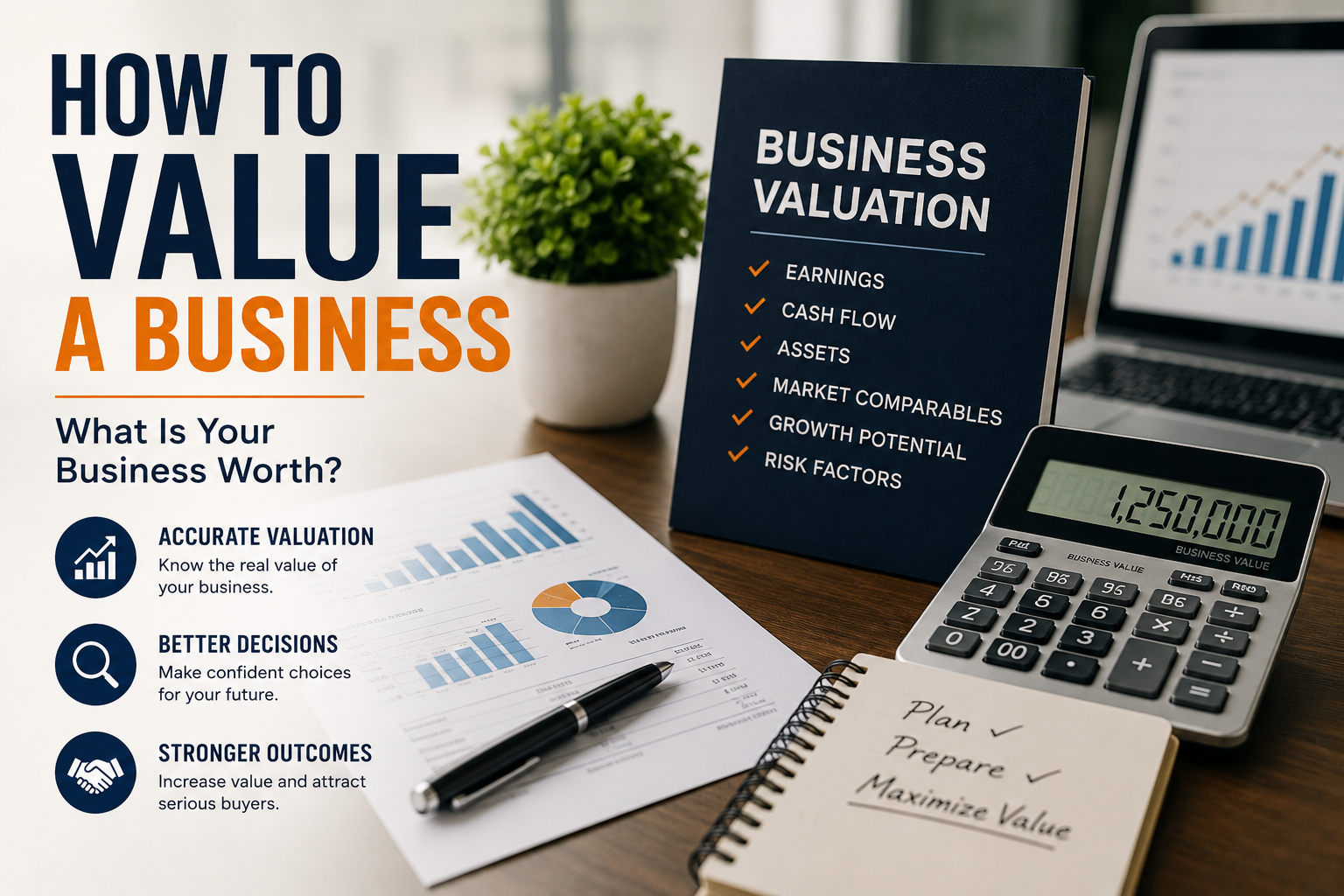
If you own a company, learning how to value a business is one of the most important steps you can take before selling, planning your exit, bringing in a partner, or making a major financial decision.
Your business may be one of your largest assets, but its value isn’t simply based on annual revenue or how much money you’ve invested in it.
Buyers look at earnings, cash flow, assets, liabilities, industry conditions, growth potential, customer concentration, and risk. Understanding these factors can give you a more realistic picture of what your company may be worth in today’s market.
Why You Need to Know How to Value a Business
A business valuation estimates the economic value of a company or ownership interest.
Business owners may need a valuation when:
- Preparing to sell a business
- Planning for retirement
- Bringing in a partner or investor
- Buying out an existing partner
- Applying for financing
- Creating an exit or succession plan
- Handling certain legal or financial matters
- Evaluating business growth
If you’re considering a sale, knowing your company’s approximate value can also help you establish realistic expectations before speaking with potential buyers.
An asking price based purely on what you want to receive may not match what buyers are willing to pay.
Three Common Business Valuation Approaches
There isn’t one formula that works for every company.
Professional valuations may consider several approaches before reaching a conclusion. Three of the most common are the income approach, market approach, and asset-based approach.
1. Income Approach
The income approach considers the company’s ability to generate future economic benefits.
For a profitable operating business, earnings and cash flow can be extremely important because buyers want to know how much financial benefit they could receive after acquiring the company.
Depending on the size and type of business, valuation professionals may examine measures such as Seller’s Discretionary Earnings (SDE), EBITDA, or cash flow.
Future earnings may also be adjusted for risk and converted into an estimate of present value.
2. Market Approach
The market approach looks at what buyers have paid for similar companies.
Think of it like comparing your business with other businesses in the same industry that have recently sold.
A valuation may examine factors such as:
- Industry
- Revenue
- SDE or EBITDA
- Location
- Company size
- Growth rate
- Customer concentration
- Comparable transaction multiples
The closer the comparable businesses are to your company, the more useful those transactions may be when estimating value.
3. Asset-Based Approach
The asset-based approach focuses on what the company owns compared with what it owes.
Assets might include equipment, inventory, vehicles, real estate, cash, accounts receivable, intellectual property, and other valuable property.
Liabilities are then considered when determining the company’s net asset value.
This approach may be particularly relevant for businesses with significant tangible assets, although it may not fully capture the value of a profitable company with substantial goodwill or other intangible assets.
How to Value a Small Business Using SDE
If you’re learning how to value a business for a potential sale, you may come across Seller’s Discretionary Earnings.
SDE is commonly used when evaluating smaller owner-operated businesses.
It attempts to show the total financial benefit available to one owner by starting with business earnings and making certain adjustments.
Depending on the circumstances, adjustments may account for items such as owner compensation, certain benefits, interest, depreciation, amortization, and qualifying one-time or discretionary expenses.
A valuation may then apply an appropriate multiple to normalized SDE.
For example, if normalized SDE were $300,000 and an appropriate market multiple were 3, the indicated value would be:
$300,000 × 3 = $900,000
This is only an illustration. The appropriate multiple can vary significantly depending on the company, industry, risk, growth, and market conditions.
What Factors Affect Business Value?
Two companies with identical revenue can have very different values.
That’s because buyers aren’t purchasing revenue alone. They’re evaluating the quality, sustainability, and risk of the company’s future earnings.
Important factors can include:
- Revenue and profitability trends
- Recurring revenue
- Customer concentration
- Owner dependence
- Employee stability
- Competitive advantages
- Industry outlook
- Growth potential
- Financial record quality
- Intellectual property
- Contracts and customer relationships
- Business systems and processes
A company with consistent earnings, diversified customers, documented processes, and low owner dependence may be more attractive than a similar company where nearly everything depends on the current owner.
Documents You Need to Value a Business
Accurate information is essential when determining business value.
Before starting the valuation process, gather at least three years of financial and operational information when available.
Useful documents may include:
- Business tax returns
- Profit and loss statements
- Balance sheets
- Cash flow statements
- Current year financials
- Customer information
- Major contracts
- Lease agreements
- Equipment and asset lists
- Debt information
Financial statements may also need adjustments to better represent the company’s normalized earnings.
Clean, organized records can make it much easier for a potential buyer, lender, broker, or valuation professional to understand the business.
Don’t Base Your Value on Revenue Alone
One common valuation mistake is assuming a business is worth a certain percentage or multiple of revenue without considering profitability.
Revenue tells you how much money comes into the company. It doesn’t tell you how much economic benefit the owner receives.
A company generating $5 million in annual revenue but very little profit could be less attractive than a $2 million company producing strong and predictable earnings.
Industry rules of thumb can provide a starting point, but they shouldn’t automatically be treated as the final value.
How to Increase Your Business Value Before Selling
Learning how to value a business can also reveal opportunities to improve its value.
If you’re planning to sell within the next few years, focus on making the company easier and less risky for another owner to operate.
That could mean improving profitability, reducing unnecessary expenses, building recurring revenue, documenting operating procedures, strengthening your management team, and reducing dependence on one or two major customers.
You should also reduce the company’s dependence on you personally.
A business that can continue operating successfully after the owner leaves may be more attractive to potential buyers.
When Should You Get a Professional Business Valuation?
Online calculators and industry rules of thumb can provide quick estimates, but they have limitations.
A professional valuation may be appropriate when the value will influence a major transaction, legal matter, ownership change, or financial decision.
A valuation professional can examine the company’s financial history, assets, industry, market conditions, earnings quality, risks, and other factors before reaching a conclusion.
Final Thoughts
Understanding how to value a business gives you a clearer picture of one of your most important assets.
Start by reviewing your company’s financial performance, assets, liabilities, earnings, industry, and comparable transactions. Consider the income, market, and asset-based approaches rather than relying on one simple formula.
Most importantly, don’t wait until you’re ready to sell.
Understanding your company’s value today can help you identify weaknesses, improve profitability, reduce risk, and make better decisions that could increase what buyers are willing to pay in the future.
Ready to Find Out What Your Business Is Worth?
Knowing how to value a business is the first step. Understanding what buyers may actually pay is even more important.
If you’re considering selling your company, planning your exit, or simply want a clearer picture of its value, BizProfitPro can help you evaluate your business and identify opportunities to increase its value before a sale.
Schedule a confidential consultation today and take the next step toward understanding what your business could be worth.