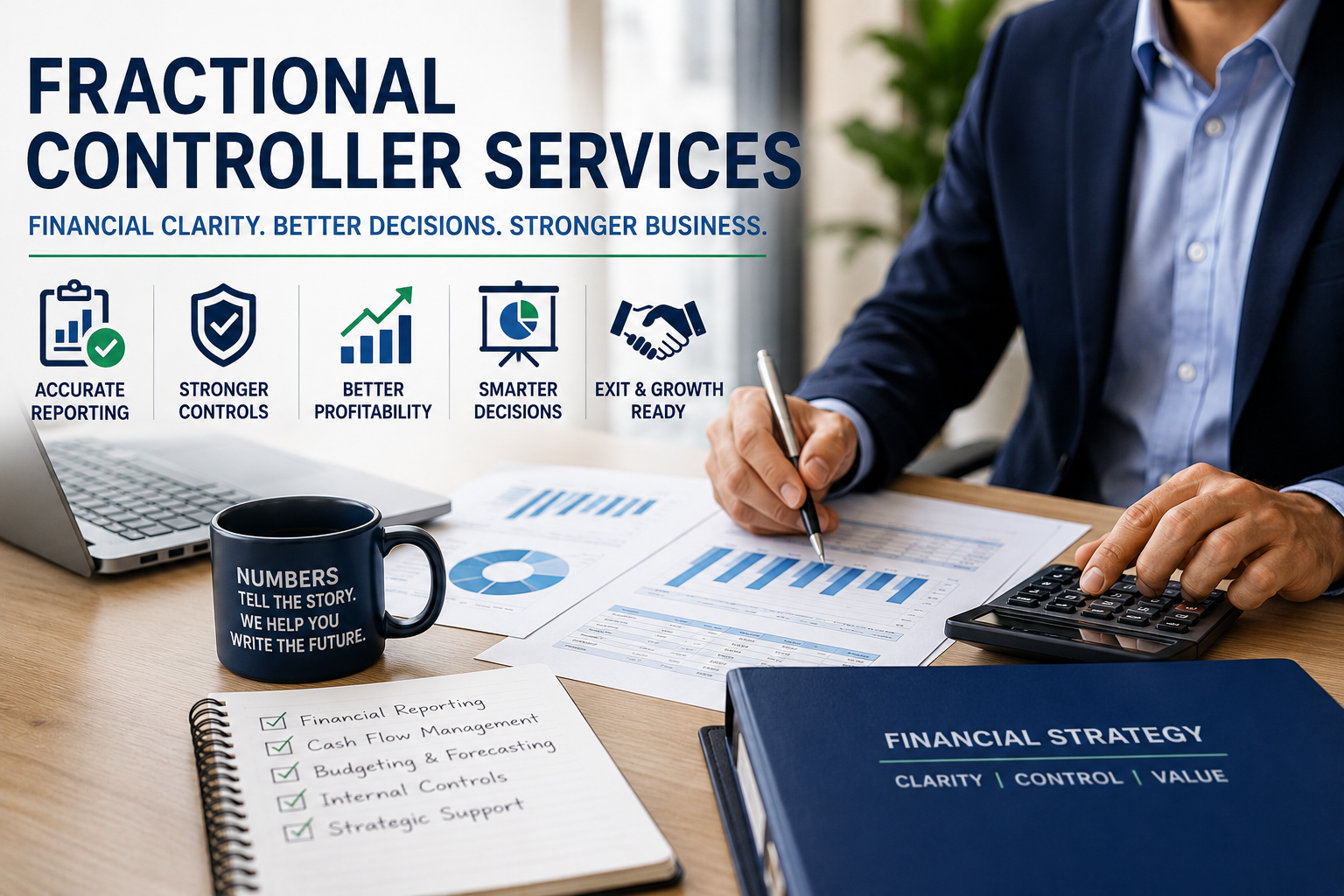
As a business grows, its financial needs become more complicated. Basic bookkeeping may have worked when the company was smaller, but eventually owners need more accurate reporting, stronger financial controls, and a clearer understanding of where the business is headed.
That is where fractional controller services can become valuable.
Instead of hiring a full-time controller, growing companies can access experienced financial oversight on a part-time or outsourced basis. This can provide better financial reporting and controls without adding another full-time executive salary to payroll.
For business owners focused on profitability, growth, financing, or preparing for a future sale, controller-level financial oversight can be an important next step.
What Are Fractional Controller Services?
Fractional controller services provide businesses with part-time or outsourced controller-level financial management.
Unlike a bookkeeper who primarily records transactions, a controller is responsible for making sure financial information is accurate, organized, consistent, and useful for decision-making.
Depending on the company, a fractional controller may work several hours each week, several days each month, or on specific financial projects.
Typical responsibilities include:
- Reviewing monthly financial statements
- Managing the month-end close
- Reconciling accounts
- Improving financial controls
- Monitoring cash flow
- Standardizing financial reporting
- Supporting budgets and forecasts
- Coordinating with accountants and tax professionals
- Preparing financial information for lenders or buyers
The objective is not simply to produce financial reports. It is to make sure management can trust the numbers behind those reports.
What Does a Fractional Controller Actually Do?
As companies become more complex, fractional controller services can provide the financial discipline that basic bookkeeping may not cover.
A controller typically oversees the accounting function rather than simply processing individual transactions.
For example, a controller might identify inconsistencies between financial statements and bank records, improve how expenses are categorized, establish approval procedures, or develop a more reliable monthly closing process.
Controllers can also help management understand why financial results differ from expectations.
If revenue increased 20% but profit declined, the controller can help identify whether payroll, materials, overhead, pricing, or another factor is responsible.
That information gives owners a stronger foundation for making decisions.
Fractional Controller vs. Bookkeeper vs. CFO
Understanding the difference between these financial roles is important.
Bookkeeper
A bookkeeper generally handles everyday financial transactions, including:
- Recording income and expenses
- Processing invoices
- Reconciling accounts
- Maintaining the general ledger
- Categorizing transactions
Controller
A controller oversees accounting quality and financial reporting.
Responsibilities often include month-end close procedures, internal controls, financial statement accuracy, accounting policies, and management reporting.
CFO
A CFO typically operates at a more strategic level.
CFO responsibilities may include:
- Financial strategy
- Capital planning
- Long-term forecasting
- Financing decisions
- Acquisition analysis
- Strategic growth planning
Fractional controller services sit between bookkeeping and CFO-level strategy. They can be especially useful when a company already has bookkeeping support but needs stronger oversight and more reliable financial information.
Signs You Need Fractional Controller Services
Not every small company needs a controller.
However, the need often becomes obvious as revenue, employees, transactions, and financial complexity increase.
You may need fractional controller services if:
- Financial reports consistently arrive late
- Your financial statements contain unexplained discrepancies
- Cash flow surprises happen frequently
- Your CPA regularly needs to correct your books
- You have multiple entities or locations
- You are moving from cash to accrual accounting
- Management cannot easily understand profitability
- You are preparing for bank or SBA financing
- You are considering selling the company
Another warning sign is when the owner spends too much time trying to understand or correct accounting problems.
As the business grows, the owner’s attention is usually more valuable in strategy, operations, customers, and growth.
How Fractional Controller Services Improve Profitability
Accurate accounting does more than keep tax records organized.
Fractional controller services can help owners identify financial issues that directly affect profitability.
For example, improved reporting may reveal:
- Declining gross margins
- Rising labor costs
- Unprofitable customers
- Excessive overhead
- Poor expense controls
- Slow accounts receivable
- Cash tied up unnecessarily
- Pricing problems
Without reliable reporting, these problems can remain hidden.
A business might appear successful because revenue is increasing while margins quietly deteriorate.
Controller-level reporting helps owners understand what is happening beneath the top-line numbers and take corrective action sooner.
Fractional Controller Services and Business Valuation
Financial quality becomes even more important when preparing to sell a company.
Potential buyers want confidence that the financial information they receive accurately reflects the performance of the business.
Fractional controller services can help improve exit readiness by establishing consistent reporting and addressing accounting issues before buyers begin due diligence.
This can include:
- Reconciling financial accounts
- Documenting owner add-backs
- Separating personal and business expenses
- Reviewing accounts receivable
- Identifying unusual expenses
- Improving month-end reporting
- Organizing historical financial information
Buyers may evaluate financial performance using metrics such as Seller’s Discretionary Earnings (SDE) or EBITDA.
If those numbers cannot be supported by reliable financial records, buyers may discount the company’s value or become concerned about the transaction.
Clean financials do not automatically guarantee a higher valuation, but poor financial records can create unnecessary risk and uncertainty.
Preparing for Due Diligence
Due diligence can expose financial weaknesses that owners have ignored for years.
Buyers and lenders may request:
- Tax returns
- Profit and loss statements
- Balance sheets
- Bank statements
- Payroll records
- Accounts receivable reports
- Accounts payable reports
- Debt schedules
- Customer information
- Supporting documentation for adjustments
Using fractional controller services before a transaction can help identify discrepancies before a buyer discovers them.
Preparing early also gives owners time to correct problems instead of trying to explain them during negotiations.
What Do Fractional Controller Services Cost?
Pricing varies based on the size and complexity of the company.
Factors may include:
- Monthly transaction volume
- Number of employees
- Number of entities
- Existing accounting systems
- Reporting requirements
- Condition of current financial records
- Frequency of controller involvement
Most arrangements use a monthly retainer or recurring service model.
Although the cost can be higher than basic bookkeeping, it is generally lower than employing an experienced full-time controller once salary, payroll taxes, benefits, and other employment expenses are considered.
For growing companies, this flexibility is one of the primary advantages of fractional controller services.
Who Benefits Most?
Controller-level financial oversight can be particularly useful for:
- Growing service businesses
- Multi-location companies
- Multi-entity organizations
- Businesses with growing payroll
- Companies seeking financing
- Businesses preparing for acquisition
- Owners planning to sell within several years
- Companies experiencing rapid growth
Businesses preparing for a sale may also benefit from reviewing a comprehensive selling a business checklist well before beginning the transaction.
The earlier financial weaknesses are identified, the more time management has to correct them.
How to Choose a Fractional Controller
When comparing fractional controller services, do not evaluate providers based on price alone.
Look for someone who understands your company’s size, industry, financial systems, and future goals.
Ask potential providers about:
- Monthly deliverables
- Reporting timelines
- Industry experience
- Accounting systems
- Communication frequency
- Internal control experience
- Cash flow reporting
- Due diligence experience
- Coordination with your CPA and bookkeeper
If you plan to sell the company, experience with exit readiness and buyer expectations can be particularly valuable.
The right controller should make your financial information easier to understand, not more complicated.
Final Thoughts
Fractional controller services are not simply another accounting expense. For the right business, they provide the financial infrastructure needed to make better decisions, improve reporting, control risk, and prepare for future growth.
Bookkeeping tells you what transactions occurred.
Controller-level oversight helps ensure those transactions become reliable financial information that owners, lenders, investors, and potential buyers can trust.
If your company has outgrown basic bookkeeping but is not ready for a full-time controller, a fractional model can bridge that gap.
Need Better Financial Clarity?
If you are ready to improve your financial reporting, profitability, or exit readiness, BizProfitPro can help you determine whether fractional controller services are appropriate for your business.
Call us between 9 AM and 5 PM to speak directly with an experienced business advisor, or schedule a convenient time to discuss your needs.
No hard sales. Just practical advice designed to help you build a stronger and more valuable business.