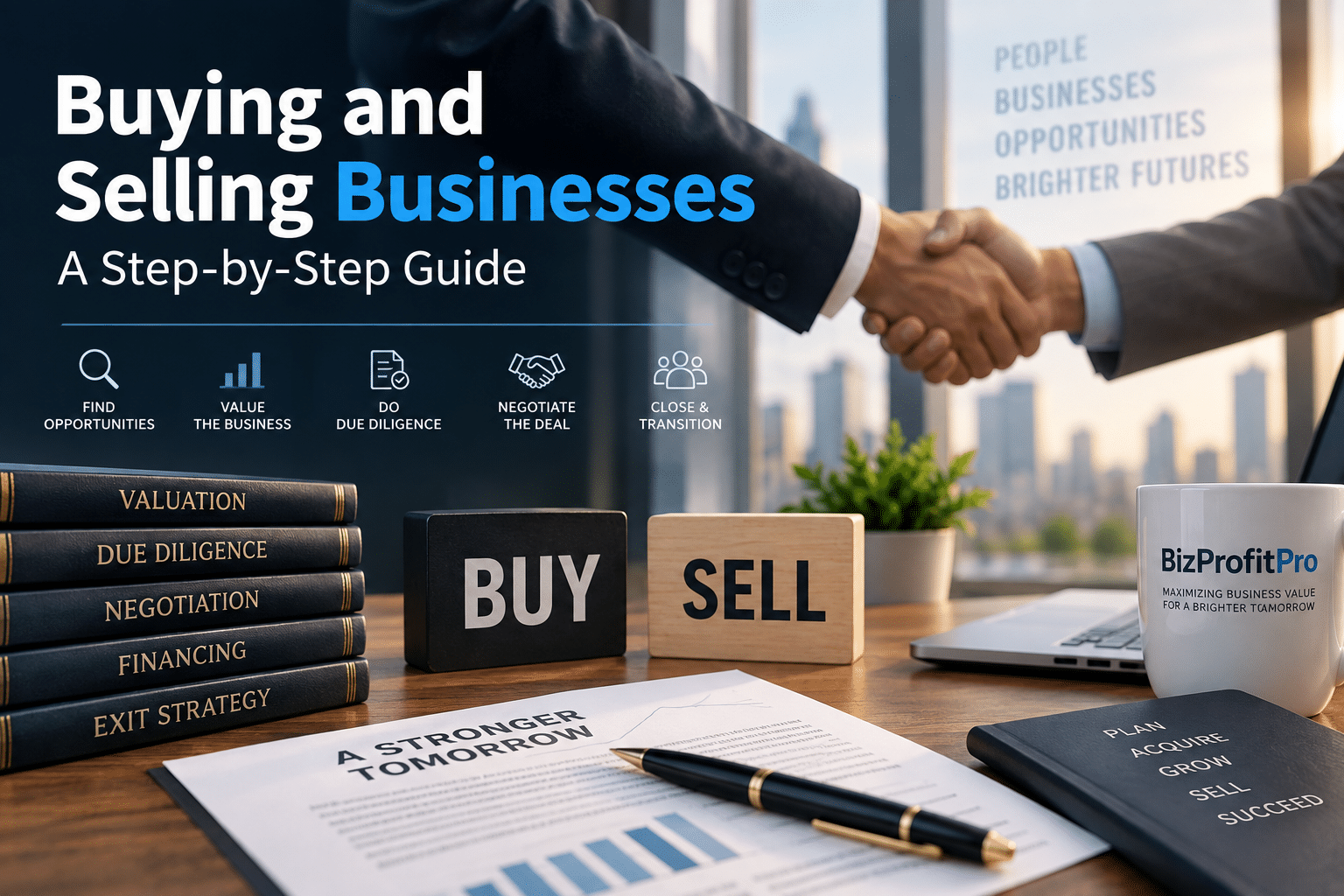
Buying and selling businesses can create significant opportunities for entrepreneurs, investors, and business owners, but successful transactions require more than finding a buyer or signing a purchase agreement. Valuation, due diligence, financing, negotiations, deal structure, and transition planning can all affect the final outcome.
For buyers, acquiring an established company can provide immediate revenue, customers, employees, operating systems, and market presence without building a business from scratch. For sellers, a properly planned exit can turn years of work into financial value while creating a path toward retirement, a new venture, or another investment.
Whether you are considering buying your first company or preparing an existing business for sale, understanding the process can help you avoid expensive mistakes.
This guide explains the essential steps involved in buying and selling businesses, from identifying opportunities and determining value to negotiating terms and closing the transaction.
Why Buying and Selling Businesses Can Create Opportunity
People enter the business acquisition market for very different reasons.
A buyer may want to become an entrepreneur without going through the uncertainty of launching a startup. Others may be experienced operators looking to expand into another market, acquire competitors, add new capabilities, or diversify their investments.
Buying an established business may provide advantages such as:
- Existing revenue and cash flow
- Established customers
- Trained employees
- Vendor and supplier relationships
- Proven operating systems
- Brand recognition
- Existing equipment and assets
- Historical financial performance
Sellers have their own motivations. An owner may be approaching retirement, experiencing burnout, pursuing another opportunity, relocating, or simply deciding that it is time to realize the value they have built.
Whatever the motivation, buying and selling businesses requires careful preparation. Buyers need to determine whether the company can generate an acceptable return, while sellers need to understand what buyers are willing to pay and how to position the company for a successful transaction.
Step 1: Define Your Business Acquisition or Exit Goals
Before searching for a business or putting one on the market, define what you want the transaction to accomplish.
Buyers should establish an acquisition profile covering factors such as:
- Preferred industries
- Geographic requirements
- Revenue range
- Cash flow or earnings requirements
- Purchase budget
- Desired level of owner involvement
- Financing capabilities
- Growth potential
This prevents buyers from wasting time evaluating businesses that do not fit their investment objectives.
Sellers should take a similar approach by defining their exit goals.
Consider your desired sale price, preferred timeline, willingness to remain involved after closing, and whether you would consider seller financing.
Clear objectives make the process of buying and selling businesses considerably more efficient.
Step 2: Determine What the Business Is Worth
Business valuation is one of the most important parts of any transaction.
An asking price and a company’s actual market value are not necessarily the same thing. Buyers want confidence that they are not overpaying, while sellers want to avoid leaving substantial value on the table.
Common valuation approaches include:
Earnings-Based Valuation
Many small businesses are valued based on their ability to generate earnings or cash flow.
Depending on the company’s size and structure, valuation professionals and buyers may examine metrics such as Seller’s Discretionary Earnings (SDE) or EBITDA.
A valuation multiple may then be applied based on the company’s industry, size, risk profile, growth prospects, and market conditions.
Market-Based Valuation
A market approach compares the business with similar companies that have recently sold.
Comparable transactions can provide useful insight into what buyers are currently willing to pay for companies with similar characteristics.
Asset-Based Valuation
Asset-based valuation considers the company’s tangible and intangible assets minus its liabilities.
This approach may be particularly relevant for asset-heavy companies or businesses where physical assets represent a substantial portion of overall value.
No single formula works for every business. Accurate valuation requires examining the company’s financial performance, industry, customer concentration, growth potential, assets, competitive position, and risks.
A professional business valuation can give both buyers and sellers a stronger foundation for negotiations.
Step 3: Prepare the Business for Sale
Owners should begin preparing well before putting their company on the market.
Buyers typically prefer businesses that are organized, profitable, transferable, and not completely dependent on the current owner.
Sellers should review areas including:
- Financial records
- Tax returns
- Customer concentration
- Recurring revenue
- Employee agreements
- Vendor contracts
- Operating procedures
- Intellectual property
- Equipment and assets
- Outstanding liabilities
- Owner dependence
Clean financial records are particularly important.
A buyer needs to understand exactly how the company generates revenue and profit. Unclear expenses, undocumented add-backs, or inconsistent bookkeeping can reduce buyer confidence and potentially reduce the company’s valuation.
Preparing early also gives owners time to address weaknesses before buyers discover them during due diligence.
Step 4: Find the Right Business or Qualified Buyer
Finding the right opportunity is another major challenge when buying and selling businesses.
Buyers can search through business-for-sale marketplaces, professional networks, direct outreach, industry contacts, and business brokers.
However, price should not be the only consideration.
A seemingly inexpensive company may have declining revenue, customer concentration problems, outdated equipment, pending legal issues, or significant working capital requirements.
Sellers face the opposite challenge: finding financially capable buyers who are genuinely prepared to complete a transaction.
A qualified buyer should generally have:
- Financial capacity
- A clear acquisition strategy
- Access to financing
- Relevant experience when necessary
- A realistic understanding of the transaction
- The ability to complete due diligence
Business brokers and M&A advisors can help connect sellers with potential buyers while managing confidentiality throughout the process.
Step 5: Conduct Thorough Due Diligence
Due diligence allows a buyer to verify what they have been told about the company before completing the acquisition.
Financial due diligence may include reviewing:
- Profit and loss statements
- Balance sheets
- Cash flow statements
- Tax returns
- Bank records
- Accounts receivable
- Accounts payable
- Debt obligations
- Owner add-backs
- Inventory
Operational due diligence may examine employees, equipment, suppliers, customers, processes, technology, and other elements necessary to operate the company.
Legal due diligence can include contracts, leases, licenses, litigation, intellectual property, employment agreements, and regulatory compliance.
Buyers should investigate carefully rather than assuming that information presented during the initial sales process tells the complete story.
Sellers benefit from preparing for due diligence before going to market. Organized records can make the transaction more credible and prevent unnecessary delays.
Step 6: Structure and Negotiate the Deal
Price is important, but it is only one component of a business acquisition.
The structure of the transaction can significantly affect both parties.
Negotiations may cover:
- Purchase price
- Asset sale versus stock or equity sale
- Cash paid at closing
- Seller financing
- Earnest money
- Working capital
- Inventory
- Non-compete agreements
- Training and transition support
- Representations and warranties
- Contingencies
- Closing timeline
For example, a seller might accept a higher overall purchase price if part of the transaction is financed over several years. A buyer might prefer a lower cash requirement at closing in exchange for structured payments.
The objective should be to create terms that adequately address the financial and risk considerations of both sides.
Once major terms are established, the parties often use a Letter of Intent (LOI) to document the proposed structure before moving into final due diligence and definitive agreements.
Step 7: Secure Financing for the Acquisition
Many buyers do not purchase businesses entirely with cash.
Depending on the transaction, financing options can include traditional bank loans, SBA-backed financing, seller financing, investor capital, or combinations of multiple funding sources.
Bank Financing
Traditional lenders may finance acquisitions when buyers and businesses meet their underwriting requirements.
Lenders typically evaluate the buyer’s creditworthiness, experience, collateral, and the company’s ability to generate sufficient cash flow to service the debt.
Seller Financing
With seller financing, the seller accepts a portion of the purchase price over time instead of receiving the entire amount at closing.
This can reduce the buyer’s upfront capital requirement while potentially expanding the pool of qualified buyers.
SBA Financing
Qualified acquisitions may also be financed through SBA-backed loan programs.
These loans can make acquiring an existing business more accessible, although buyers and businesses must satisfy lender and SBA eligibility requirements.
Financing should be considered early in the acquisition process because the available capital structure can influence which businesses a buyer can realistically acquire.
Step 8: Address the Legal and Tax Considerations
Business transactions can create significant legal and tax consequences.
Buyers and sellers should work with qualified attorneys, accountants, and tax professionals before completing a transaction.
Legal documents may include:
- Confidentiality agreements
- Letters of intent
- Asset purchase agreements
- Stock or membership interest purchase agreements
- Promissory notes
- Non-compete agreements
- Employment or consulting agreements
- Closing documents
Deal structure can also affect taxes for both parties.
For example, an asset sale may produce different tax consequences than an equity sale. Purchase price allocation can also influence how various portions of the transaction are taxed.
These decisions should be evaluated before final agreements are signed rather than after closing.
Step 9: Close the Business Sale
Once due diligence, financing, and final negotiations are complete, the transaction can move toward closing.
Before funds change hands, both sides should confirm that all required conditions have been satisfied.
Depending on the transaction, closing may involve:
- Signing the purchase agreement
- Transferring funds
- Assigning contracts or leases
- Transferring business assets
- Updating licenses and permits
- Transferring ownership interests
- Finalizing financing documents
- Completing escrow requirements
- Establishing transition responsibilities
Professional guidance can be especially valuable at this stage because seemingly minor documentation issues can delay or complicate a transaction.
Step 10: Plan the Ownership Transition
Closing is not necessarily the end of the process.
A successful transition can help protect the company’s value after ownership changes.
Sellers may remain involved temporarily to introduce customers, vendors, employees, and key partners to the new owner. They may also provide training covering operational systems and institutional knowledge.
Buyers should have a transition plan before taking control.
Avoid making unnecessary changes simply to establish new ownership. Employees and customers may already be uncertain about the transition, and abrupt changes can create additional risk.
Instead, learn how the company operates, identify its strengths and weaknesses, and make improvements based on evidence.
Common Mistakes When Buying and Selling Businesses
Even experienced entrepreneurs can make mistakes during a transaction.
Some of the most common include:
- Setting an unrealistic asking price
- Buying based on emotion instead of financial performance
- Failing to conduct adequate due diligence
- Relying on inaccurate financial records
- Ignoring customer concentration
- Underestimating working capital needs
- Failing to plan financing early
- Negotiating only on purchase price
- Overlooking tax implications
- Failing to create a transition plan
Professional advice does not eliminate every risk, but experienced valuation experts, business brokers, attorneys, and accountants can help identify problems before they become expensive mistakes.
Should You Use a Business Broker?
A business broker can help manage many aspects of buying and selling businesses, particularly for owners who have never completed a transaction.
For sellers, a broker may assist with valuation, confidential marketing, buyer screening, negotiations, and transaction coordination.
For buyers, an experienced broker can help identify acquisition opportunities, understand financial information, communicate with sellers, and move the transaction toward closing.
The right advisor should understand business valuation, transaction structure, negotiation, and the realities of transferring ownership.
Ready to Buy or Sell a Business?
Successfully buying and selling businesses requires preparation, accurate valuation, disciplined due diligence, strong negotiations, appropriate financing, and careful transaction planning.
Buyers should understand exactly what they are acquiring and whether the company’s cash flow, risks, and growth potential justify the investment.
Sellers should understand what their company is worth, prepare it for buyer scrutiny, and develop an exit strategy before going to market.
BizProfitPro helps business owners and prospective buyers navigate business valuations, acquisitions, sales, and exit planning. Whether you want to determine what your company is worth, prepare a business for sale, or evaluate an acquisition opportunity, experienced guidance can help you make a more informed decision.
Schedule a confidential consultation with BizProfitPro to discuss your business acquisition, valuation, or exit strategy.