Blog

Top Ten Business for Sale by Owner

business for sale by owner

Top Ten Business for Sale by Owner

This is a list of the top ten businesses for sale by owner that are listed on Businesses For Sale by Owner. The list includes the most popular enterprises in the United States that can be found in virtually every city and state. The list contains a mix of small businesses, medium-sized businesses, large businesses, and franchises.


There are on average about 30 businesses for sale by owner for every million people in the United States, meaning that every 10 minutes a business is listed for sale. This is a list of the top ten most popular enterprises for sale by owner in the United States.

Most Popular Business for Sale by Owner

E-Commerce
Restaurants
Convenience Stores
Coffee Shops
Bars
Services Businesses
Auto Repair, Service & Parts
Liquor Stores
Marketing Businesses
Health & Fitness Clubs

Top ten businesses for sale according to businessesforsale.com analyzes the hits on their site by business type. These businesses represent the most popular enterprises in the United States that can be found in virtually every city and state. The key to buying a business for sale by owner is to check the major business for sale websites to see what is available and what type of company you want to own. 


Websites like bizbuysell.com, businesssforsale.com, diybizseller.com, bizquest.com are sources to find businesses for sale. Alerts can be set up that will automatically notify you when companies that meet your criteria are listed. This is a great time saver and allows for a systematic search of businesses of interest.


Due Diligence When Buying A Business

Do proper due diligence on any business you are considering buying. Due diligence is part of the buying process that allows the buyer to examine the financials of the company in addition to a comprehensive inspection of the operation. Due diligence is a chance to find any misrepresentations or unknows before you purchase a business. You may consider professional help when going through this process. Contact us for a free consultation should you have any questions about the process.

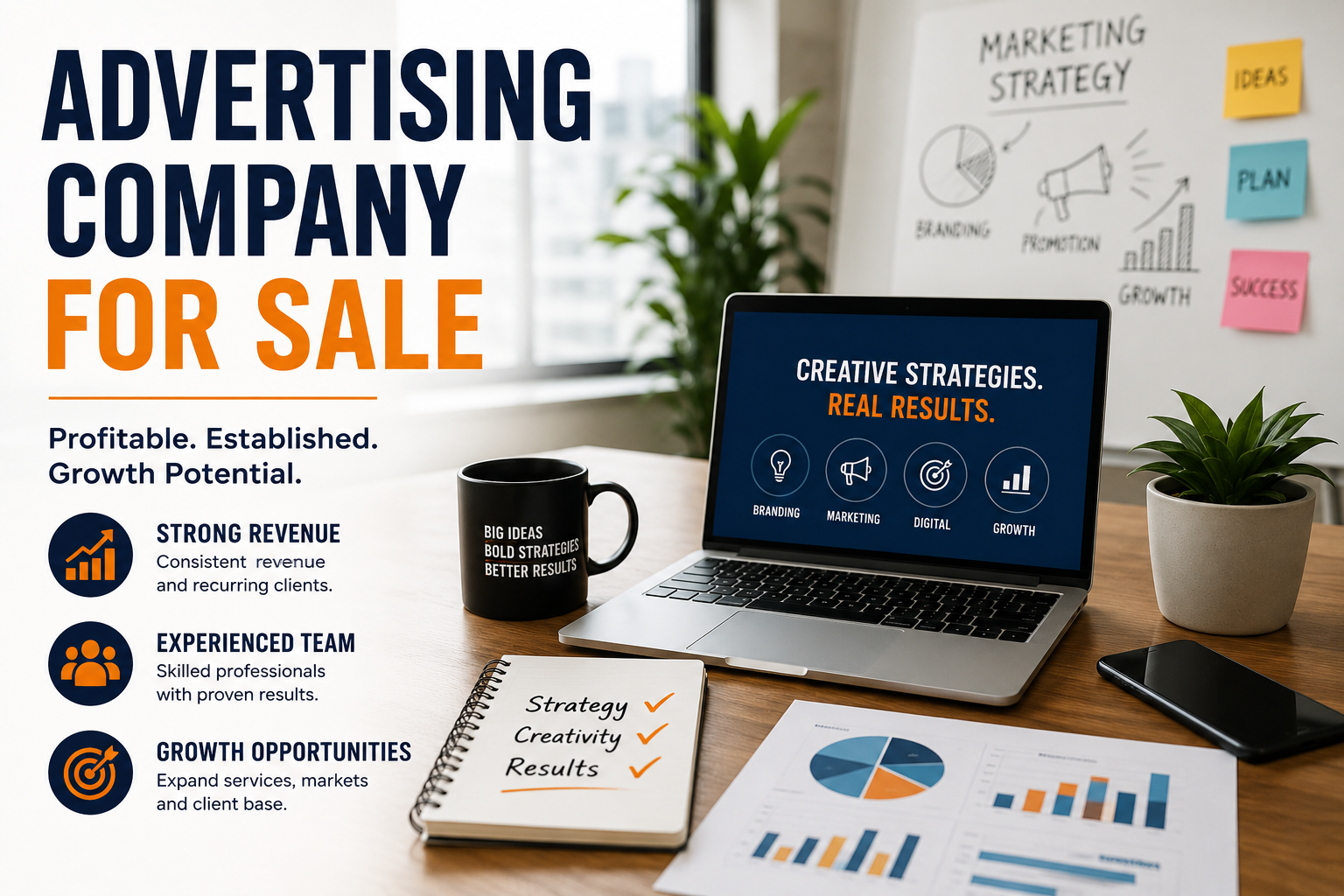
Advertising Company for Sale: How to Attract the Right Buyers

advertising company for sale

If you have an advertising company for sale, finding the right buyer requires more than posting a quick listing online. You need to get your company in front of qualified buyers while protecting confidential information about your clients, employees, finances, and operations.

Maximum exposure can help create competition for your business, but confidentiality matters just as much. If employees, customers, or competitors learn about the sale too early, it could negatively affect the company.

The best strategy is to advertise your company discreetly while giving serious buyers enough information to become interested.

How to Advertise an Advertising Company for Sale

When marketing an advertising company for sale, start by thinking about what makes the business valuable to a potential buyer.

Advertising and marketing companies may attract buyers because of their recurring clients, experienced team, reputation, industry expertise, or opportunities for growth.

Your initial advertisement can highlight:

  • Years in business
  • General location
  • Annual revenue
  • Seller’s Discretionary Earnings (SDE) or EBITDA
  • Recurring client revenue
  • Number of employees
  • Services provided
  • Growth opportunities
  • Reason for selling

Provide enough information to generate interest without revealing details that immediately identify your company.


Best way to advertise your business for sale


Keep the Sale Confidential

Confidentiality is one of the most important parts of selling a business.

If news of the sale becomes public too early, employees may become concerned about their jobs. Clients may wonder whether their accounts will continue receiving the same level of service. Competitors may also use the information to approach your customers or employees.

When creating an advertising company for sale listing, avoid publishing your company name, exact address, client names, employee information, or proprietary information.

Instead, you might use a headline such as:

Established Advertising Agency With Recurring Clients and Growth Potential

This tells buyers what type of opportunity is available without revealing the company’s identity.

Require an NDA From Potential Buyers

Don’t provide confidential information to everyone who responds to your advertisement.

Start by determining whether the prospective buyer is serious and financially capable of completing an acquisition.

Qualified buyers should sign a Non-Disclosure Agreement (NDA) before receiving sensitive information.

After the NDA is signed, you can gradually provide more details about the company, including financial statements, client concentration, contracts, staffing, operations, and other information required to evaluate the business.

This allows serious buyers to learn more while helping protect your company.

Where to List an Advertising Company for Sale

Business-for-sale websites can put your company in front of people actively looking for acquisition opportunities.

Popular marketplaces include:

  • BizBuySell
  • BizQuest
  • BusinessesForSale
  • BusinessBroker.net
  • DealStream
  • SMERGERS
  • GlobalBX

You don’t necessarily need to use every marketplace.

Consider your company’s size, location, revenue, asking price, and ideal buyer when deciding where to advertise.

An advertising company for sale may also benefit from industry-specific networks where agency owners, investors, and marketing professionals are more likely to see the opportunity.

Look for Strategic Buyers

The best buyer may never see your online advertisement.

Strategic buyers are companies or individuals who see additional value in acquiring your business because it complements something they already own.

Potential strategic buyers for an advertising company could include:

  • Competing advertising agencies
  • Digital marketing companies
  • Public relations firms
  • SEO agencies
  • Web development companies
  • Media companies
  • Larger agencies entering your market

A buyer may be particularly interested in your client portfolio, employees, geographic reach, recurring revenue, industry specialization, or reputation.

Direct outreach to carefully selected strategic buyers can expand your pool of potential purchasers.

Use Social Media to Reach Buyers

Social media can also help market an advertising company for sale, but it should be used carefully.

LinkedIn can be particularly useful for identifying agency owners, executives, investors, and companies that may have an interest in an acquisition.

Facebook and X can provide additional exposure depending on your target market.

However, avoid publicly announcing your company’s identity if confidentiality is important. Social media is often more effective for targeted networking and outreach than simply broadcasting that your company is for sale.

Prepare Your Advertising Company Before the Sale

Before putting your advertising company for sale on the market, make sure your financial and operational records are organized.

Potential buyers will want to understand how the company makes money and how easily it can operate after ownership changes.

Prepare important documents such as:

  • Profit and loss statements
  • Balance sheets
  • Business tax returns
  • Client contracts
  • Employee information
  • Vendor agreements
  • Lease agreements
  • Operating procedures
  • Asset lists

For an advertising company, buyers may pay particular attention to recurring revenue and client concentration.

If one or two clients generate a large percentage of revenue, buyers may consider that a risk. A diverse client base and documented systems can make the business more attractive.

Understand What Your Company Is Worth

Before advertising the company, establish a realistic value.

Buyers will examine revenue, profitability, SDE or EBITDA, client retention, recurring revenue, growth trends, owner dependence, and other factors.

An unrealistic asking price can discourage serious buyers.

Understanding the company’s value also gives you a stronger foundation for evaluating offers and negotiating with potential purchasers.

Should You Hire a Business Broker?

You can market and sell your business yourself, but the process requires time and organization.

A business broker or M&A advisor may help prepare marketing materials, identify buyers, maintain confidentiality, screen prospects, coordinate due diligence, and negotiate offers.

They may also have an existing network of buyers interested in advertising and marketing companies.

Professional representation can be particularly helpful when you want to continue operating the company without personally handling every inquiry.

Final Thoughts

Selling an advertising company for sale requires a balance between getting maximum exposure and protecting confidential information.

Create an anonymous but compelling listing, advertise through reputable business-for-sale marketplaces, identify strategic buyers, and use professional networks to expand your reach.

Screen prospective buyers carefully and require an NDA before sharing sensitive financial, client, or operational information.

Most importantly, prepare your company before putting it on the market. Organized financial records, recurring clients, documented processes, a capable team, and realistic pricing can make the business easier for buyers to evaluate.

The goal isn’t simply to generate inquiries. It’s to reach qualified buyers, create genuine competition, and find the right buyer for your advertising company.


Best way to advertise your business for sale
pixel bizprofitpro

Best Small Business Loan

Getting The Best Small Business Loan

We can help you get the best small business loan. Bizprofitpro has lenders that offer a range of solutions from the most proven sources with the best terms. Every business, at some point, will require capital to start or buy an existing business. You might also need money to continue operations and fund growth. We have several lenders with different products for whatever your circumstance may be. Get a customized funding solution to achieve your financing goals. We do the work to find you the money at the best terms. The following products have proven the highest approval rates with a fast loan process.


best small business loan


Best Small Business Loan Products

* Business Credit Card Program
* Unsecured lines of credit for individuals with a score of 680 or better
* Conventional bank loans
* SBA Loan
* Short-term small business loans
* Equipment Leases


Qualifying for The Best Small Business Loan

Qualifying for the best loan requires a credit score above 680 on all three credit bureaus. Selecting the right loan product will depend on your circumstance. Every situation has a loan product, even if your credit is not perfect. The most important factor in getting a small business loan is the ability to repay the loan. The loan should only be for purchasing an asset that will create a return that can service the debt. Click the link below and fill out the form, and we will work with our lenders to get the money you need.


best small business loan


How to Sell My Company In 5 Steps

People ask “how to sell my company” all the time. Selling a business is one of the most complex transactions you are likely ever to be involved in. Unlike a publicly-traded company that is run for the benefit of shareholders, a privately held small business is run entirely for the benefit of its owner. The business is operated to maximize the lifestyle and the perks for its owner. This causes there to be many discretionary expenses that may be considered perks or items that contribute more to the lifestyle of the owner than the need of the business.


Critical Steps to Sell My Company

Small business owners make decisions to legally reduce the tax burden by expensing as much as possible through their business. This may come in the form of a luxury car, boat, house, business trip, or having a spouse on the payroll. These are considered “discretionary expenses” that are added back to income because the new owner won’t need these discretionary expenses to operate the business. Discretionary expenses and perks of small business owners make it difficult or nearly impossible to determine the exact cash flow for a new owner. Many deals fall apart because there is no way to make an accurate forecast of future earnings.


“Opportunities don’t happen. You create them.” –Chris Grosser


Sell My Company in Five Steps


1. Making the Decision
Making the decision to sell a business is the most important step in the process. Many owners identity is attached to being a business owner. Friends, family, and the community look at business owners in a certain light which may be difficult to lose after the business is sold. There is also a financial consideration and how the sale of the business will affect future plans.


2. Optimize the Value of the Enterprise
Prospective buyers or a new owner would be willing to pay more for a business for these reasons:
a) Generates a lot of income
b) Income is steady every single month
c) Business has systems in place and not dependent on the owner
d) Business has a history of Growth

By improving the above-mentioned items, your business will become more desirable and sell for the most money. Don’t worry if your business is not perfect, no business is. People expect things to be wrong with any business and they come in with the expectation that they will use their ideas to fix it after they buy.


3. Decide whether to use legal professionals
There is a cost associated with using professionals but selling a business alone may put you at great of future liability or other complications. At a minimum, you will need an attorney to draft a Purchase and Sale Agreement that properly transfers the business and all of its assets to the new owner and eliminates any and all future liabilities. Additionally, you will want to consult with an accountant to best determine how to structure the financial part of the transaction and any tax liabilities you need to be aware of.


4. Determine the Value of the Business
There are countless numbers of valuation models that can be used to calculate the value of a business. The comparable sales method compares similar transactions and uses the data to determine a price. The debt capacity method is based on the amount a bank will loan for the acquisition of the business. The cost to replace method calculates the investment to replace equipment, furniture, and fixture. There are also rules of thumb that take the earnings of the company and multiples by a certain multiple depending on the industry. It’s not uncommon for there to be a wildly different valuation calculated by a buyer and seller. The buyer is usually 20% to 40% less than the sales price the seller estimates. Sellers should set the sales price reasonable or risk scaring buyers off and not even getting an offer.


5. Do the Actual Selling On Your Own or Use a Broker
Ensure that you work with reputable business brokers or business intermediaries. Business brokers and business intermediaries are experienced at pricing your business to sell at the maximum price. They also have expertise in confidentially marketing your business to the largest audience. The process of selling a business can be very complicated and time-consuming. While there is a fee associated with using a business broker, it is almost always money well spent. Most businesses never sell because it’s so difficult for a business owner to operate their business and have the time to market professionally and sell their business.


Sell My Company Fast

Selling a business is hard work and takes time. Delegate the appropriate tasks to professionals so you give yourself the best chance to have the most profitable transaction. Most deals fall apart a few times before actually getting closed. It is critical to allow your professionals to do their jobs and move the transaction along for your maximum benefit. You can learn more about the process of selling a business by clicking here.


Sell My Business Free Call

Click Here

800-905-1213

Profitable Franchises To Buy

THE MOST PROFITABLE FRANCHISE TO BUY


PROFITABLE FRANCHISE TO BUY

The most profitable franchise to buy can be found by evaluating the Franchise Disclosure Document, Bankability (SBA Approved Financing), Proven Business Model, Training, and Scalability of the franchise being evaluated.  Rank a franchise among their peers and only consider the best of the best. Conduct interviews with key franchise executives to determine to confirm your research findings. Also, interview franchisees of “going” franchises to get real-world experiences and look for red flags. Use resources like The Business Reference Guide by Tom West of Business Brokerage Press, considered the most authoritative source of industry-specific business information. 


Franchise Disclosure Document (FDD)

The Franchise Disclosure Document is a legal document that is available to the prospective buyer of a franchise in the pre-sale disclosure process. The FDD contains all of the information that state and federal franchise regulators consider relevant to a franchise investment, and it is the holy grail in researching a franchise. Information in the FDD ranges from the franchisor’s history and the business experience of its executives to the fees that the company charges, to the requirements for purchasing inventory, to the form of the franchise agreement, to three years of the franchisor’s financial statements. We pay special attention to Item 19 as it is a critical part of every franchise disclosure document. It provides a clear avenue for delivering performance information and must meet or exceed performance by its peers. Item 20 also gets extra scrutiny in our rankings to get the number of franchises and if they increase or decrease. Item 20 also contains contact information for current franchisees that we use to contact franchisees as part of our research.


Bankability (SBA Approved Financing)

For a franchise to make our Top 10 Franchise List, the franchise must qualify for the SBA Express Loan Program, which offers streamlined and expedited loan procedures for borrowers. The SBA Express Loan gives small business borrowers an accelerated turnaround time for SBA review; a response to an application will be given within 24 hours.


Proven Business Model

We use Item #20 of the Franchise Disclosure Document, The BRG Business Reference Guide, and other sources to validate the business model for growth and sustainability. Growth has to exceed the growth of the economy as measured by Gross Domestic Product (GDP)


Training

Strong training and support should be included in your consideration. Use franchisees’ input to review systems that support the owners.  Review what the franchises offer in software, computer systems, group coaching, classroom training, mentorships, etc., and determine if they meet your needs.


Scalability

Verify that the Business Model has the potential to be scalable. We define scalability as the franchise’s ability to grow in profitability so that the owner can remove themselves from day-to-day operations. After the business has achieved scale, the owner can use the business to support their lifestyle or choose to grow to the next level. 


Qualified franchisees can get SBA Express Loans in less than 24 hours.  Investing in a franchise business is one of the safest ways to go if you’re thinking of buying a small business. A franchise has the business model, training, and systems to give you the best chance for success. You should also consider franchise resales because they already have customers and financial history.


List Of Best Franchises To Buy Approved By The SBA

Best Franchise to Buy

The Small Business Administration (SBA) approved the best franchises to buy. Not only are they easier to finance, but they have to meet a minimum level of financial performance. Investing in a franchise business is a way to reduce the risk of becoming an entrepreneur. A franchise has a proven business model, training, and systems to give you the best chance for success. We have compiled a list of franchises with a total investment of less than $750,000 while reporting the highest financial success compared to its peers. They must also be approved for financing with an SBA or a traditional bank loan.

best franchise to buy

An SBA Express Loan can get you up to $150,000 in as little as 30 days. These are the best startup business loans available. 10-year terms, NO pre-payment penalty, No pledge of personal assets as collateral, Interest Prime + the prevailing interest rate.


Here is a list of franchises with a strong financial history that scored the highest in our review. We scored each franchise for Bankability (SBA Approved Financing), Viable Business Model, Training, Scalability, and Growth to be considered for our list. We then ranked the franchises among their peers and picked the best of the best. While every effort has been made to deliver accurate information, it is the buyer’s responsibility to conduct their due diligence. Bizprofitpro, LLC takes no responsibility for any action you may take regarding any information contained in our review.


“The best time to plant a tree was 20 years ago. The second best time is now.”
-Proverb


Best Franchise To Buy Approved by the SBA


Above Grade Level in Home Tutoring
Above Grade Level is a hot concept in an incredible growth market – education. We have the most comprehensive teaching materials of any tutoring provider! Twenty-five years in the making, our teaching materials have helped tens of thousands of students achieve academic success.
above_grade


Advanta Clean
AdvantaClean Environmental is a dynamic, rapidly expanding concept that services the emerging and ever-growing indoor air quality market. This powerful franchise opportunity is built upon a multi-revenue stream business model, paperless operating platform, National Customer Care Center, and our franchisees’ savvy business skills.


advantaclean-logo


Budget Blinds was founded on providing high-quality window coverings to consumers in a highly convenient way and at prices that fit almost every budget. Today, the Budget Blinds franchise system still strives to provide consumers with superior products through convenient, complimentary in-home consultations that include measuring and professional installation. Every year since 1996, Budget Blinds has been voted the #1 window coverings franchise by Entrepreneur Magazine (Entrepreneur, 2015). 


budget-blinds-logo-300

CertaPro is the largest painting company in North America, with system-wide sales approaching $250 million. There are over 360 locations in the US and Canada, and the Pennsylvania-based company plans to have 550 locations by the end of 2016. The painting service industry is large, at over $40 billion annually. CertaPro is unique in the service category because its owners drive revenue from residential (B2C) and commercial (B2B) clients. Business owners scale by adding salespeople for residential and commercial sales, and most owners use subcontractors to produce the work – keeping overhead low.

certa-pro-paint


The Closets by Design business model focuses on all aspects of the business. Each franchise designs sells, manufactures, and installs the complete portfolio of products, including closets, offices, garages, pantries, wall units, and beds. It begins with a proven and effective lead generation strategy. This, coupled with a disciplined and client-oriented sales model and metric-driven manufacturing and installation efficiencies, provide the tools for the franchise to manage and grow their business effectively. Each location has a factory and showroom located in a light-manufacturing industrial park. The average annual revenue of a Closets By Design Franchise in 2013 was 2.9 million dollars.

closets-by-design_logo

CMIT is a leading provider of IT services for small and mid-sized businesses (SMB) that employ 5 to 99 employees – large enough to need IT services but not big enough to warrant in-house IT departments. CMIT Solutions operates on a managed services model that offers specialized outsourced IT services at affordable monthly rates, with contracts lasting one to three years. Our subscription model allows small business owners to budget IT expenses effectively and saves them money in the long run. At CMIT, we focus on business results – performance, productivity, and profit for our clients we know that technology is a tool to accomplish those goals, and we ensure that our clients get the most out of their investment in technology.

Services offered to the business market include remote monitoring and repair, Helpdesk support, troubleshooting, networking, data backup, data recovery, website design, internet security and firewalls, software training, updates/upgrades, system administration, database design, and one-on-one mentoring. The new franchisee can secure a protected territory or become an area developer and grow to multiple locations in a larger territory. CMIT Solutions is looking for new franchisees focused on marketing and growing the business instead of working in it. The franchisor trains the franchise to build a sales and service team. Franchisor provides help desk and monitoring service, a low number of employees.

cmit_logo


logo-sbaSBA’s Express programs offer streamlined and expedited loan procedures for buying an SBA-approved business. SBA Express gives small business borrowers an accelerated turnaround time for SBA review; a response to an application will be given within 24 hours. The franchises we have listed are approved for an SBA Express Loan. Our franchise list includes the cheapest franchise to own while being the most profitable franchises. Investing in a franchise business is one of the safest ways to go if you’re buying a small business.

Reinventing Yourself After 50 by Mario Puig, MD

 REINVENTING YOURSELF AFTER 50 WITH PURPOSE

reinvent yourself after 50Reinventing yourself after 50 can be overwhelming and challenging. By the time you have reached many milestones and are likely to have a great deal of life experience, you don’t want to go backward. Most people think that life is a linear progression, and it’s not. Life is almost always full of ups and downs, but we would want to think of it as a linear process. Life is unpredictable and full of surprises, which should be embraced for the new possibilities they present.


Reinventing yourself is really about change. There is a discipline known as change management, which is typically applied to organizations, but it also holds equally true for individuals. Change Management is the discipline that guides how we prepare, equip, and support the successful adaptation of change for a successful outcome. It is never too late to become the person you were meant to be.


“Most people don’t grow up. Most people age. They find parking spaces, honor their credit cards, get married, have children, and call that maturity. What that is, is aging.”

— Maya Angelou
Watch this short video and learn how to reinventing yourself today.

by Mario Puig, MD


Further Reading

In a compelling personal essay, Stephen Starring Grant, a 50‑year‑old marketing veteran, shares how he was laid off in early March 2020—and just two months later, faced prostate cancer and the loss of his health insurance. With limited options for traditional employment, he took a mail carrier job with the U.S. Postal Service to support his family. His story highlights the emotional upheaval of pivoting from brand strategist to mailman, and how the new routine ultimately brought structure, purpose, and a renewed sense of identity. Click here for more


How to Reinvent Yourself After 50


 HOW TO REINVENT YOURSELF AFTER 50

reinvent yourself after 50

People often ask “how to reinvent yourself after 50” and as an over 50 myself I realized how difficult it can be.  I have more friends than I can count that were downsized many years ago out of corporate American and have never found their way back to full employment or comparable compensation. I know people that made more out of college than they are making now. My personal experience and what is being written is depressing. I was just reading a blog and was blown away by what a lady that posted ” I’m 53 and still have an 11 and 12-year-old at home. Have a college education and can’t even get an interview.” This story repeated over and over again across America. One of my neighbors worked for a large insurance company for 18 years before being let go. After 3 years, he was only able to get a temp job that led to 6 months of employment before ending. Now he can be seen most mornings walking the dog and performing yard work during what most consider working hours.  Younger people may be younger and hungrier than you and willing to accept lower pay but they lack the experience that decades of life experience brings. It may be time to create an opportunity that is best suited for your skills and experience. Working for yourself or owning a business is the only guarantee to be the architect of your future. You can join the ranks of entrepreneurs and enjoy the lifestyle and economic benefits that come with it.


Starting a business is not easy and can take a very long time before you are profitable. The better safer option is to buy an existing business that can be profitable on day one of ownership. Learn how to buy a profitable business with little or no money down. You just need to know and follow the necessary steps. Reserve a spot at our next Business Buying Workshop where you will get the steps to business ownership. Entrepreneurship is not for everyone. Take a free Entrepreneur Quiz that asks a few questions that will give you insight on your compatibility for entrepreneurship. We will cover the topics below and much more:


Fill out my online form


REINVENT YOURSELF AFTER 50 BUSINESS BUYER WORKSHOP 

Topics Covered

How to find the right business

Finding the right things wrong in a business

How to quickly know what any business is worth

Understanding the numbers – balance sheet, P&L, and cash flow statement

What you need to know about adjusted cash flow

How to determine value if the financial statements suck or inaccurate

Pros and Cons of an asset sale versus a stock sale

How to bankruptcy proof any business

Maximizing profits in your business

What it takes to be an entrepreneur 

Question & Answer


Click Here To Reserve Your Spot

Are You Ready to Own a Business That Works for You?

own a business

Many entrepreneurs dream of becoming their own boss, building financial independence, and controlling their future. But deciding to own a business is about more than replacing a traditional job with a company that demands even more of your time.

A successful business should eventually provide greater control over your income, schedule, and long-term goals. It should not require you to personally handle every customer, sale, employee issue, and operational decision.

If you want to own a business that works for you instead of constantly working for it, you need the right mindset, people, systems, and financial structure.

The goal is simple: build an organization that can operate and grow without depending entirely on you.

What Does It Mean to Own a Business?

To own a business successfully, you need to think differently from an employee.

Employees are generally paid to complete specific tasks. Business owners must create an organization that allows those tasks to be completed consistently by the right people.

Many entrepreneurs technically own companies but have actually created demanding jobs for themselves. If every important decision, customer relationship, and operational task requires your personal involvement, the company may struggle whenever you step away.

True ownership means building something that can eventually operate without your constant attention.

Build Around Your Natural Strengths

One advantage when you own a business is the ability to structure your role around your strongest skills.

You might excel at:

  • Sales
  • Marketing
  • Leadership
  • Operations
  • Strategy
  • Customer relationships
  • Financial management

You probably also have responsibilities that drain your energy or fall outside your expertise.

Trying to personally handle every function can limit growth. Your job is not to become an expert at everything. Instead, determine where you create the most value and build an organization that handles the rest.

Work On Your Business, Not Just In It

If you own a business, one of the most important transitions is moving from working in the company to working on the company.

Working in the business involves daily activities such as answering customers, preparing invoices, completing services, or solving routine problems.

Working on the business involves:

  • Creating strategy
  • Building systems
  • Hiring employees
  • Improving profitability
  • Monitoring financial performance
  • Developing new revenue streams
  • Planning future growth

Both types of work may be necessary initially. As the company grows, however, your role should gradually shift toward activities that strengthen the organization itself.

Create Systems That Reduce Owner Dependence

Systems are essential if you want to own a business that does not depend entirely on you.

Imagine you own a janitorial company but dislike cleaning. You do not need to personally clean every customer’s property.

Instead, you can create systems for:

  • Recruiting employees
  • Training cleaners
  • Scheduling jobs
  • Managing supplies
  • Inspecting work
  • Handling complaints
  • Collecting payments

The same principle applies to almost any company.

Documented and repeatable processes allow employees to perform important tasks consistently without relying on the owner’s memory or daily involvement.

Hire People Who Complement Your Skills

When you own a business, you do not need to be the best person at every job.

If you are excellent at sales but struggle with bookkeeping, spending hours managing financial records may not be the best use of your time.

Hiring someone who specializes in bookkeeping allows you to focus on activities where you create more value.

Effective delegation does not mean losing control. It means creating clear expectations, assigning responsibility, measuring performance, and allowing qualified people to do their jobs.

Your organization becomes stronger when talented people can make decisions without constantly waiting for your approval.

Understand Your Business Numbers

If you want to own a business that creates financial freedom, you need to understand how it makes money.

Revenue alone does not determine success.

Important financial metrics may include:

  • Gross profit
  • Net profit
  • Cash flow
  • Operating expenses
  • Working capital
  • Recurring revenue
  • SDE
  • EBITDA

A company can generate significant revenue while producing little profit for its owner.

Understanding the numbers helps identify where money is being made, where it is being lost, and what needs improvement.

Regular financial reporting can also help you make better decisions about pricing, hiring, marketing, expansion, and investments.

Build Predictable Revenue

Another important goal when you own a business is developing predictable revenue.

Depending on the industry, predictable income may come from:

  • Recurring contracts
  • Memberships
  • Subscriptions
  • Maintenance agreements
  • Retainer relationships
  • Repeat customers

Predictable revenue makes it easier to plan expenses, staffing, marketing, and growth.

It can also make the company more attractive if you eventually decide to sell because a potential buyer has greater visibility into future revenue.

Reduce Dependence on Yourself

Entrepreneurs who own a business should constantly look for ways to reduce unnecessary owner dependence.

Ask yourself what would happen if you stepped away for a month.

Would customers still receive the same service? Could employees make decisions? Would sales continue? Could bills be paid and operations managed without you?

If not, start transferring knowledge and responsibilities into the organization.

Document recurring processes, establish standard operating procedures, train employees, and give important customer relationships multiple points of contact.

Every responsibility successfully transferred from you to the organization can make the company stronger.

Build a Business Someone Else Would Want to Buy

Learning to own a business without becoming trapped in daily operations can also increase its value.

Potential buyers want to know what will happen after the current owner leaves.

A more transferable company typically has characteristics such as:

  • Reliable employees
  • Documented systems
  • Consistent profitability
  • Recurring customers
  • Clean financial records
  • Transferable contracts
  • Limited owner dependence

A company that can continue producing profits after ownership changes may be more attractive than one where everything depends on the seller.

Understanding what buyers look for when buying a business can help you build a company with long-term value.

Should You Start or Buy a Business?

You do not necessarily need to start from zero to own a business.

Another option is to buy an existing business with established customers, employees, systems, and revenue.

Buying an established company may provide:

  • Existing cash flow
  • Trained employees
  • Brand recognition
  • Customers
  • Vendor relationships
  • Historical financial records
  • Operating systems

Starting a company gives you more freedom to build from scratch, while acquiring one may give you a functioning operation from day one.

The right choice depends on your experience, capital, goals, and risk tolerance.

Common Business Ownership Mistakes

Choosing to own a business creates opportunities, but several mistakes can prevent the company from becoming independent of its owner.

Trying to Do Everything Yourself

Doing everything may save money temporarily, but eventually it limits growth.

Ignoring Financial Performance

Your bank balance does not provide a complete picture of the company’s financial health. Review financial reports regularly.

Growing Without Systems

Rapid growth can create staffing problems, cash flow issues, and inconsistent customer experiences when processes are not established.

Making Yourself Indispensable

If every customer, employee, and operational decision depends on you, you become the company’s biggest bottleneck.

Build an organization capable of operating independently.

Frequently Asked Questions

How Much Money Do I Need to Own a Business?

The amount varies depending on whether you start or acquire a company, the industry, financing structure, operating expenses, and working capital requirements.

Is It Better to Buy or Start a Business?

Neither approach is automatically better. Starting gives you greater control over the company’s creation, while buying an established business can provide existing revenue, employees, customers, and operating history.

Can a Business Operate Without Its Owner?

Yes, but developing that independence usually requires documented systems, trained employees, management, financial controls, and clear responsibilities.

What Makes a Business More Valuable?

Profitability, cash flow, recurring revenue, growth potential, customer diversification, management strength, documented systems, and limited owner dependence can all influence business value.

Final Thoughts

The decision to own a business should ultimately support the life and financial future you want to create.

Owning a company does not automatically create freedom. Freedom comes from building systems, hiring capable people, understanding your numbers, reducing owner dependence, and focusing your time where it creates the most value.

Whether you are a seasoned entrepreneur or considering your first acquisition, focus on building an organization instead of simply creating another job for yourself.

Ready to Build or Buy the Right Business?

If you are considering buying a company or want to improve the profitability and value of one you already own, BizProfitPro can help you evaluate the numbers, identify opportunities, and develop a stronger strategy.

Creating a clear business plan can also help you define your financial objectives, operating structure, and growth strategy.

Schedule a confidential consultation with BizProfitPro to discuss your business ownership, growth, or acquisition strategy.

Understanding E-2 Visa Requirements

E2 VISA PROGRAM

The E-2 Visa Program is a popular program to gain U.S. Citizenship. The E-2 Investor Visa allows people to work inside of the United States based on an investment in a business. Seller’s need to understand the requirements Of E2 Visa’s as it can affect the structure and value of your deal. An E2 Visa applicant must show they have put capital at risk in a business. They must also have an active role in operating the company.

The Investment Required to Obtain an E2 Visa

The investment to get an E-2 visa is a minimum of $100,000. The type of business also has determines the size of the required investment. The investment required for the E2 Visa includes any business that actively managed to buy the E2 Visa applicant. The investment must be significant which isn’t quantified, however, it suggests an income that would support a family at a minimum. The input by the E2 Visa must be active. The spirit of the program is to increase economic activity with direct investment of capital and management. It is not a ticket to live in the U.S. by creating a shell company with little or no economic output.

The business can be a start-up, acquisition or partnership. The capital investment must be committed as a long-term investment for the enterprise to be considered. You must show that you will develop and manage the business with at least 50 percent ownership or by possessing operational control.

The E2-Visa Program is run by U.S. Citizenship and Immigration Services (UCIS) and can be renewed every two years. There is no limit to how many times it can be renewed as long as the investment in the business is maintained. Learn more about the E-2 classification at the USCIS’s website or contact us and we can explain how the program works. We have qualified businesses that qualify for the E2 Visa Program that are available today. Click the link below to schedule a call if you have any questions about the E2 Visa Program.

E2 Visa Program Assistanceclick here to schedule call

]

E2 VISA PROGRAM

The E-2 Visa Program is a popular program to gain U.S. Citizenship. The E-2 Investor Visa allows people to work inside of the United States based on an investment in a business. Seller’s need to understand the requirements Of E2 Visa’s as it can affect the structure and value of your deal. An E2 Visa applicant must show they have put capital at risk in a business. They must also have an active role in operating the company.

The Investment Required to Obtain an E2 Visa

The investment to get an E-2 visa is a minimum of $100,000. The type of business also has determines the size of the required investment. The investment required for the E2 Visa includes any business that actively managed to buy the E2 Visa applicant. The investment must be significant which isn’t quantified, however, it suggests an income that would support a family at a minimum. The input by the E2 Visa must be active. The spirit of the program is to increase economic activity with direct investment of capital and management. It is not a ticket to live in the U.S. by creating a shell company with little or no economic output.

The business can be a start-up, acquisition or partnership. The capital investment must be committed as a long-term investment for the enterprise to be considered. You must show that you will develop and manage the business with at least 50 percent ownership or by possessing operational control.

The E2-Visa Program is run by U.S. Citizenship and Immigration Services (UCIS) and can be renewed every two years. There is no limit to how many times it can be renewed as long as the investment in the business is maintained. Learn more about the E-2 classification at the USCIS’s website or contact us and we can explain how the program works. We have qualified businesses that qualify for the E2 Visa Program that are available today. Click the link below to schedule a call if you have any questions about the E2 Visa Program.

E2 Visa Program Assistanceclick here to schedule call

[/wr_column]

Valuing a Business The Easy Way


Valuing a Business for Free

Valuing a Business for FreeValuing a business is essential for every business owner, whether or not they plan to sell in the near future. Understanding the value of your business can provide critical insights for growth, partnership opportunities, financing, or even future exit strategies. But for many, the thought of business valuation feels overwhelming. The good news is that it doesn’t have to be complicated. We’ve simplified the process to make valuing a business easier than ever, providing clarity and essential information with minimal effort on your part.


At its core, a business is valued based on its ability to generate both current and future earnings. Investors, partners, and buyers are most interested in how reliable these earnings are. The more predictable and sustainable the earnings, the higher the business valuation. Factors like strong cash flow, a solid customer base, effective cost management, and growth potential all contribute to a company’s value. However, even if you’re not planning to sell right away, there are countless reasons why understanding the value of your business is priceless. Here are some of the benefits of valuing a business:


Growth Planning: Knowing your business value can help you make informed decisions about growing or scaling your operations.

Partnering: Are you bringing on new partners or investors? To negotiate fairly, you’ll need a solid understanding of your business’s worth.

Financing: Many lenders or investors require a valuation to determine how much financing to extend to a business.

Exit Strategy: Whether you plan to retire in a few years or just want to keep your options open, having a baseline valuation allows you to build a more effective exit plan.

Valuing your business helps clarify your company’s strengths and highlights areas for improvement. It also gives you confidence in your business decisions.


Simplifying the Business Valuation Process

Traditional business valuations can be time-consuming and expensive, often involving detailed financial analyses and external audits. But we believe in simplifying the process. With our free business appraisal service, we provide you with a clear understanding of your business’s worth in just a few simple steps.

Here’s how it works:

1. Quick Consultation: We start with a short phone call where we gather some basic information about your business. This includes details like your revenue, profits, and industry.

2. Analysis of Comparable Sales: We then compare your business to others in the same industry that have recently sold. By applying specific industry benchmarks and rules of thumb, we get a clear picture of what your business would likely sell for in the current market.


3. Preliminary Valuation: Within a short time, we present you with a preliminary valuation that you can use however you wish. Whether you’re making decisions about growth, considering partnerships, or just curious, this free service gives you a quick snapshot of your business’s value.

This straightforward, no-obligation valuation is designed to be hassle-free and efficient. You don’t need to dig through mountains of paperwork or prepare complicated financial statements. Just a few minutes of your time will give you the insight you need to make informed business decisions.

The Importance of a Trusted Valuation Expert

We provide this service not just to help business owners but also to build relationships. Our goal is to be your trusted partner regarding future business transitions. We want to be your first call if you ever decide to sell. Our network of buyers is always looking for quality businesses, and we can present your company to them when the time is right.


Additionally, knowing your business’s value helps you set long-term goals even if you’re not ready to sell. You may want to increase your valuation over the next few years. Understanding your current position gives you a more straightforward path toward improving profitability and sustainability.

Take Action Today

There’s no reason to delay valuing your business. Even if selling isn’t in your immediate plans, the information is invaluable for strategic planning, securing financing, or simply having peace of mind. Take advantage of our free, easy valuation service and better understand your company’s worth. It only takes a few minutes to start the process, and the insights you’ll gain could be a game-changer for your business.

Click here to value a business today!

Valuing a business doesn’t have to be complicated. With the proper guidance and tools, you can get a clear picture of what your business is worth—and use that knowledge to make the right decisions about your company’s future.


Buying a Lousy Business: When a Bad Business Can Be a Great Deal

Buying a Lousy Business

Most advice about buying a business starts with the same recommendation: find a profitable company with strong financials, good management, growing sales, and clean operations.

That’s good advice.

It’s also the type of business everyone else wants to buy.

Strong businesses tend to attract more buyers, command higher multiples, and give sellers considerably more negotiating power. If you’re working with a limited acquisition budget, you may spend months looking for the “perfect” company and never find one at a price that makes sense.

That is why buying a lousy business shouldn’t automatically be dismissed.

A struggling company can sometimes be an excellent acquisition, but only when you understand exactly why it is struggling and have a realistic way to fix the problem.

The goal isn’t to buy a bad business and hope for the best. It’s to find a business with the right things wrong.

What Does Buying a Lousy Business Actually Mean?

A lousy business isn’t necessarily a worthless business.

It may have declining sales, weak marketing, poor margins, outdated systems, inconsistent management, or an owner who has simply stopped investing in growth.

Those problems can make the company unattractive to traditional buyers.

But underneath them, there may still be valuable assets.

The business might have equipment, inventory, employees, customers, vendor relationships, licenses, intellectual property, a recognizable name, or a product that customers genuinely want.

The question is whether those assets are worth more in your hands than they are under the current ownership.

That’s the opportunity behind buying a lousy business.

You’re not paying a premium for a perfectly operating company. You’re looking for assets and earning potential that may be undervalued because of problems you believe you can solve.

Look for a Business With “The Right Things Wrong”

This is one of the most important ideas when evaluating a struggling business.

A company can have problems and still be a good acquisition. But they need to be problems that match your experience, resources, and ability to execute.

Suppose you are excellent at sales and marketing.

You find a company with a good product, loyal customers, capable employees, and terrible lead generation. The owner has done almost no digital marketing, has no real sales process, and depends primarily on referrals.

That could be interesting.

The core business works. The weakness happens to be something you know how to improve.

Now consider a different company with the same poor sales. This time, customers dislike the product, competitors are taking market share, margins are disappearing, and the industry itself is shrinking.

That’s a very different problem.

You can’t fix every lousy business with better marketing.

The best turnaround opportunities are often companies where the major weakness falls directly within the buyer’s area of expertise.

Know What You’re Actually Buying

When buying a lousy business, don’t automatically value it the same way you would value a healthy, profitable company.

If there is little sustainable cash flow, the transaction may make more sense as an asset purchase.

Instead of paying a large multiple based on questionable future earnings, you may be evaluating tangible and intangible assets such as:

  • Furniture, fixtures, and equipment (FF&E)
  • Inventory
  • Customer lists
  • Websites and domains
  • Intellectual property
  • Brand assets
  • Supplier relationships
  • Contracts that can be transferred
  • Licenses or permits
  • Operational infrastructure

The condition and usefulness of those assets matter.

A seller may have invested $500,000 in equipment several years ago, but that doesn’t mean the equipment is worth $500,000 today.

Buyers should determine what the assets are realistically worth and what it would cost to acquire or recreate them elsewhere.

That’s where an apparently bad business can become an interesting deal.

Don’t Confuse a Low Price With a Bargain

This is where buyers need discipline.

A cheap business isn’t necessarily a good deal.

A company losing $20,000 every month can become very expensive very quickly, even if you acquire it for almost nothing.

Before making an offer, understand why the company is struggling.

Is the problem weak marketing?

Poor pricing?

Bloated overhead?

Bad management?

Owner burnout?

Operational inefficiency?

Or is something fundamentally wrong with the business model?

Some problems can be fixed. Others can consume enormous amounts of time and capital without ever producing an acceptable return.

One of the biggest mistakes when buying a lousy business is focusing on the acquisition price while ignoring what happens the day after closing.

The purchase price may only be the beginning of your investment.

Calculate the Real Cost of the Turnaround

Suppose you can acquire a struggling business for $150,000 when a healthy competitor might cost $600,000.

At first glance, you’ve found a bargain.

But what happens after closing?

Maybe you need another $100,000 in working capital, $75,000 in equipment upgrades, $50,000 for marketing, and six months before the company becomes consistently profitable.

Suddenly, your $150,000 acquisition requires significantly more capital.

That doesn’t automatically make it a bad deal.

It simply means you need to evaluate the total investment, not just the purchase price.

Before closing, build a realistic turnaround budget that accounts for operating losses, working capital, equipment, hiring, marketing, professional fees, technology, and unexpected problems.

Then ask whether the potential return still justifies the risk.

Due Diligence Matters Even More With a Troubled Business

Buying a successful company requires careful due diligence.

Buying a struggling one requires even more.

Don’t assume the problems you can see are the only problems you’re buying.

Review financial statements, tax returns, bank records, customer concentration, accounts receivable, contracts, leases, inventory, equipment, employees, legal obligations, and other areas that could affect the transaction.

Pay particular attention to the seller’s explanation for why the business is struggling.

Then verify it.

If the owner says, “The only problem is marketing,” make sure that’s actually true.

Poor marketing is fixable.

A collapsing market, unprofitable product, major lawsuit, disappearing customer base, or unsustainable cost structure may be considerably harder to solve.

The better you understand the cause of the company’s problems, the better you can determine whether you’re looking at an opportunity or a liability.

Your Skills Should Match the Business’s Weaknesses

This is where turnaround acquisitions can become powerful.

If you’re an experienced operator, you may be able to improve a company with weak systems and inefficient processes.

If you’re strong in sales, a company with a great product but no sales process could have potential.

If you’re experienced in financial management, you may identify opportunities to improve pricing, margins, working capital, and cost controls.

But be careful about assuming you can fix areas outside your expertise.

Buying a lousy business works best when you bring something specific to the table that the current owner doesn’t have.

Your advantage should be identifiable before you make the acquisition.

“I think I can do better” isn’t a turnaround strategy.

A Motivated Seller Can Create Negotiating Leverage

Owners of struggling businesses often begin with unrealistic expectations.

They remember what they invested in the company. They know how many years they’ve worked there. They may have a number in mind that has little connection to what buyers are actually willing to pay.

You don’t have to argue with them.

Make an offer based on what the business is worth to you and be prepared to walk away.

Time can change a seller’s expectations.

If a business remains on the market without receiving acceptable offers, the owner may eventually become more realistic about price and deal structure.

That can create opportunities for patient buyers.

Seller financing, asset purchases, earnouts, and other deal structures may also help bridge valuation gaps, depending on the circumstances.

But don’t let the desire to “win” a negotiation push you into a bad acquisition.

The goal isn’t to get the seller to accept your offer.

The goal is to buy a business that can produce an attractive return after accounting for the money, work, and risk required to fix it.

When You Should Walk Away

Sometimes the smartest acquisition decision is saying no.

Walk away if you can’t clearly identify why the business is failing.

Walk away if the turnaround requires more capital than you can comfortably afford.

Walk away if due diligence uncovers problems that materially change the economics of the deal.

And walk away if your investment thesis depends on everything going perfectly after closing.

There will always be another opportunity.

Discipline is especially important when buying a lousy business because low asking prices can make buyers overlook risks they would never accept in a larger acquisition.

Buying a Lousy Business Can Work, But Buy the Right Problems

A struggling business can offer something a highly successful company often can’t: the opportunity to acquire useful assets at an attractive price and create value through improvements you control.

But the discount alone doesn’t make the acquisition worthwhile.

The best opportunities have identifiable problems, useful underlying assets, a realistic path to profitability, and weaknesses that match the buyer’s skills and resources.

That’s what it means to find a business with the right things wrong.

If you can identify those businesses, negotiate based on their current reality, complete thorough due diligence, and accurately estimate the cost of the turnaround, buying a lousy business can become a very profitable acquisition strategy.

Thinking About Buying a Business?

Before you make an offer, make sure you understand what you’re actually buying, what the business is worth, and how much capital it may take to reach its potential.

BizProfitPro can help you evaluate an acquisition, review the numbers, identify potential risks, and determine whether the opportunity makes financial sense. Contact BizProfitPro today to discuss the business you’re considering and get experienced guidance before you buy.

https://calendly.com/bizprofitpro

5 Things to Do Before Lunch That Will Grow Your Business

grow your business


If you want to grow your business, you don’t necessarily need to work longer hours or fill every minute of your day. Sustainable growth often comes from consistently focusing on the activities that strengthen customer relationships, create new opportunities, and make your business more efficient.

The key is deciding which activities actually move your company forward. Instead of spending your morning responding to every notification or jumping between small tasks, dedicate your most productive hours to high-value work.

With the right priorities and systems in place, you can accomplish meaningful work before lunch and still have time to focus on the rest of your business.

Here are five practical things you can start doing to build a more productive routine and support long-term growth.

1. Stay in Touch With Your Clients

Your existing customers can be one of your company’s most valuable sources of future revenue. Staying connected can lead to repeat business, referrals, testimonials, and additional opportunities.

A customer relationship management (CRM) system can make this process much easier. Instead of relying on memory, spreadsheets, or scattered notes, a CRM allows you to keep important customer information organized in one place.

Modern platforms such as Salesforce, HubSpot, Zoho CRM, and Pipedrive can help you track conversations, schedule follow-ups, organize leads, and monitor opportunities as they move through your sales pipeline.

Make client follow-up part of your morning routine. Review your CRM and identify a few customers or prospects who need attention. You might send a quick email, schedule a call, follow up on a proposal, or simply check in with a previous customer.

These actions don’t have to take hours. Consistent communication can help keep your company top of mind and prevent valuable relationships from fading over time.

Most importantly, don’t make every conversation about making another sale. Ask how customers are doing, learn about their current challenges, and look for ways your company can provide additional value.

2. Maintain a Consistent Social Media Presence

Social media has become an important part of how customers discover and evaluate businesses.

Even if your company doesn’t generate sales directly through social media, your profiles can influence whether a potential customer trusts your brand. Someone who hears about your business may visit LinkedIn, Facebook, Instagram, X, or YouTube before contacting you.

You don’t need to be active everywhere. Focus on the platforms where your customers and industry decision-makers are most likely to spend their time.

Modern tools such as Buffer and Hootsuite can help you schedule posts and manage multiple accounts. Canva can simplify visual content creation, while AI-powered tools can help brainstorm topics, create initial drafts, and repurpose existing content.

The important thing is to maintain a consistent presence without allowing social media to consume your entire morning.

Set aside a specific amount of time to respond to comments, engage with relevant people, and schedule useful content. Sharing industry insights, answering common customer questions, highlighting company successes, and explaining your expertise can all help establish authority.

Consistency matters more than posting constantly.

3. Schedule Networking and Build Relationships

Technology has changed how businesses connect, but relationships remain a powerful driver of growth.

Networking can introduce you to potential customers, strategic partners, vendors, advisors, and other business owners who may eventually become valuable sources of referrals or opportunities.

Look for local networking events, industry conferences, trade associations, webinars, and professional groups relevant to your company. Platforms such as Eventbrite, Meetup, and LinkedIn can help you discover events and professional communities.

Networking also doesn’t have to happen exclusively in person.

Google Meet makes it easy to schedule video conversations with customers, prospects, referral partners, and colleagues. A focused 20-minute video meeting can sometimes accomplish more than a long chain of emails.

Try scheduling networking activities ahead of time instead of waiting until you have a reason to contact someone.

You could aim to attend a few relevant events each month while also scheduling regular conversations with people in your professional network.

Approach networking by asking how you can help other people, not simply what they can do for you. Strong professional relationships develop over time, and the value often extends far beyond an immediate sale.

4. Find New Leads to Grow Your Business

A consistent supply of qualified leads is essential if you want to grow your business over the long term.

Every company needs a reliable way to attract potential customers. However, the best approach will vary depending on your industry, audience, and business model.

Retail businesses might rely on digital advertising, email marketing, local promotions, social media, or product demonstrations. Professional service companies may generate opportunities through referrals, SEO, LinkedIn, educational content, networking, and strategic partnerships.

Manufacturers and B2B businesses may benefit more from trade shows, industry associations, outbound sales, partnerships, and account-based marketing.

The goal isn’t to use every marketing strategy available.

Instead, identify the channels that consistently generate qualified leads and turn those activities into repeatable systems.

You should also measure what happens after a lead enters your pipeline. Track important metrics such as lead volume, conversion rates, customer acquisition costs, average customer value, revenue, and profit margins.

These numbers can help you identify which marketing activities actually contribute to profitable growth.

Generating more revenue doesn’t necessarily mean your company is financially stronger. Rapid growth can create cash flow challenges, increase expenses, and place additional pressure on operations.

If you need more visibility into the financial side of growth, our Fractional CFO services can help you understand your financial performance, manage cash flow, and make more informed strategic decisions.

5. Stay Up to Date With Technology

Technology continues to change how companies communicate, manage information, automate repetitive work, and serve customers.

However, staying current doesn’t mean adopting every new application or AI tool.

Focus on technology that solves a specific problem or improves an existing process.

For video meetings and remote collaboration, Google Meet provides an easy way to communicate with employees, customers, prospects, and business partners.

Google Drive and Microsoft 365 can help teams create, organize, and share documents. Project management platforms such as Asana, ClickUp, and Trello can help manage responsibilities, deadlines, and projects.

Slack and Microsoft Teams can simplify internal communication, while automation platforms such as Zapier can connect applications and reduce repetitive administrative work.

AI tools are also becoming increasingly useful for everyday business operations. They can assist with research, brainstorming, content creation, data analysis, customer support, and workflow automation.

Before investing time or money into a new tool, ask:

Will this save time, improve decision-making, increase productivity, or help us serve customers better?

If the answer isn’t clear, you probably don’t need it.

Focus on What Actually Helps Grow Your Business

One of the biggest changes you can make is shifting your mindset from working more hours to accomplishing more meaningful work.

Imagine you only had four to six hours available today. What would you prioritize?

Client relationships, lead generation, networking, financial visibility, and efficient systems are much more likely to contribute to sustainable growth than simply staying busy.

Schedule those high-value activities during the hours when you’re most focused. Then look for opportunities to automate, delegate, or eliminate repetitive tasks that don’t contribute directly to your goals.

Work has a way of expanding to fill the time available. Measuring productivity by hours worked can encourage activity without necessarily producing better results.

Instead, measure what you accomplish.

You don’t need to finish everything before lunch. You need to make sure the work you’re doing is helping move your company in the right direction.

Ready to Grow Your Business?

If you’re ready to grow your business with better financial visibility and more confident decision-making, BizProfitPro can help.

Our Fractional CFO services can help you understand your financial performance, improve cash flow, evaluate growth opportunities, and develop a clearer strategy for building a more profitable business.

book a call

SEO For Small Business

The 6 Essentials of SEO for Small Business


1. What is SEO for Small Business, and how does it work?SEO For Small Business

SEO is a remarkably powerful form of marketing. It affects your business’s overall success, including lead generation, brand awareness, credibility, and so much more. SEO is simply an abbreviation for “search engine optimization.” The term is used to describe how search engines (i.e., spiders) view your website and how they can be managed to enhance your online visibility and position you higher in searches. One of the most efficient ways to achieve this is by using a website search engine optimization (SEO) campaign. SEO, or Search Engine Optimization, is not only one of the most powerful forms of marketing but also the most effective way for your business to reach customers because it’s based on extremely simple principles.


2. What are the benefits of SEO for small businesses?

SEO is one of the most powerful forms of marketing for small businesses. SEO helps you get more customers and generate more leads. SEO also helps you get more traffic and converts more visitors into sales.
The benefits of SEO for small businesses are many:

a.) You can increase your traffic by creating a solid online presence.
b.) You can drive more visitors to your website by offering a unique product or service that will be of interest to them.
c.) You can improve your conversion rate by improving the quality of your content.
d.) You can drive traffic to your website through search engine optimization. This makes it easier for people to find what they are looking for and, ultimately, they will come back again when they need it again.
e.) You can increase awareness, which leads to sales, which makes you a stronger brand with better customer loyalty and, ultimately, greater profits than if you were not using SEO in the first place.


3. How can small businesses improve their SEO?

Your website is the most important piece of your online marketing strategy. Without it, you’ll have difficulty getting visitors to take action. The best way to improve your SEO is to find out what search engines are looking for when they type in your terms and make your webpage match their expectations. First, you should learn how your site ranks on major search engines like Google, Bing, and Yahoo. Semrush.com is one of many tools you can use for keyword research.  In addition, make sure you use descriptive keywords when possibly using industry-specific terms like “online marketing software,” “e-commerce store management software,” or “web hosting services.” 


4. What are some of the most common mistakes small businesses make with their SEO?

SEO is one of the most powerful forms of marketing for small businesses. It’s a proven route to success, but it’s easy to make mistakes with SEO. I recently spoke with one of my clients about their SEO strategy. Their list had over 20,000 keywords, and they only used 10% of them on their website. While using all that keyword-rich content was wonderful, they missed out on other opportunities due to poor keyword choice. They’d only been using SEO for a few months and didn’t know that you can significantly improve search rankings by making your content more accessible via the user interface.


5. What are the future trends for SEO?

SEO is one of the most powerful forms of marketing for small businesses. SEO is a key element in a company’s overall marketing strategy and can be highly proportionate to (a) the money spent on advertising, (b) the number of clicks that a particular page receives, and (c) how long a page stays on a particular search engine result page.


Factors Affecting SEO for Small Business

Regarding SEO, many factors determine how well your business will fare. The first and most important factor is where your business is located concerning search engines. If you are placed at the top of Google’s results, you will receive more traffic than you would if you were at the bottom. The second major factor is how long visitors stay on your website. The longer visitors stay on your website, the more time they spend viewing your site and the more time they spend researching products or services that interest them before making their final decision to make a purchase.


Reducing Costs With SEO

Therefore, SEO helps reduce costs and increase sales by providing visitors with more valuable content that can be retained for longer periods. The third factor affecting results from SEO is what keywords are used when searching online for specific products or services. For example: “redhead hair extensions” may not rank high for certain searches because only one keyword phrase may be used in such searches, whereas “natural redhead hair extensions” may rank high but not be used in such searches because two keywords phrases may be used instead: “hair color red” and “platinum blonde hair extensions.”


Factors Affecting SEO Results

The fourth factor that affects results from SEO is whether or not users have chosen to link back to your site from their websites or blogs. If users have linked to your site from their websites or blogs, their visits will affect which pages rank higher for certain keyword phrases. Lastly, it also affects how much traffic you receive from search engine crawlers. These crawlers collect data about search engine behavior rather than searching queries and are, therefore, less likely to return any false results when resolving queries.


6. How can small businesses make the most of their SEO investment?

SEO is one of the most powerful forms of marketing for small businesses. You can improve your search engine ranking through SEO by targeting keywords such as “SEO” and “small business.” SEO is a great tool for increasing traffic to your site, whether it’s from Google, Yahoo, Bing, or another search engine. You can increase your rankings in several ways, such as using meta keywords, optimizing your site for Google and using SEO Tools to increase rankings on Google.


Conclusion

Search engine optimization (SEO) is optimizing your website for search engines. You should know how it works because it helps you rank higher on search engines. This allows you to gain more customers and make more money. It also increases the value of your business. Schedule a call today if you would like to learn how to grow your business using SEO.


SEO For Small Business


Keys To Business Growth

Free Business Growth Strategies

Man talking about business growth

The goal of this article is to share business growth strategies that are free. Business owners can get massive growth in their company quickly by taking action on the strategies found here. The strategies are simple and effective and can be started today. Business growth starts with opening your mind to ideas that you may have never considered or may not be in your comfort zone. Change your mindset, and the growth of your business will start to happen immediately.


Requirement for Massive Growth

The first requirement for massive growth is a clear vision of where you want to take the business. It can be revenue, profit, or some other metric component of growth. Regardless of where the business is currently, your vision should be bold. Your vision should border on unachievable, but possible with a solid plan.  You need a bigger vision if you share your vision with people who believe you can do it beyond being kind.


Getting Help

The first strategy is to get advisors to help you create business growth in your company. Advisors can help you plan and execute your vision. I’m sure you have shared your knowledge with others simply because you were asked. Knowledgeable people enjoy sharing their experiences if they are approached the right way. You need advisors because most of us don’t possess all the knowledge and experience to do great things alone.


Finding Advisors To Help You

A great way to find advisors is at trade associations. Professionals in your industry, circle of friends, relatives, and colleagues are other places to locate advisors. Use social media sites like LinkedIn, Twitter, and other sites where people with knowledge and thought leaders are.  Be sure to compensate them in some way to show your appreciation. The compensation need not be financial. Saying thank you and showing appreciation goes a long way. Public acknowledgment on social media, networking events, or any place your community is present. Tokens of appreciation like gift certificates, lunch, tickets to a ball game, or any nice gesture goes a long way. Use your imagination and take the time to find out what your advisors like, after all, they will be a key to your success.

Don’t Reinvent The Wheel

The key to this strategy is the avoidance of solving problems that have already been solved. The CEO of Tesla, Elon Musk, considers Nikola Tesla a personal hero and not a stretch to say an advisor as Nikola Tesla’s work creating induction motor technology made the Tesla Automobile possible. Nikola Tesla died in 1943, but Elon used him as an advisor to build Tesla Motors. Elon Musk didn’t waste time solving the problem of electric propulsion, he used a 100-year-old solution and added innovation to make the Tesla Model S. Motor Trend Car of the year a massive publicly traded company.


Virtual Board Members

Your Board of Advisors should be people you can access, but there are instances where you need specialized experience that you can’t access other than through the person’s past work. Any person or body of work that you can draw from can be considered for your board. Nikola’s published works on induction motors were enough to build the Tesla Model S.


Meeting With Your Board

Establishing a board of advisors shouldn’t be difficult. It can take on any form that allows regular meetings and benefit from the board’s experience. It can be formal, following protocols and keeping minutes, or informal. Be flexible and make it easy for your board to participate. Consider using technology to meet online, by phone, etc. Remember, they are doing you a huge favor, so it shouldn’t be burdensome on them. 

Mastermind Groups

Ben Franklin established a mastermind group in 1727. A mastermind group is a group organized around mutual improvement. Napolean Hill also used it in his classic book “Think and Grow Rich.” He describes a Mastermind Group as “the coordination of knowledge and effort of two or more people, who work toward a definite purpose, in the spirit of harmony.” Mastermind groups offer mutual accountability, brainstorming, and constructive criticism, and everyone in the group is invested in helping each other.


Conferences

Live instruction and immersion into your field are advantageous because you can access instructors and peers from whom you can learn. You may seek board members at the conference or use the event as an advisory session for your board. There are lists of conferences organized by category so you can find dates and times for the conferences in your industry. 10 Times Events is another resource for finding conferences to attend.

Coaching

A consistent, ongoing relationship where the coach helps to implement new skills and assist in achieving your goals. The coach maintains objectivity and uses a formalized system to get you functioning at a higher level. There is the cost usually associated with coaching, but it’s money well spent if you achieve your goals.


Mentors

Everyone entrepreneur should have a mentor. It doesn’t have to be formal, and you can have several mentors. Multiple mentors can cover a wide range of expertise that may be required for business growth.  You can have a mentor and never let that person know they are mentoring you. If they are up for a formal relationship, that is great, but if you can have non-formal mentors without titles or structure.


Score

The non-profit association Score (Senior Core of Retired Executives) comprises 11,000 volunteers dedicated to helping businesses achieve their goals through education and mentoring. The volunteers have a broad mix of senior executive and small business experience. Score can be a sounding board for ideas, finding solutions, and help avoid costly mistakes. Score is also helpful in expanding your network quickly. It has been widely quoted that your network and net worth are related.


Chamber of Commerce

Your local chamber is a great place to network with local business people. Get to know the business people in the chamber and contribute to the organization and its people.  The chamber is a place to help grow your business and could also be a great place to recruit for your board.


“When you establish a destination by defining what you want, then take physical action by making choices that move you towards that destination, the possibility for success is limitless, and arrival at the destination is inevitable.” Steve Maraboli.


Creating an Advisory Board 

Every business will benefit from an advisory board. It can be formal or informal. The advisory board should have regular meetings in person or virtually. Frequency and agenda can be structured or flexible depending on the goals of the advisory board and the board members. There should be free sharing of information, including financials. You may choose to limit some information you deem sensitive. For example, you may share profit numbers but not sales numbers or vice versa. You may share gross profit numbers but not line items. You may divulge new customer acquisitions, web traffic, or whatever is a meaningful measurement. The board meetings should be planned to share information with board members that have a material impact on the company.  The results can’t be good if the members don’t have good information. You may even want to sign a non-disclosure agreement if you have any concerns about misusing the information you share.


Board Meeting Preparation

Formal or informal advisory boards require preparation before every meeting. Everyone’s time is valuable, and you want to be productive in the shortest amount of time, even if it is an unstructured event. Any information should be shared before the meeting so board members can review the information beforehand. Board meetings should have an agenda that includes the biggest challenge in executing your vision. The meeting’s goal is to create actions to overcome obstacles preventing the fulfillment of the vision.


Bold Vision Have Setbacks

Any bold vision has points where things don’t work or are in jeopardy of failing. Setbacks should be expected and learned from. Setbacks have to be taken for what it is: An event that needs to be analyzed and tried again with a new approach based on lessons learned. Look at setbacks as a bug in a computer program. You may need to re-write the code dozens of times before the program runs as it should. All of the greats have failed a lot more than the average person. Entrepreneurs with vision aren’t average people, so they embrace failure and keep moving to solutions.


Accountability to Your Success

The strategies included in this article are meant to help you create and execute your best ideas for business growth. Ideas that seemed brilliant when confined to your thoughts may not survive the journey to the written page. The strategies outlined here are collaborative. You should choose to have people around you that have experiences and skills that you don’t. Your ideas will have the benefit of experience and skills that you lack. 


Exponential Growth

The process of sharing your ideas with knowledgeable colleagues, mentors, board members, advisors, etc., will be your engine for massive business growth and innovation. Your experience and skills will increase exponentially by involving others with your vision.