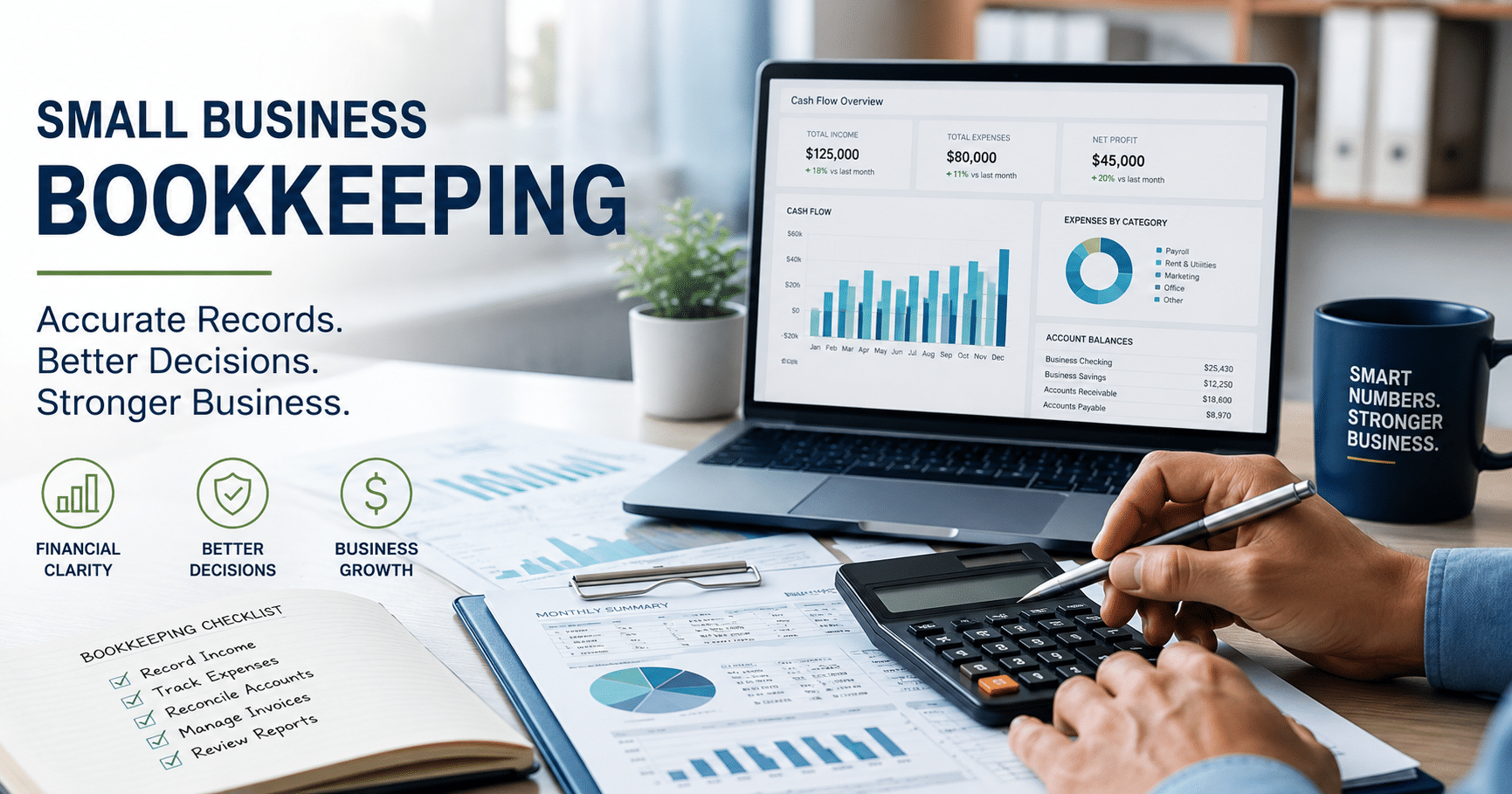
Accurate financial records are the backbone of every successful business. While entrepreneurs often focus on increasing sales, attracting customers, and expanding operations, effective small business bookkeeping provides the financial visibility needed to support sustainable growth.
Bookkeeping is more than simply recording transactions. It enables business owners to understand cash flow, monitor profitability, prepare for tax obligations, secure financing, and make informed strategic decisions. Businesses with organized financial records are also better positioned for mergers, acquisitions, and succession planning.
Whether you’re launching a startup or managing an established company, implementing sound bookkeeping practices will strengthen your financial foundation and reduce costly errors.
This guide explains what small business bookkeeping involves, why it matters, and how to build an efficient bookkeeping system that supports long-term success.
What Is Small Business Bookkeeping?
Small business bookkeeping is the systematic process of recording, organizing, and maintaining a company’s financial transactions. Every invoice, expense, payment, payroll entry, and bank transaction should be accurately documented to create a complete financial picture of the business.
Bookkeeping serves as the foundation for accounting and financial reporting. While bookkeeping focuses on recording financial activity, accounting interprets that information to provide business insights and strategic guidance.
Proper bookkeeping helps business owners:
- Monitor revenue and expenses
- Track cash flow
- Prepare financial statements
- Manage accounts receivable and payable
- Simplify tax preparation
- Support budgeting and forecasting
- Improve decision-making
Without accurate bookkeeping, it becomes difficult to evaluate business performance or identify financial risks before they become significant problems.
Why Small Business Bookkeeping Is Essential
Many business owners view bookkeeping as an administrative task rather than a strategic business function. In reality, accurate bookkeeping directly contributes to better financial management and long-term profitability.
Better Cash Flow Management
Cash flow remains one of the leading challenges for small businesses. Bookkeeping allows owners to understand exactly when money enters and leaves the business, making it easier to anticipate shortages and maintain adequate working capital.
Regular financial monitoring also helps reduce unnecessary expenses and improve collections on outstanding invoices.
Improved Financial Decision-Making
Business decisions should be based on reliable financial information—not assumptions.
Well-maintained bookkeeping provides valuable insights into:
- Monthly revenue trends
- Operating expenses
- Profit margins
- Customer payment patterns
- Seasonal fluctuations
- Overall financial performance
These insights allow business owners to allocate resources more effectively and identify opportunities for growth.
Easier Tax Compliance
Organized financial records significantly simplify tax preparation.
Accurate bookkeeping ensures that:
- Income is properly reported
- Business expenses are documented
- Tax deductions are supported
- Required financial reports are readily available
Maintaining current books throughout the year reduces stress during tax season and minimizes the risk of costly filing errors.
Increased Business Value
If you plan to sell your business in the future, accurate bookkeeping becomes even more important.
Potential buyers, lenders, and investors expect to review clean financial records during due diligence. Businesses with organized bookkeeping typically inspire greater confidence and often receive stronger valuations.
Financial transparency demonstrates operational discipline and reduces perceived investment risk.
Core Bookkeeping Responsibilities
Successful bookkeeping involves more than entering transactions into accounting software.
The following tasks should be performed consistently.
Recording Income
Every source of business revenue should be accurately recorded.
This includes:
- Customer payments
- Online sales
- Service income
- Subscription revenue
- Other operating income
Recording income promptly helps maintain accurate financial reports and supports cash flow monitoring.
Tracking Business Expenses
Documenting expenses allows businesses to monitor profitability and identify opportunities to reduce costs.
Common business expenses include:
- Rent and utilities
- Payroll
- Marketing
- Insurance
- Office supplies
- Software subscriptions
- Equipment purchases
- Professional services
Maintaining supporting documentation for every expense is essential for financial reporting and tax compliance.
Bank Reconciliation
Bank reconciliation involves comparing accounting records with bank statements to verify accuracy.
Reconciling accounts each month helps identify:
- Duplicate transactions
- Missing deposits
- Bank errors
- Unauthorized charges
- Recording mistakes
Routine reconciliation ensures financial reports remain reliable.
Managing Accounts Receivable
Outstanding invoices directly affect cash flow.
Effective bookkeeping includes:
- Issuing invoices promptly
- Tracking customer payments
- Following up on overdue accounts
- Maintaining accurate customer balances
Reducing collection delays improves liquidity and supports business operations.
Managing Accounts Payable
Bookkeeping also involves tracking obligations to vendors and suppliers.
Timely payment management helps businesses:
- Maintain positive supplier relationships
- Avoid late payment penalties
- Improve budgeting
- Manage cash flow effectively
Financial Reports Every Business Should Review
Accurate bookkeeping produces financial statements that help owners evaluate performance.
Profit and Loss Statement
The Profit and Loss Statement summarizes:
- Revenue
- Cost of goods sold
- Operating expenses
- Net profit
This report measures business profitability over a specific period.
Balance Sheet
The Balance Sheet provides a snapshot of the company’s financial position by showing:
- Assets
- Liabilities
- Owner’s equity
It helps business owners evaluate financial stability and overall business health.
Cash Flow Statement
The Cash Flow Statement tracks how cash moves through the business.
It identifies:
- Operating cash flow
- Investing activities
- Financing activities
Understanding cash flow is critical for maintaining day-to-day operations.
Common Small Business Bookkeeping Mistakes
Many businesses encounter financial challenges because of poor bookkeeping practices.
Common mistakes include:
- Mixing personal and business finances
- Waiting until year-end to update records
- Losing receipts and supporting documentation
- Failing to reconcile bank accounts
- Ignoring financial reports
- Misclassifying expenses
- Not backing up accounting data
- Relying solely on spreadsheets as the business grows
These issues can create inaccurate financial reports, tax complications, and poor business decisions.
Best Practices for Small Business Bookkeeping
Developing consistent bookkeeping habits improves financial accuracy and operational efficiency.
Recommended best practices include:
Separate Business and Personal Accounts
Maintain dedicated business checking and credit card accounts to simplify financial tracking.
Update Records Regularly
Recording transactions weekly—or even daily—prevents backlogs and improves reporting accuracy.
Automate Routine Processes
Cloud-based accounting software can automate recurring invoices, expense categorization, and bank feeds.
Automation reduces manual data entry while minimizing errors.
Review Financial Reports Monthly
Monthly financial reviews allow business owners to identify trends before they become larger problems.
Maintain Digital Documentation
Store electronic copies of receipts, invoices, contracts, and financial records in secure cloud storage.
Work with Financial Professionals
As your business grows, partnering with bookkeeping professionals or fractional CFO services can provide valuable financial oversight and strategic guidance.
Choosing Bookkeeping Software
Modern bookkeeping software streamlines financial management while improving reporting accuracy.
Popular options include:
- QuickBooks Online
- Xero
- FreshBooks
- Zoho Books
- Wave Accounting
When evaluating software, consider:
- Ease of use
- Reporting capabilities
- Integration with banking and payroll
- Scalability
- Security features
- Customer support
The right platform should support both your current needs and future business growth.
When Should You Hire a Professional Bookkeeper?
While many entrepreneurs initially manage bookkeeping themselves, increasing business complexity often requires professional support.
Consider outsourcing bookkeeping if:
- Financial records consume too much time
- Revenue is growing rapidly
- Payroll has become more complex
- You need financing
- You’re preparing to sell your business
- Financial reporting has become difficult to manage
Professional bookkeeping improves financial accuracy while allowing business owners to focus on operations and growth.
Beyond Bookkeeping: Building Long-Term Business Value
Bookkeeping provides the financial data needed to operate a successful business—but strategic financial management transforms that information into measurable growth.
At BizProfitPro, we help business owners move beyond basic bookkeeping through comprehensive financial advisory services, including:
- Fractional CFO services
- Business valuation
- Exit planning
- Growth strategy
- Financial analysis
- Business performance improvement
Strong financial records are the first step toward increasing profitability, improving operational efficiency, and maximizing business value.
Whether your goal is expansion, succession planning, or preparing for an eventual sale, organized bookkeeping creates the financial foundation necessary for long-term success.
Conclusion
Effective small business bookkeeping is not simply about staying organized—it is a strategic investment in your company’s future.
Accurate financial records improve cash flow management, strengthen decision-making, simplify tax compliance, and position your business for sustainable growth. As your company evolves, maintaining reliable bookkeeping practices becomes increasingly valuable for attracting investors, securing financing, and maximizing business value.
If you’re ready to move beyond bookkeeping and develop a stronger financial strategy, BizProfitPro provides the advisory expertise, fractional CFO services, and business planning solutions to help your company achieve its next stage of growth.
