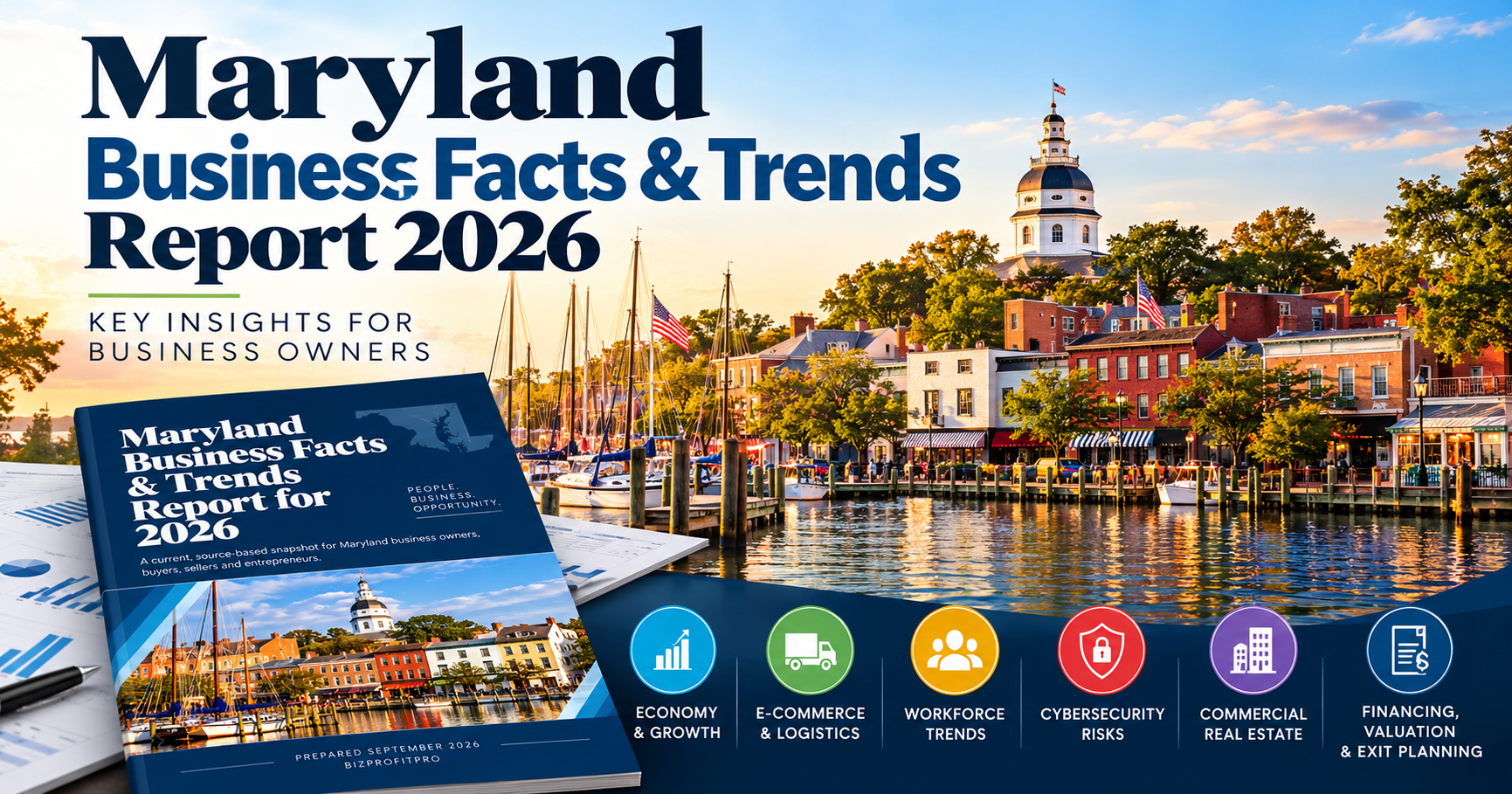
Maryland offers business owners a diverse economy, access to major transportation networks, a skilled workforce, and opportunities across several industries. However, understanding the state’s business environment also means paying attention to changing workforce patterns, cybersecurity risks, commercial real estate conditions, and the financial decisions that influence long-term success.
The Maryland Business Facts & Trends Report provides a closer look at these factors and what they may mean for entrepreneurs, business owners, buyers, and sellers in 2026. From economic indicators and digital marketing to business valuation and exit planning, the report brings together information that can help readers better understand Maryland’s business landscape.
Whether you’re starting a company, expanding an existing operation, considering an acquisition, or preparing to sell, these insights can help you identify important areas to evaluate as you plan your next move.
1. Maryland’s Economy Offers Opportunities Across Multiple Industries
Maryland’s economy includes a wide range of industries, including aerospace and defense, biotechnology, financial services, insurance, energy, hospitality, food, apparel, and networking technology.
This diversity creates opportunities for businesses operating in different markets. The state’s economic development priorities also highlight areas such as information technology, life sciences, and aerospace and defense. These industries are part of Maryland’s broader efforts to encourage business development, innovation, and job creation.
Income data provides another perspective on the state’s economic environment. According to the U.S. Census Bureau’s QuickFacts data, Maryland’s median household income was $103,678, compared with $80,734 nationally, based on 2020–2024 data.
These figures help provide context for understanding Maryland’s economy, although household income alone does not determine the demand for a particular business’s products or services.
For business owners, understanding the industries, customers, and economic conditions relevant to their markets is an important starting point for making informed decisions.
2. Maryland’s Location Supports Logistics and E-Commerce
Maryland’s location along the Northeast Corridor gives businesses access to major population centers and important transportation infrastructure. Highways, rail connections, airports, and the Port of Baltimore support the movement of goods and connect businesses with regional and national markets.
This transportation network is particularly relevant to logistics, distribution, and e-commerce companies. Businesses that depend on shipping, warehousing, or moving products between markets may find Maryland’s location an important factor when evaluating operational opportunities.
The report also highlights Amazon distribution-center projects in Baltimore City, Baltimore County, Cecil County, and Washington County. These projects represented approximately 7,000 jobs among the business-attraction projects tracked by the state.
For entrepreneurs and business owners, logistics is worth considering when evaluating a company’s location, supply chain, distribution strategy, or expansion plans. Transportation access can influence operating decisions, although the right location will depend on a company’s specific needs and costs.
3. Digital Marketing Remains Important for Business Growth
Customers increasingly have multiple ways to discover and evaluate businesses. Websites, search engines, social media, email marketing, and online reviews all contribute to how companies reach potential customers and build credibility.
The Maryland Business Facts & Trends Report examines digital marketing developments relevant to businesses in 2026, including the use of AI-assisted marketing. These tools can create additional ways to develop content, communicate with audiences, and support marketing activities.
However, having access to more marketing channels does not automatically translate into better results. Businesses still need to understand their target customers, communicate their value clearly, and maintain consistent messaging across their online presence.
Online reviews also deserve attention because prospective customers may use them when comparing businesses and deciding which companies to trust.
For small and midsize businesses, a practical approach is to focus on the channels most relevant to their audiences, maintain an accurate website, encourage genuine customer feedback, and review marketing performance regularly.
4. Remote and Hybrid Work Continue to Shape Workforce Planning
Work arrangements remain an important consideration for employers. Remote and hybrid work can influence hiring, employee expectations, workplace requirements, and decisions about office space.
The report references U.S. Bureau of Labor Statistics data showing that 34.5% of employed people worked at home on days they worked in 2025. The report also discusses Maryland’s comparatively high level of telework.
These figures provide context for understanding changes in how people work. However, different government surveys measure working from home in different ways, so their percentages should not automatically be treated as directly comparable.
For business owners, workforce planning involves more than deciding whether employees should work remotely. Companies also need to consider communication, productivity, collaboration, employee needs, and the type of work being performed.
Reviewing these factors can help employers develop arrangements that support both operational requirements and employee effectiveness.
5. Cybersecurity Risks Can Affect Businesses of Every Size
Cybersecurity is another important consideration in Maryland’s business environment. Small and midsize businesses may face threats involving software vulnerabilities, ransomware, stolen credentials, social engineering, and third-party systems.
A cyber incident can disrupt operations, expose sensitive information, compromise accounts, or lead to fraudulent payments. These consequences can affect customer relationships and create additional costs for a business.
One example discussed in the report is business email compromise. In these schemes, criminals may use compromised email accounts or convincing messages to redirect payments and deceive employees into transferring money. The FBI’s Internet Crime Report provides additional information about reported cybercrime and online fraud.
Businesses can reduce exposure by taking practical precautions. These may include using multifactor authentication, keeping software updated, limiting account access, training employees to recognize suspicious messages, and verifying payment changes through a trusted communication channel.
Cybersecurity should not be treated as an issue reserved for large companies. Even a relatively small incident can create significant disruption when a business lacks clear procedures for responding to threats.
6. Commercial Real Estate Conditions Require Careful Evaluation
Commercial real estate conditions can influence business expansion, operating costs, and investment decisions. The report reviews second-quarter 2026 commercial real estate activity in the Baltimore metropolitan statistical area.
According to the referenced MacKenzie Commercial Real Estate Quarterly Market Report, retail recorded positive net absorption, while office, industrial flex, and warehouse properties recorded negative net absorption during the period. Readers can explore additional market information through MacKenzie’s quarterly market reports.
Net absorption is a measure of the change in occupied commercial space over a given period. These figures offer insight into market activity, but they do not guarantee how a particular property or location will perform.
Business owners considering a lease, relocation, expansion, or property investment should evaluate their specific requirements alongside local market conditions. Factors such as occupancy costs, accessibility, customer demand, workforce needs, and lease terms can all influence a decision.
Understanding these considerations can help businesses make more informed real estate choices instead of relying on broad market trends alone.
7. Financing Resources Can Support Business Development
Access to financing can play an important role in starting, expanding, or acquiring a business. Depending on the company’s circumstances, funding may be needed for equipment, working capital, hiring, innovation, or other operational requirements.
The report identifies financing resources available through the Maryland Department of Commerce and the Department of Housing and Community Development. These resources may include loans, grants, and other forms of financing intended to support business activity and development.
Business owners can explore available programs through the Maryland Department of Commerce’s financial incentives and financing resources.
Business buyers may also need to consider Small Business Administration loans, state programs, commercial financing, and seller financing when evaluating an acquisition.
Each option has its own requirements, costs, and limitations. Business owners and prospective buyers should review eligibility criteria, repayment obligations, available capital, and the financial condition of the business before making commitments.
If you’re considering an acquisition, you may also find our guide on How to Buy an Existing Business With No Money helpful when exploring potential financing strategies.
A clear understanding of funding needs and financing options can help support more realistic growth and acquisition plans.
8. Business Valuation and Exit Planning Matter
For business owners thinking about selling, understanding valuation is an important step. A company’s value may depend on its industry, size, financial performance, risk profile, and market conditions.
The report discusses valuation approaches that include Seller’s Discretionary Earnings (SDE), Adjusted EBITDA, and market benchmarks. These measures can help buyers and sellers evaluate financial performance and compare businesses, but the appropriate approach depends on the company being assessed.
Preparing a business for sale also involves reviewing financial records, evaluating operations, identifying potential risks, and conducting due diligence. Buyers need to understand what they are purchasing, while sellers benefit from preparing clear and reliable information.
Owners can also take steps to strengthen their businesses before an eventual exit. Reducing dependence on the owner, diversifying revenue, improving financial transparency, and establishing consistent operating processes may help create a smoother transition.
Financial controls and key performance indicators can provide additional visibility into profitability, cash flow, and business performance. These practices are useful not only when preparing for a sale but also when managing a company through its growth stages.
For more guidance, explore our articles on How to Prepare a Business for Sale, How to Increase EBITDA Before Selling Your Business, and 11 Tips to Sell Your Business Fast Without Losing Value.
Explore the Maryland Business Facts & Trends Report for 2026
Maryland’s business environment presents opportunities alongside challenges that owners need to evaluate carefully. Industry developments, transportation infrastructure, digital marketing, workforce changes, cybersecurity, commercial real estate, financing, and exit planning all contribute to the decisions businesses make.
The Maryland Business Facts & Trends Report brings these topics together to give readers a broader understanding of the factors affecting Maryland businesses in 2026. It also covers practical considerations for starting a company, buying an existing business, evaluating a company’s value, improving financial performance, and preparing for an eventual sale.
Rather than relying on a single economic indicator or business trend, owners can use the report to explore several areas that may influence their planning and priorities.
Read the full Maryland Business Facts & Trends Report for 2026 to explore the data, sources, and additional insights in greater detail.
If you’re considering buying or selling a business, improving profitability, or preparing your company for its next stage of growth, the BizProfitPro team can help you explore the questions and planning considerations relevant to your goals.