BizBuySell.com
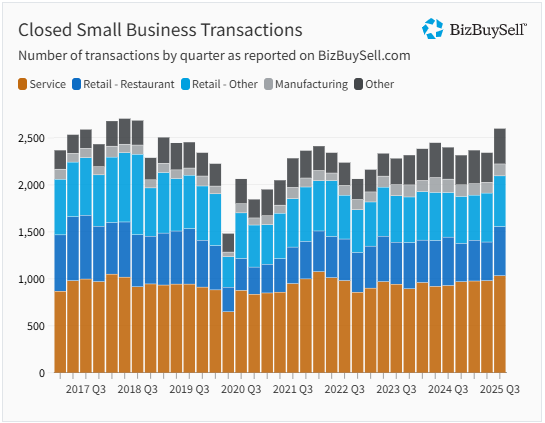
The small business-for-sale market gained momentum in the third quarter of 2026, even as owner confidence and sale prices softened slightly. According to the latest BizBuySell Insight Report, closed transactions reached 2,599, marking an 8% year-over-year increase and an 11% gain over Q2.
These numbers confirm one thing — demand is still strong, and small business sales trends are moving upward despite broader economic headwinds.
Transaction Growth Driven by Service and Retail Sectors
Service and retail businesses are leading this wave of activity. Service-based acquisitions increased 11%, while retail jumped 14% compared to the same period last year. Buyers are clearly favoring essential industries like HVAC, plumbing, landscaping, and home improvement — sectors that remain stable even during economic shifts.
“I focus on residential and commercial services. The market is still hot for HVAC, plumbing, and electrical,” said Adam Pratt of Atlantic Business Brokers. “There are not enough listings for all the buyers.”
On the other hand, manufacturing faced headwinds, with transactions dropping 11% year-over-year. Persistent tariffs, material costs, and global supply chain uncertainty continue to suppress deal flow in that sector.
This divide highlights one of the key small business sales trends of 2026 — essential, locally-driven industries are thriving, while capital-intensive manufacturing deals are slowing down.
Lower Sale Prices, Faster Closures
Even with more activity, average sale prices slipped slightly. The median sale price fell 2% year-over-year to $320,044, and 9% quarter-over-quarter. Median revenue also declined 2% to $674,500, reflecting thinner profit margins due to rising costs.
But what’s truly notable is the speed of deal closures. Businesses now spend an average of 149 days on the market, compared to 176 days last quarter — the fastest pace since 2017.
“The market is strong. Sellers are surfacing and moving toward realistic expectations,” said Matt Valantine of Valantine Ventures.
This suggests that even though valuations have softened slightly, buyers are ready to move quickly when they find a solid opportunity — another defining characteristic of current small business sales trends.
Why More Owners Are Choosing to Sell in 2026
For many small business owners, 2026 represents the right time to sell. Rising operational costs, persistent inflation, and tariff uncertainty are pushing many to act before potential price drops.
According to the BizBuySell Insight Report, 55% of owners believe they can achieve their desired price now, while 60% worry that waiting until next year could mean receiving less.
“Sell when you, your family, and your company are ready,” advised Bill White of Murphy Business & Financial Corp. “Don’t let the economy stop you. In the end, it won’t make that much of a difference.”
This mindset reflects a growing reality: many small business owners are timing their exits around personal readiness rather than market timing — a trend that’s likely to continue into 2026.
The Rise of Corporate Refugee Buyers
The job market slowdown has created a new category of small business buyers — the “corporate refugees.”
According to the report, 40% of business buyers now fall into this group, most of them aged 40–59, who are leaving layoffs or restructuring in search of independence and stability.
“There are many more buyers than sellers,” said Joe Braier of Lake Country Advisors. “Sellers who have a good cash flow business in a desirable industry are typically choosing from multiple LOIs.”
This shift is fueling buyer demand and shortening the sales cycle, keeping competition strong even as confidence wavers. It’s one of the most visible small business sales trends shaping the 2026 marketplace.
AI Adoption Strengthens Small Business Performance
Artificial intelligence is reshaping how small businesses operate — and that’s reflected in this quarter’s data.
More than 55% of business owners report using AI tools, primarily in marketing (69%), analytics (56%), and customer service (39%). Among them, 76% say AI has improved business performance, helping cut costs, enhance decision-making, and streamline operations.
While 13% of owners reduced staff due to automation, 5% added new roles, showing that AI isn’t just replacing jobs — it’s transforming them. For buyers, this signals an opportunity to acquire businesses already optimized for efficiency and scalability.
Restaurants Hold Steady, Manufacturing Struggles
Restaurants performed better than expected in Q3, with closed deals up 2% year-over-year and 27% quarter-over-quarter. Despite a slight 1% drop in median sale price to $220,000, restaurants saw a 4% increase in cash flow and 8% rise in revenue.
This stability proves that adaptable restaurant owners — those who refine menus, optimize labor, and focus on loyal customers — can thrive even amid inflation.
By contrast, manufacturing sales fell sharply, with median prices down 37% to $550,000 and cash flow down 28%. Ongoing tariff issues, material shortages, and fluctuating input costs continue to challenge valuations in this space.
Confidence Declines, But Momentum Persists
The BizBuySell Buyer-Seller Confidence Index revealed that owner confidence dipped from 50 to 48, and buyer confidence edged down from 54 to 52. These readings show modest concern about the economy but no indication of a market slowdown.
Buyers still see opportunity: 77% remain confident they can purchase a business at a fair price today, and 78% expect to find equal or better value next year.
The Federal Reserve’s expected rate cuts later in 2026 could further stimulate acquisitions, making financing more accessible for entrepreneurs ready to enter the market.
“High interest rates remain the most impactful economic barrier for deals,” said David A. Smith of The Agency NW RE. “Once rates ease, we’ll likely see another wave of activity.”
Expert Advice for Buyers and Sellers
For Buyers:
Be realistic about your expectations.
“If you find a perfect business, get ready to compete with dozens of other buyers,” said Rebecca Carr of West Shores Realty. “If you find a decent one at a bargain, focus on making it better — that’s where the real value lies.”
For Sellers:
Preparation is key.
“If you’re taking unreported cash, stop it now — ideally three years before selling,” advised Charlie MacPherson of Inbar Group.
Clean financials, transparent tax records, and realistic pricing remain the foundation of successful exits.
The Bottom Line
Q3 2026 reaffirmed a clear pattern in small business sales trends:
-
More businesses are selling.
-
Deals are closing faster.
-
Buyers are more strategic.
-
Sellers are adjusting expectations.
While macroeconomic uncertainty continues, both buyers and sellers are adapting quickly — proof that entrepreneurship remains resilient.
If you’re considering selling your business or buying one, the next few months could be the most favorable window before 2026’s potential slowdown.
Thinking About Buying or Selling a Business?
Schedule a free consultation to discuss your goals with one of our business advisors.
📞 https://calendly.com/bizprofitpro
