Every business generates data — sales figures, cash flow reports, profit margins, and customer metrics. But the real question is: what are you doing with it?
Many companies collect financial information simply because they have to. Reports are generated, spreadsheets are stored, and numbers are reviewed briefly at the end of the month. Yet the businesses that consistently grow and outperform competitors treat financial data differently. They use it as a decision-making tool.
The most successful companies don’t just collect numbers — they interpret them. They use financial data to drive growth, improve efficiency, and make smarter strategic decisions. And for many small to mid-sized businesses, a fractional CFO is the expert who turns raw numbers into meaningful direction.
Fractional CFOs provide the financial leadership of a full-time chief financial officer without the full-time salary. They analyze performance, uncover trends, and translate financial insights into actionable strategies that help businesses scale sustainably.
Here are five powerful ways they use financial data to drive growth and improve your bottom line.
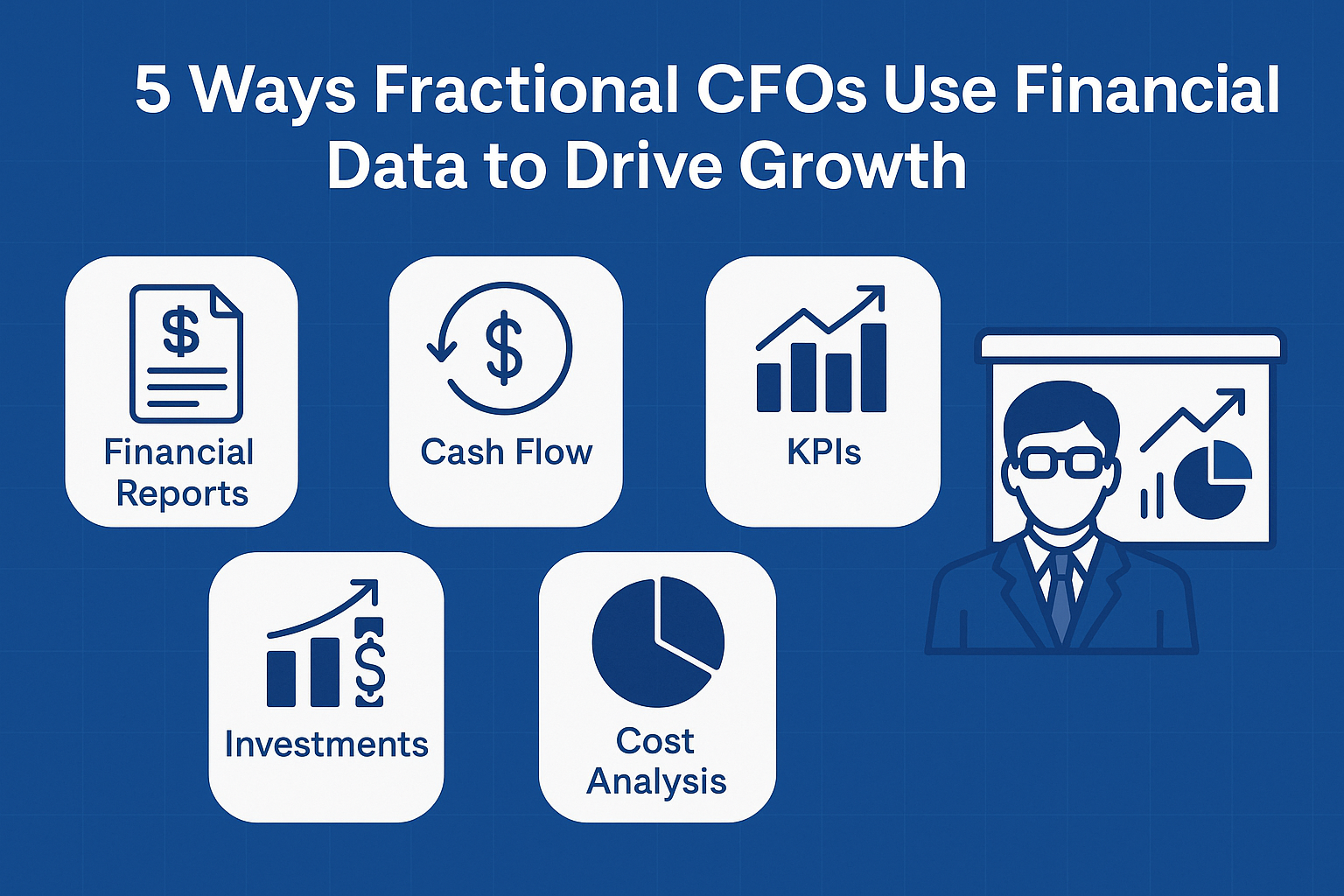
5 Ways Fractional CFOs Use Financial Data to Drive Growth
1. Turning Financial Reports Into Business Strategy
Most business owners review their profit and loss statement monthly, glance at their balance sheet, and move on to daily operations. While this provides a snapshot of performance, it rarely reveals the deeper story behind the numbers.
A fractional CFO goes far beyond surface-level reporting. Instead of simply reviewing totals, they analyze trends over time — identifying patterns across revenue streams, expenses, and margins that reveal opportunities or potential risks.
They help answer strategic questions such as:
-
Which products or services generate the highest profit margins?
-
Are operating expenses increasing faster than revenue?
-
Where is cash being tied up unnecessarily?
-
Which clients or customer segments contribute the most value?
These insights allow business owners to make informed decisions about pricing, service offerings, staffing, and operational priorities.
Example:
A service-based company may discover that 60% of its profits come from just 30% of its clients. With this data, a fractional CFO might recommend refining pricing models, improving retention strategies, or shifting marketing efforts toward higher-value customers.
When you use financial data to drive growth, business strategy becomes intentional rather than reactive.
2. Improving Cash Flow and Forecasting
Cash flow is the heartbeat of every business. Even profitable companies can struggle if cash isn’t available at the right time.
Fractional CFOs use financial data to drive growth by building accurate cash flow forecasts and financial models. By analyzing historical performance and seasonal trends, they project future inflows and outflows — helping business owners plan with confidence.
These forecasts allow companies to:
-
Prepare for slower revenue periods
-
Allocate funds for taxes and large expenses
-
Plan hiring or expansion timelines
-
Avoid unnecessary borrowing
Beyond forecasting, fractional CFOs examine the cash conversion cycle — the time it takes to turn sales into actual cash. Delayed payments, inefficient invoicing processes, or unfavorable payment terms can quietly strain liquidity.
By improving billing systems, renegotiating payment terms, or strengthening collections processes, they help businesses shorten this cycle and maintain healthier cash reserves.
Data-driven cash flow management reduces uncertainty and ensures your business has the financial stability needed to pursue growth opportunities when they arise.
3. Tracking Key Performance Indicators (KPIs)
Growth becomes measurable when the right metrics are tracked consistently. Fractional CFOs help businesses identify and monitor key performance indicators (KPIs) that truly reflect financial health and scalability.
Common KPIs include:
-
Gross Profit Margin: Profit remaining after direct costs
-
Customer Acquisition Cost (CAC): Cost to acquire a new customer
-
Customer Lifetime Value (LTV): Total revenue generated per customer
-
Operating Cash Flow: Cash generated from daily operations
-
Debt-to-Equity Ratio: Level of financial leverage
Rather than overwhelming business owners with dozens of metrics, fractional CFOs focus on the numbers that directly influence profitability and long-term growth.
For example, if customer acquisition costs rise while lifetime value remains flat, marketing investments may need adjustment. If operating margins decline, operational inefficiencies may be developing.
Fractional CFOs often create simplified dashboards that track performance over time, allowing leadership teams to quickly understand progress and identify trends.
When companies consistently use financial data to drive growth, they shift from reactive problem-solving to proactive leadership.
4. Guiding Data-Driven Investments and Scaling Decisions
Growth frequently requires investment — hiring employees, expanding product lines, upgrading systems, or entering new markets. However, expansion without financial analysis can introduce significant risk.
A fractional CFO evaluates opportunities using financial modeling, return-on-investment (ROI) analysis, and break-even calculations. Instead of relying on intuition alone, decisions are grounded in measurable financial outcomes.
Before opening a second location, launching a new product, or increasing payroll, a fractional CFO will model multiple scenarios, including best-case, expected, and conservative projections.
They assess questions such as:
-
How long until the investment becomes profitable?
-
Can current cash flow support additional overhead?
-
What happens if revenue grows slower than expected?
They also analyze debt capacity, helping business owners determine whether financing options like loans or lines of credit are sustainable without putting financial stability at risk.
With this level of analysis, scaling becomes strategic rather than speculative — allowing businesses to grow confidently and responsibly.
5. Enhancing Profitability Through Cost Analysis
Growth doesn’t always mean increasing sales. Often, the fastest way to improve profitability is optimizing how resources are used.
Fractional CFOs use financial data to drive growth by conducting detailed cost analysis across operations. They examine spending patterns, compare actual performance against budgets, and identify inefficiencies that quietly reduce profits.
This process often uncovers opportunities such as:
-
Renegotiating vendor contracts for better pricing
-
Reducing excess inventory or waste
-
Improving staffing allocation and productivity
-
Eliminating underperforming expenses
Even small operational improvements can have a significant financial impact. Reducing costs by just 5% can dramatically increase net profit without requiring additional revenue.
By aligning spending with strategic priorities, fractional CFOs help businesses become leaner, more efficient, and better positioned for sustainable expansion.
How Financial Data Creates Long-Term Growth
The real power of using financial data to drive growth lies in connecting numbers to decisions. Financial reports should not exist solely for compliance or recordkeeping — they should guide leadership.
Fractional CFOs conduct ongoing financial reviews and trend analysis to help business owners anticipate challenges before they escalate. Early warning signs such as shrinking margins, rising expenses, or declining cash reserves can be addressed proactively.
This continuous cycle of analysis, insight, and action transforms finance from a reporting function into a growth engine.
Instead of reacting to problems after they occur, businesses gain clarity and confidence in their direction.
When to Bring in a Fractional CFO
You don’t need to be a large corporation to benefit from CFO-level expertise. Many companies engage a fractional CFO during key transition stages, including:
-
Rapid growth without structured financial systems
-
Strong revenue but unclear reinvestment strategies
-
Increasing operational complexity
-
Uncertainty around pricing, margins, or cash flow
-
Preparing for expansion, acquisition, or eventual sale
At these stages, using financial data to drive growth becomes essential rather than optional.
A fractional CFO provides the strategic financial oversight needed to see the full picture and make decisions grounded in real performance data.
The Bottom Line
In today’s competitive market, understanding how to use financial data to drive growth is what separates thriving businesses from those that plateau.
Fractional CFOs bring the experience and strategic thinking needed to transform your data into meaningful direction — helping you maximize profits, strengthen cash flow, and create a roadmap for the future.
If you’re ready to make your financial data work harder for you, BizProfitPro can connect you with trusted financial experts who understand your business and your goals.
📞 Schedule a free consultation to discuss your business’s financial strategy:
https://calendly.com/bizprofitpro
Let’s take the first step together — toward smarter financial decisions and sustainable business growth.
